

CAR OWNERSHIP GUIDES
Flooded-car insurance in Vietnam: what does your policy cover?
Learn what to check for flood and hydrolock cover in Vietnam: exclusions, deductibles, EV batteries and the documents to prepare for a claim.
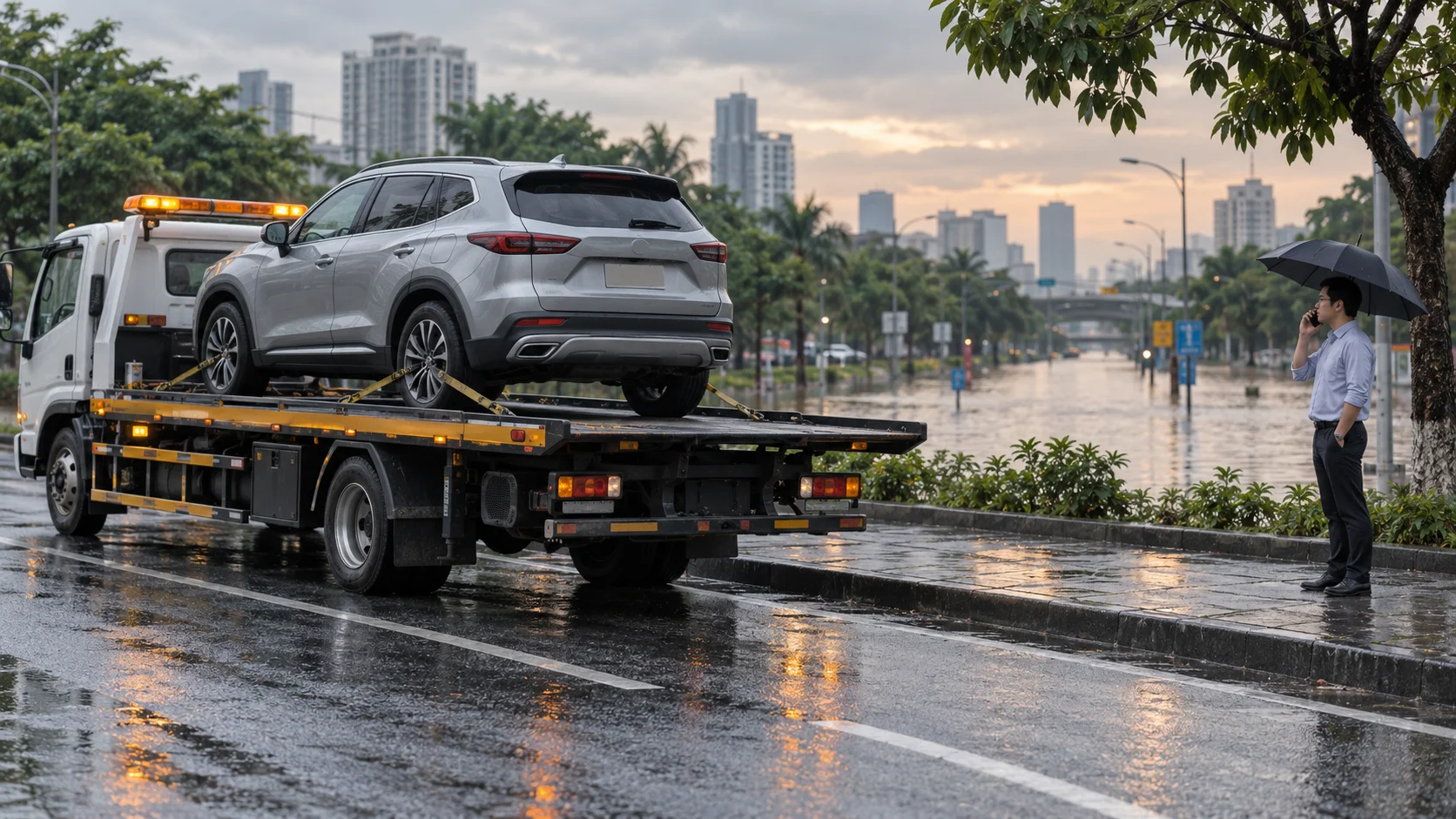
Flood damage can be insured, but a flooded car does not automatically mean the insurer pays the entire repair bill. You need suitable own-damage cover; water-related engine damage may require an endorsement. Compulsory motor liability insurance does not pay to repair your own flooded car. I would start with three questions: which parts does my policy protect, in which circumstances, and how much would I pay myself?
Sources: [1] Government — Decree 67/2023/ND-CP, Articles 5 and 7: compulsory motor liability scope · [2] Bảo Việt — Motor own-damage policy wording, Article 17: flooded-vehicle extension · [3] PVI — Hydrolock cover explained and restarting exclusions
Why is “two-way insurance” not enough to establish cover?
Compulsory motor liability insurance covers liability to third parties and passengers within its statutory scope. Articles 5 and 7 of Decree 67/2023/ND-CP establish liability cover, rather than property insurance for your own car. You should therefore locate your own-damage insurance certificate, rather than checking only the compulsory insurance document.
Sources: [1] Government — Decree 67/2023/ND-CP, Articles 5 and 7: compulsory motor liability scope
I would not use the informal label “two-way insurance” as proof of a benefit. Read the certificate, policy wording and endorsements together. A benefit appearing in a product brochure does not establish that you bought it.
Are flooding, hydrolock and battery damage the same risk?
Hydrolock involves water entering a combustion engine’s cylinders. Do not equate this with all flood damage. For an EV, ask separately about the battery and electric drivetrain.
Sources: [3] PVI — Hydrolock cover explained and restarting exclusions
- A parked car floods in a basement: ask about flooding while parked and the affected components; do not assume that leaving the engine off guarantees payment for everything.
- A car stalls while travelling through floodwater: ask about the water-ingestion endorsement and how the cause will be assessed.
- A flooded car was powered on or restarted: describe the sequence accurately to the assessor, including the actions you took.
- An EV or hybrid floods: ask for specific confirmation about the high-voltage battery, motor, controller and applicable limits.
Which parts should you check before signing?
Here is the question list I would use to compare quotations. It is not a claim that every insurer has identical terms. Ask for written answers identifying the applicable clauses.
- Vehicle and validity: are the registration or VIN, use of the vehicle, start of cover and premium-payment requirements correct?
- Flood scope: how are flooding while parked and flooding during operation treated? Is an extra benefit required?
- Exceptions: which actions could exclude or reduce payment, and what evidence does the insurer use to establish the cause?
- Your share: is the deductible a percentage or fixed amount, is there a minimum, what amount is it calculated on, and how is it applied per loss?
- Repairs: can you use an authorised workshop, and how are new parts, depreciation, the sum insured and liability limits handled?
- Recovery and paperwork: whom should you call, what cost or distance limits apply, and what are the notification and document deadlines?
How do actual terms differ?
For example, Article 17 of Bảo Việt’s wording provides a scheduled flood extension for combustion-engine/electrical damage and EV battery, motor and controller damage during operation in flooded areas. Its separate deductible is 10%, minimum VND 3 million per loss; other policy conditions still apply.
Sources: [2] Bảo Việt — Motor own-damage policy wording, Article 17: flooded-vehicle extension
PTI’s Hyundai Auto Care brochure lists a hydrolock deductible of 20%, minimum VND 2 million, for Gold, and 10%, minimum VND 1 million, for Platinum. This is a partner product for Hyundai vehicles distributed by HTV, not the default wording for every PTI-insured car. These examples illustrate differences; check the policy actually issued to you.
Sources: [4] PTI — Hyundai Auto Care: Gold and Platinum benefit comparison
How does the deductible affect the payment?
Illustrative calculation: assume a policy deducts 10% of the accepted loss before the deductible, with a minimum of VND 3 million per incident. Assume all the costs below are accepted, with no other limits, depreciation or deductions. This is a worked example, not a particular insurer’s claim settlement.
- Accepted cost of VND 100 million: 10% is VND 10 million, above the minimum. You pay VND 10 million; the insurer pays VND 90 million.
- Accepted cost of VND 20 million: 10% is VND 2 million, below the minimum. You pay VND 3 million; the insurer pays VND 17 million.
I would compare both the annual premium and your share of the same hypothetical loss. Ask the insurer to calculate an example using your actual wording, including whether a general deductible also applies. A lower premium does not necessarily mean a lower total cost after a claim.
What extra battery questions should EV owners ask?
State whether you own or lease the battery, whether its value is included in the sum insured, and whether battery-only damage is considered or must accompany other damage. Ask about the criteria for repair versus replacement and your share of the cost. These are questions I recommend resolving before purchase, not a claim that every policy pays for a complete replacement battery.
On safety, NHTSA warns that flooding can damage high-voltage batteries and create shock or fire hazards. Do not dismantle, repair or experiment with the high-voltage system yourself. Have qualified professionals inspect it and follow the manufacturer’s instructions.
Sources: [5] NHTSA — Electric/hybrid vehicle safety and flooded-battery hazards
Your car has flooded: how do you protect people and the claim?
Your safety matters more than photographs. Do not return to floodwater to retrieve belongings or gather evidence. For a submerged vehicle, Honda advises against starting the engine or switching POWER on; arrange recovery and inspection instead. If you notice smoke, popping, hissing or unusual heat, move away and contact emergency responders; Tesla’s guidance identifies these warning signs too.
Sources: [6] Honda — What to do when a vehicle has been submerged · [7] Tesla — Submerged vehicle guidance
- Once safe, call the assistance number on your policy; request a claim reference and named contact. Ask immediately about suitable recovery for your car.
- Record the time, location and actual sequence: was the car parked or moving, had it stalled, and was restarting attempted? Keep existing photos, videos or dashcam footage if safely accessible.
- Request assessment and repair instructions before authorising dismantling, replacement or disposal of parts. For urgent loss-limiting measures, prioritise safety, notify promptly and retain cost evidence.
- Keep the policy, requested vehicle and driver documents, assessment report, diagnosis, itemised quotation, recovery invoices and insurer correspondence.
Bảo Minh’s published process shows why prior agreement matters: even straightforward repairs after assessment require a quotation and agreement on costs and the repair approach before work begins. For your policy, request the exact document list and deadlines; do not apply a deadline heard elsewhere to every insurer.
Sources: [8] Bảo Minh — Motor claim assessment and settlement process
What if the claim is refused or the payment is lower than expected?
Ask for a written explanation identifying the cause, applicable clause and calculation: which items were accepted, which were not, and each deductible or reduction. Compare it with your policy and the technical findings, then request clarification or complain through the insurer’s official channel. For a substantial dispute, seek independent legal advice. I cannot determine a claim entitlement from a photograph of a flooded car.
Frequently asked questions
Does attempting a restart automatically invalidate all cover?
Do not make that blanket assumption. PVI’s hydrolock guide describes deliberately restarting to travel through flooding, causing engine damage, as a non-paying case. Your claim still requires the actual policy, cause and individual damage items to be examined. Stop testing the car and report what happened accurately.
Sources: [3] PVI — Hydrolock cover explained and restarting exclusions
What if only the interior flooded and the engine is undamaged?
It may be considered under your policy’s own-damage and flood scope, but an engine-water endorsement should not automatically be applied to every item. Request an assessment of the interior, electrical equipment and necessary cleaning, then confirmation of which costs are accepted.
Does having cover make it reasonable to drive through flooding?
No. I would choose another route or wait somewhere safe. Financial protection does not ensure personal safety or remove policy conditions and exclusions. Do not treat ground clearance or a generic water-depth figure as permission to cross flooding.
What can you prepare today?
Save your policy and recovery number on your phone, and send the six groups of questions above to your insurer. If you are still choosing a car, use the on-road calculator to plan the purchase, then budget separately for quoted own-damage cover. The calculator does not determine flood-insurance coverage. The two related guides below explain vehicle recovery and the wider insurance categories.
- Flooded car: safety and checks after recovery
- Car insurance in Vietnam: types and costs
- Estimated on-road price calculator
References
- Government — Decree 67/2023/ND-CP, Articles 5 and 7: compulsory motor liability scope
- Bảo Việt — Motor own-damage policy wording, Article 17: flooded-vehicle extension
- PVI — Hydrolock cover explained and restarting exclusions
- PTI — Hyundai Auto Care: Gold and Platinum benefit comparison
- NHTSA — Electric/hybrid vehicle safety and flooded-battery hazards
- Honda — What to do when a vehicle has been submerged
- Tesla — Submerged vehicle guidance
- Bảo Minh — Motor claim assessment and settlement process