

CAR OWNERSHIP GUIDES
What to do if your car is flooded: a practical guide for owners in Vietnam
Rush-hour flooding, hydrolock, recovery, workshop checks and insurance: how to protect yourself and your car after heavy rain in Vietnam. Sources reviewed on 2 October 2026.
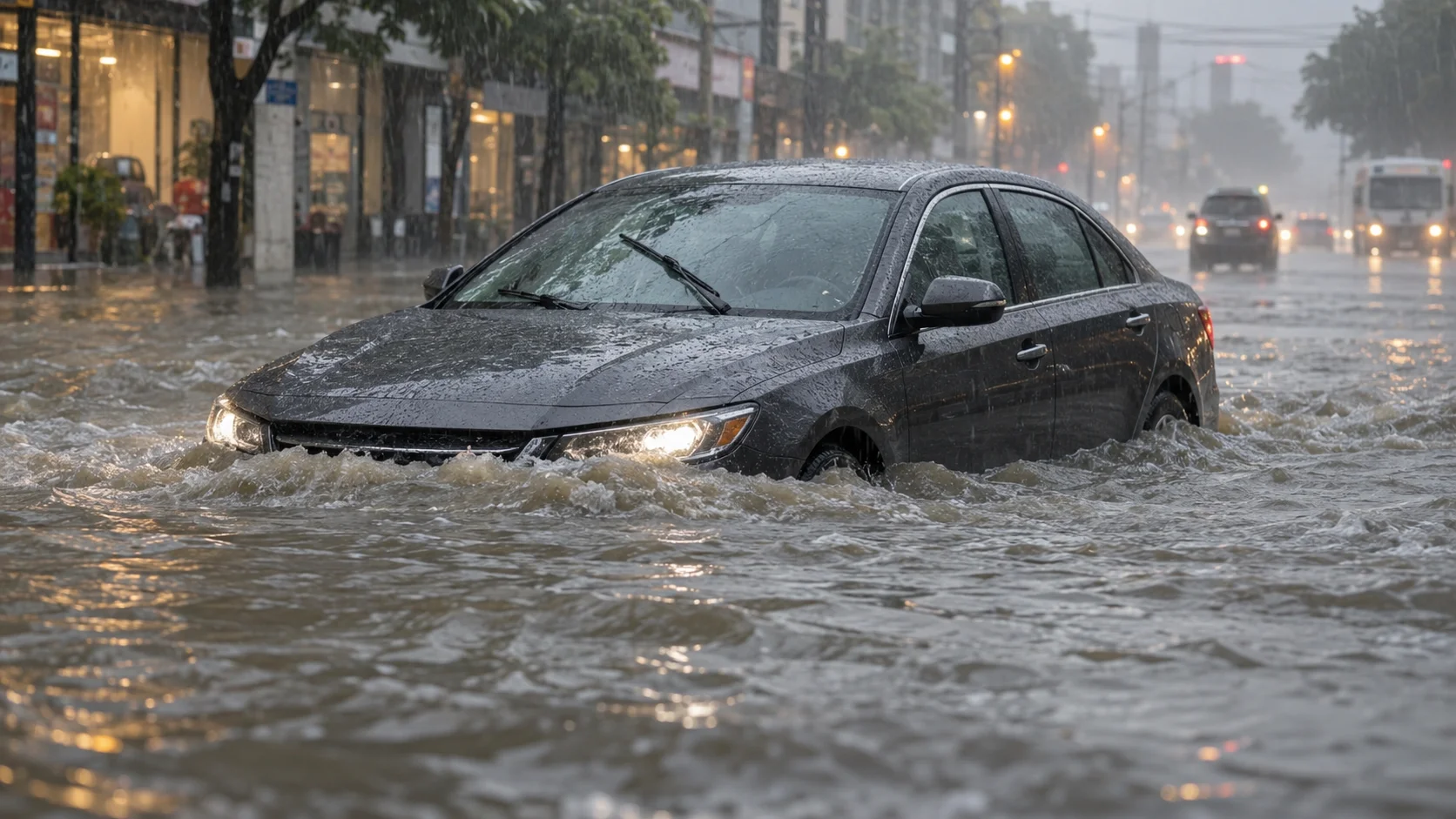
You leave work one afternoon and a familiar road has turned into muddy water. Horns sound behind you, traffic inches forward, and it is tempting to think that home is just a little farther away. If this has happened to you, I want to start with one thing: do not rush to blame yourself, and do not rush to try starting the car again. What you need now is a clear order of action: protect people first, then the vehicle.
If the car stalls in water or you suspect water has entered the engine, do not restart it or try a jump-start. A parked car that has flooded also needs assessment before power is switched on. If an EV or hybrid may have flood damage, do not switch it to READY or plug it in to test it.
Sources: [4] Toyota Vietnam — hydrolock and post-flood checks · [6] Honda — do not start or switch POWER on after flooding · [9] Tesla — submerged vehicle guidance
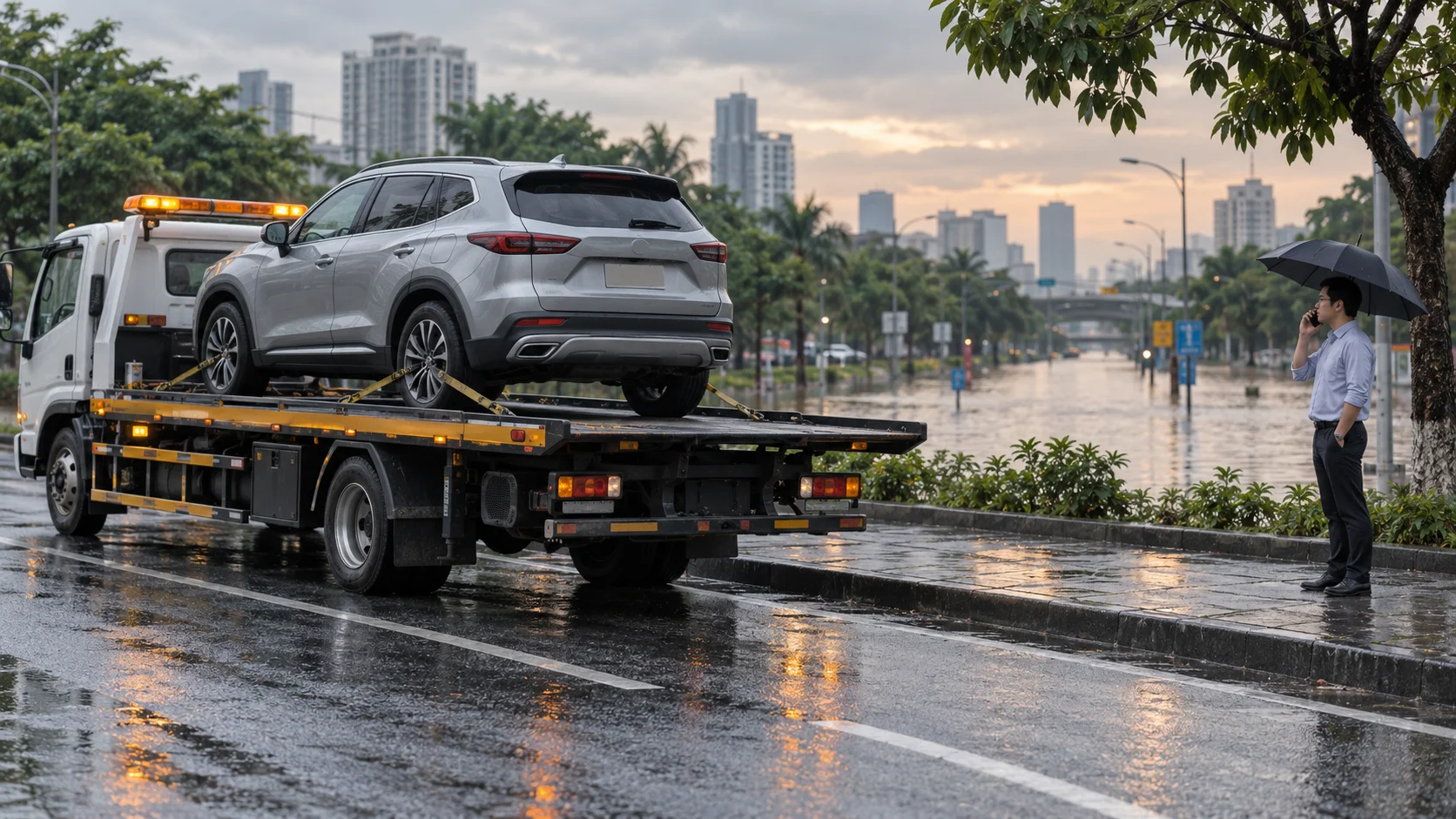
I have put this guide together from sources reviewed on 2 October 2026 to help you speak with recovery services, workshops and insurers. It does not replace the repair procedure for your particular model. The images are AI illustrations, not photographs of the rain events cited below.
1. What do the recent heavy rains remind us?
In Ho Chi Minh City, Vietnam News Agency reported heavy rain during the evening rush hour on 1 October 2026. At around 17:30, water rose quickly around Tan Son Nhat market; Phan Van Tri, Hong Ha and other roads flooded, disrupting traffic. The report also noted that repeated rainfall on 30 September–1 October combined with high tides increased risks in low-lying areas. These are reported events, not a forecast for every subsequent day.
Sources: [1] Vietnam News Agency/VietnamPlus — Ho Chi Minh City rush-hour flooding, 1 October 2026
In Hanoi, a warning on 15 September 2026 highlighted the risk of heavy rain during rush hour. By the morning of 17 September, reports described widespread flooding after several rainy days, with some western and southern areas particularly affected. These were separate episodes, but both are reminders to have an alternative plan for your journey home.
Sources: [2] VnExpress — Hanoi rush-hour heavy-rain warning, 15 September 2026 · [3] VnExpress — widespread Hanoi flooding, 17 September 2026
There is a distinction I want to make clear: these reports confirm flooding and traffic disruption, not a verified count of cars diagnosed with hydrolock. A photograph of a car in water cannot tell you whether its engine has failed. The actual damage needs to be assessed vehicle by vehicle.
2. Flood damage and hydrolock are not the same thing
Hydrolock occurs when water enters the combustion chamber. Because water is difficult to compress, the resulting forces can bend connecting rods or damage pistons and cylinders. Trying to restart the engine can worsen the damage. Not every flooded car has suffered hydrolock.
Sources: [4] Toyota Vietnam — hydrolock and post-flood checks
A flooded vehicle can also have damaged electrical connectors, control units, starter motor, interior or safety systems without hydrolock. Tell the workshop whether the water reached the floor, seats or dashboard. This helps guide inspection, but it is not a diagnosis: immersion time and the design of the individual car matter too.
Sources: [5] Toyota Vietnam — components at risk at different flood levels
A battery-electric car has no combustion chamber to suffer hydrolock in that sense, but its battery, high-voltage equipment and other systems remain at risk. Hybrids have both a combustion engine and high-voltage electrical components, so they are not immune.
Sources: [4] Toyota Vietnam — hydrolock and post-flood checks · [8] NHTSA — electric/hybrid vehicles and post-flood battery risks
3. Your first response: protect people and stop testing the car
- Before entering a flooded stretch, take another route or wait on higher ground where stopping is permitted and safe. Do not drive around barriers or assume that another car getting through proves yours can.
- If water is rising around the car, prioritise reaching higher ground if there is a safe escape route. Do not wade through fast-moving water, areas where you cannot see the road, or places with electrical cables. Do not return for belongings or photographs as conditions worsen.
- If someone is trapped or life is at risk, call 112. Give the clearest possible location, the number of people and the water conditions. This is an emergency rescue number; for a car safely awaiting repair, contact a vehicle recovery service.
Sources: [7] National Weather Service — safety during a flood · [13] Government — national emergency number 112
- If the car stalls or behaves abnormally in water, stop trying to start it. Tell the recovery service that water may have entered the engine. Do not ask someone else to try starting it or tow-start it.
- If a parked car or a car in a basement has flooded, do not turn the ignition or POWER on simply to see whether it still works. Contact a workshop and arrange transport for inspection.
- Receding water does not prove the vehicle is safe. Do not disconnect wiring, open the battery or apply power yourself. Let qualified technicians decide how to isolate power and inspect it.
Sources: [4] Toyota Vietnam — hydrolock and post-flood checks · [6] Honda — do not start or switch POWER on after flooding · [8] NHTSA — electric/hybrid vehicles and post-flood battery risks
4. What should you tell the recovery service?
Give the make, model, petrol/diesel/hybrid/electric powertrain and drive layout if you know it. Explain whether the car is in a basement or on the street, whether it stalled, whether anyone tried restarting it, and the highest water level you observed. If you already attempted a restart, say so honestly. That information helps diagnosis; it is not there to judge you.
Ask the recovery operator to check the manufacturer's transport instructions. AWD cars, EVs and many transmissions have specific restrictions on wheels rolling along the road. I would ask how this particular car must be transported, rather than only asking the towing price. A flatbed is often worth considering; do not assume every car can be rope-towed or shifted into neutral in the same way.
Sources: [9] Tesla — submerged vehicle guidance
5. Electric cars and hybrids need extra care
Do not touch orange cables, damaged connectors or a damaged battery casing, and do not remove a high-voltage battery yourself. Stop using a flooded vehicle, or one with suspected water ingress, and do not charge it until a qualified service provider confirms it is safe. Normal charging in rain with suitable equipment is not the same as charging a car that has just flooded.
Sources: [8] NHTSA — electric/hybrid vehicles and post-flood battery risks · [9] Tesla — submerged vehicle guidance
If you notice smoke, hissing, crackling or unusual heat, move away, warn others and call emergency services. Do not drive a vehicle showing these signs elsewhere. NHTSA advises keeping damaged vehicles with lithium-ion batteries out of garages and about 15 metres away from structures, other vehicles and flammable materials. Let qualified responders arrange suitable transport and storage.
Sources: [8] NHTSA — electric/hybrid vehicles and post-flood battery risks · [9] Tesla — submerged vehicle guidance · [13] Government — national emergency number 112
The workshop should assess components below the waterline and signs of water entering connectors, the battery, charge port and high-voltage system, using manufacturer documentation. Tesla's guidance is an example of a systematic inspection process, not a universal standard to apply unchanged to VinFast, BYD or every hybrid.
Sources: [10] Tesla — flooded vehicle inspection bulletin TN-25-00-001 R1
6. What should the workshop inspection cover?
When handing over the car, I would ask for a clear written assessment, not just a promise to dry it out and start it. Ask the workshop to record the water level, take photographs before work and report on each system. The checklist below can help your conversation; the technician must still decide which tests and replacement parts the actual vehicle needs.
- Engine and intake: inspect the air filter, intake path and possible water entry before running the engine. If hydrolock is suspected, ask for diagnostic findings, not just a successful test start.
- Fluids and drivetrain: assess possible water contamination in engine oil, transmission, differentials and related components. Treat or replace fluids according to the findings and manufacturer procedure; do not assume every car needs every fluid changed repeatedly.
- Brakes, steering and underbody: check submerged components, bearings, joints and safety functions. Do not drive home to test a car that has not been assessed as safe.
Sources: [4] Toyota Vietnam — hydrolock and post-flood checks · [11] AAA — mechanical, interior and electrical flood damage
- Electrical and safety systems: inspect connectors, wiring and control units, and retain diagnostic reports from before and after repairs. Ask specifically about ABS, airbags and belt tensioners if their mounting areas were submerged. A warning light going out does not prove every component is sound.
- Interior and air conditioning: inspect under carpets, padding, seats and enclosed spaces exposed to dirty water. Clean, dry or replace materials according to contamination. A pleasant smell or dry carpet surface does not prove the layers underneath are clean.
- EVs and hybrids: include the manufacturer's high-voltage, battery and charging/operating clearance checks. Use a service provider qualified for that work.
Sources: [5] Toyota Vietnam — components at risk at different flood levels · [10] Tesla — flooded vehicle inspection bulletin TN-25-00-001 R1 · [11] AAA — mechanical, interior and electrical flood damage
AAA notes that corrosion and electrical faults may emerge weeks or months after flooding. That is why I suggest asking not only whether the car can run, but which systems have been checked and which still need monitoring.
Sources: [11] AAA — mechanical, interior and electrical flood damage
7. Insurance, repair costs and resale value
Contact your insurer early and ask about reporting and assessment before repairs. For example, PVI's guidance published on 19 May 2026 treats hydrolock as an additional coverage clause, with conditions and exclusions concerning attempted restarts. That is one insurer's example, not a promise of payment under every policy. Open your own policy and confirm flood, engine and battery coverage, recovery costs and the excess you must pay.
Sources: [12] PVI — hydrolock insurance conditions, 19 May 2026
Once it is safe, save photographs of the water level and car, the time and location, recovery calls, intake report, quotations and invoices. Ask the insurer which documents it needs and how replaced parts should be retained. Do not delay saving people or preventing immediate danger while waiting for an assessor; record why emergency action was necessary.
Before authorising repairs, request separate prices for recovery, diagnosis, cleaning, mechanical work, electrical/electronic work and the battery where relevant. Establish which damage is confirmed, what may emerge after dismantling, the repair warranty and expected timeframe. If the proposed work includes an engine, battery or several control units, I would consider a second opinion while keeping the car safely stored.
I do not want to give you a fixed resale-value loss because there is no reliable percentage that applies to every flooded car. My view is to focus on what you can control: proper repairs, complete records and disclosure of the history when selling. Cosmetic work that conceals water marks does not fix hidden faults. An independent inspection helps a buyer understand the condition, but it cannot guarantee the value of a car that has never flooded.
Sources: [14] AAA Northeast — identifying flood-damaged used cars
8. Collecting the car and arranging follow-up checks
Only collect the car to drive it yourself once the workshop confirms it is fit to operate. Before leaving, ask the technician to explain the faults resolved, items still to monitor and a follow-up schedule for your vehicle. Do not rely on rules of thumb such as waiting 24 hours for it to dry. No universal waiting period replaces a technical assessment.
Sources: [15] NHTSA — assessing flood-damaged vehicles before restarting
- Keep diagnostic reports, the list of replaced parts and fluids, before-and-after photographs and repair warranty terms together.
- After the car is cleared for use, watch for returning damp smells, condensation in lamps, window faults, air-conditioning problems or intermittent electrical behaviour. Report these to the workshop.
- If a safety warning appears, braking or steering changes, the engine makes unusual noises or fluids leak, stop safely and contact the workshop instead of continuing to monitor it while driving. For unusual heat, smoke or hissing from an EV, keep your distance and call emergency help.
Sources: [14] AAA Northeast — identifying flood-damaged used cars · [8] NHTSA — electric/hybrid vehicles and post-flood battery risks
9. Prepare for the next rainy afternoon
Before leaving, check weather reports and flood warnings, plan an alternative route or wait somewhere safe. If your parking area is at risk, move the car to higher ground early while access is safe. Do not enter a flooding basement to save it. I also suggest saving the manufacturer recovery and insurer numbers before you need them.
Sources: [7] National Weather Service — safety during a flood · [9] Tesla — submerged vehicle guidance
High ground clearance is not permission to drive through water. No universal half-wheel depth is safe for every car: intake positions and surrounding conditions vary. If you do not know the depth or the state of the road underneath, the lower-risk choice is not to enter.
Sources: [4] Toyota Vietnam — hydrolock and post-flood checks · [7] National Weather Service — safety during a flood
What I hope you remember is that you do not need to prove how well your car can wade. You need to get home safely. If flood damage is suspected, do not try starting it; call for help and ask for a clear assessment before returning to the road.
The car flooded but still starts. Can I keep driving?
A successful start is not proof that the car is safe. If water may have entered it, have it inspected before further use. Damage may not be visible from outside.
Sources: [15] NHTSA — assessing flood-damaged vehicles before restarting
My car flooded in a basement with its engine off. Does it need recovery?
Do not switch POWER on or start a flooded car to drive it out. Call the workshop or recovery service, describe the water level and request transport according to that model's instructions.
Sources: [6] Honda — do not start or switch POWER on after flooding
Is drying the interior enough to protect resale value?
No. You need inspection and repair records and assessment of the affected systems. Damp smells, silt, corrosion and electrical faults call for professional checks. Covering up an odour does not fix its cause.
Sources: [14] AAA Northeast — identifying flood-damaged used cars
References
- Vietnam News Agency/VietnamPlus — Ho Chi Minh City rush-hour flooding, 1 October 2026
- VnExpress — Hanoi rush-hour heavy-rain warning, 15 September 2026
- VnExpress — widespread Hanoi flooding, 17 September 2026
- Toyota Vietnam — hydrolock and post-flood checks
- Toyota Vietnam — components at risk at different flood levels
- Honda — do not start or switch POWER on after flooding
- National Weather Service — safety during a flood
- NHTSA — electric/hybrid vehicles and post-flood battery risks
- Tesla — submerged vehicle guidance
- Tesla — flooded vehicle inspection bulletin TN-25-00-001 R1
- AAA — mechanical, interior and electrical flood damage
- PVI — hydrolock insurance conditions, 19 May 2026
- Government — national emergency number 112
- AAA Northeast — identifying flood-damaged used cars
- NHTSA — assessing flood-damaged vehicles before restarting