

CAR OWNERSHIP GUIDES
Car insurance in Vietnam: what you need to know before buying
Understand compulsory insurance, optional cover, annual premiums, insurer reputation rankings and what to do after a crash in Vietnam. Sources reviewed on 2 October 2026.
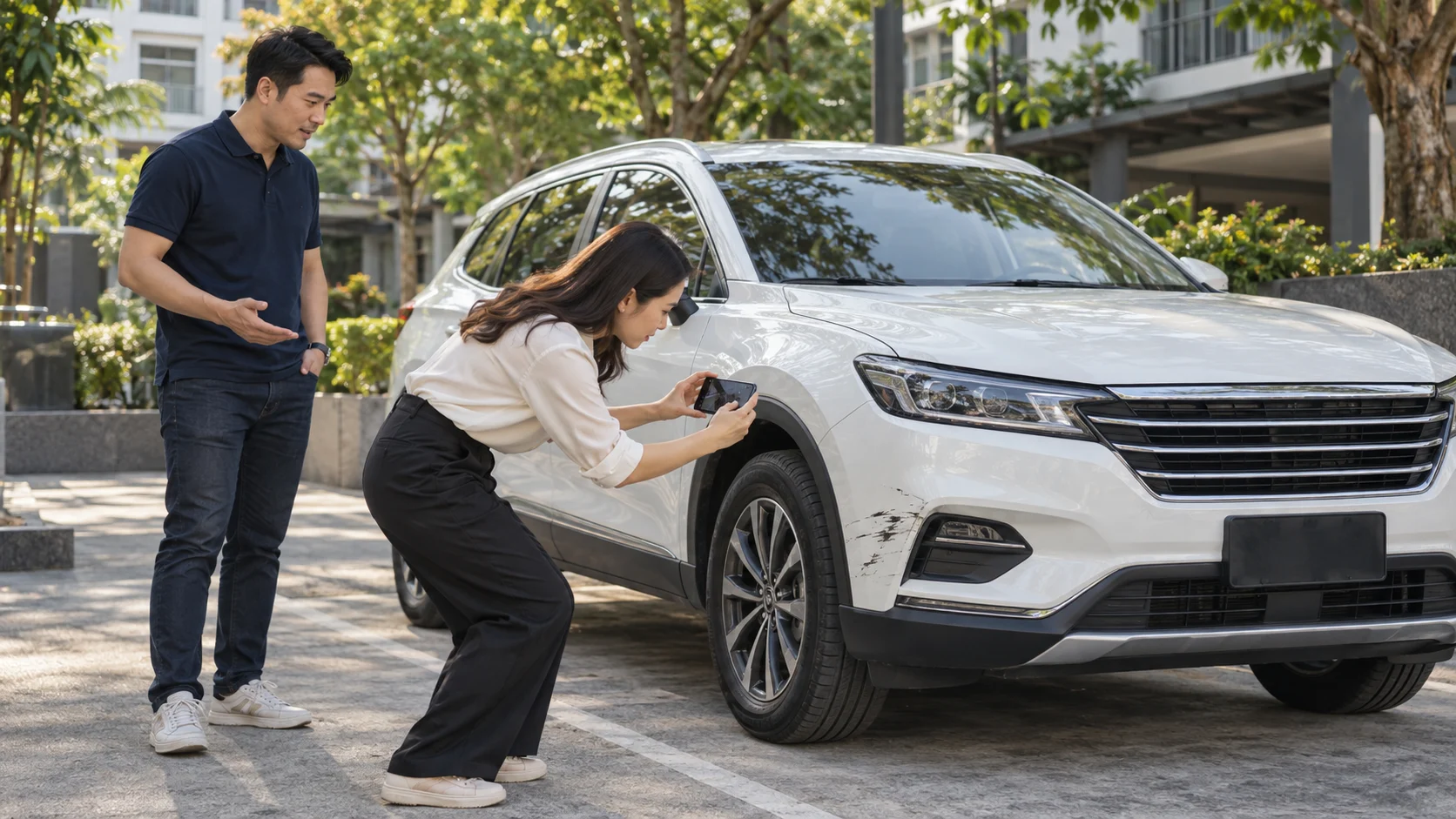
After buying a car, you may receive several offers at once: compulsory insurance, own-damage cover, hydrolock protection and occupant accident insurance. Before comparing prices, I suggest asking three questions: who does this policy protect, what does it pay for, and what will I still have to pay myself? This guide helps you read quotations and handle incidents in Vietnam, rather than buying insurance simply to have a certificate.
Sources reviewed on 2 October 2026. This guide mainly concerns privately owned and company cars in Vietnam. Premium examples state their assumptions and are not offers to sell insurance. Mua Xe Gì .vn is independent. The insurer ranking cited here is not our own ranking, and this article does not replace policy wording, a certificate or advice on a particular dispute.
At a glance: what should you buy and remember?
- Compulsory: motor vehicle owners' civil liability insurance, usually called TNDS in Vietnam. It is not insurance to repair your own car.
- To protect your car itself, consider own-damage insurance and suitable extensions, paying particular attention to flood cover, approved garages and the excess.
- Basic annual premiums including 10% VAT: VND 480,700 for a noncommercial five-seat car and VND 873,400 for a noncommercial seven-seat car. Commercial transport vehicles belong to different premium categories.
- After an accident, put people first, notify the authorities and insurer, preserve evidence safely, and arrange assessment before repairs.
Sources: [1] Government — Decree 67/2023/ND-CP, especially Articles 7–13 and Annex I · [4] Government portal — compulsory insurance premium schedule under Decree 67 · [5] Bảo Minh — motor civil liability insurance, premiums and VAT · [11] Official Gazette — Road Traffic Order and Safety Law 36/2024/QH15, Article 80
1. Which insurance is legally compulsory in Vietnam?
Owners must hold compulsory motor civil liability insurance when their vehicles participate in traffic or operate in Vietnam. For cars, the liability limits are VND 150 million per person per accident for bodily injury or death and VND 100 million per accident for property damage. These are limits, not automatic payments whenever a crash occurs. The amount payable depends on the damage, scope of cover and applicable compensation rules.
Sources: [1] Government — Decree 67/2023/ND-CP, especially Articles 7–13 and Annex I
Compulsory liability insurance addresses liability to third parties and passengers' bodily injury or death within the statutory scope. Do not assume it covers the driver, every family member and every kind of damage to your own car. Any liability you legally owe beyond the insurance limit does not simply disappear.
Sources: [1] Government — Decree 67/2023/ND-CP, especially Articles 7–13 and Annex I
Decree 67/2023/ND-CP is the main basis for this guide's compulsory-insurance section. I also checked Decree 220/2026/ND-CP, effective from 1 July 2026. It changes the Vietnamese terminology for a third party from ‘người thứ ba’ to ‘bên thứ ba’; it does not replace the motor premium schedule in Annex I with a new motor schedule. Do not apply the construction-insurance schedule in the amending decree to a car.
Sources: [1] Government — Decree 67/2023/ND-CP, especially Articles 7–13 and Annex I · [2] Government — Decree 220/2026/ND-CP, Articles 8–10, effective 1 July 2026
An electronic insurance certificate may be issued under the rules. Verify it through the insurer's official channel and check the plate or chassis number, owner, declared use and effective period. A payment receipt or an unverified QR-code image alone does not establish that the car is insured.
Sources: [1] Government — Decree 67/2023/ND-CP, especially Articles 7–13 and Annex I
Own-damage insurance is not a general statutory requirement for every car. If you finance the purchase, the lender may require insurance under the credit or security agreement. Read your particular loan terms, including the beneficiary requirement, rather than treating them as a rule for all owners.
2. Four groups of cover to help you choose
- Compulsory civil liability: covers liability within statutory scope and limits. It does not repair your car after you drive it into a post.
- Own-damage insurance, often marketed as bodywork insurance: protects the car against risks stated in the policy. The marketing name does not mean every component or every cause of failure is covered.
- Driver, assistant-driver and occupant accident insurance: protects people according to the product's insured amounts, eligible persons and conditions. It is separate from cover for the vehicle.
- Extensions or specialised products: higher third-party liability limits, flood damage, theft of individual parts, choice of garage or cargo liability for transport vehicles. Some are add-on clauses rather than separate policies.
Sources: [1] Government — Decree 67/2023/ND-CP, especially Articles 7–13 and Annex I · [12] Bảo Minh — driver, assistant-driver and occupant accident insurance · [13] PTI — motor own-damage insurance and applicable wording
For example, PTI's own-damage product describes risks including collision, overturning, fire, explosion, natural perils and theft of the whole car, subject to its conditions. You still need to read the wording and exclusions. Routine maintenance, wear and pre-existing faults do not become insured accidents merely because you purchased own-damage cover.
Sources: [13] PTI — motor own-damage insurance and applicable wording
I do not think you need to buy all four groups just to complete a list. You need to address your biggest gaps. Someone parking outdoors, a frequent interprovincial driver, an EV owner and a commercial driver may need different answers from the same quotation.
3. How much does car insurance cost each year?
The figures below are basic one-year premiums for the stated vehicle categories, before adjustments based on risk history. I show both pre-tax and tax-inclusive amounts using 10% VAT so you can compare the total payable. These are not the entire cost of owning a car.
Sources: [4] Government portal — compulsory insurance premium schedule under Decree 67 · [5] Bảo Minh — motor civil liability insurance, premiums and VAT
- Noncommercial five-seat car: VND 437,000 before VAT → VND 480,700 including VAT.
- Noncommercial seven-seat car: VND 794,000 before VAT → VND 873,400 including VAT.
- Commercial transport car with fewer than six seats, before any taxi multiplier: VND 756,000 before VAT → VND 831,600 including VAT.
- Commercial transport seven-seat car, before any taxi multiplier: VND 1,080,000 before VAT → VND 1,188,000 including VAT.
- Taxis: the scheduled premium is 170% of that for a commercial transport vehicle with the same seating capacity. Ask the insurer to confirm the classification in your documents and policy.
Sources: [4] Government portal — compulsory insurance premium schedule under Decree 67 · [5] Bảo Minh — motor civil liability insurance, premiums and VAT
Under Article 8(2) of Decree 67, an insurer may consider increasing or reducing the scheduled premium by up to 15%, based on the vehicle's claims history or the owner's accident history. Ask why a quotation differs from the base amount. Company ownership does not automatically mean commercial transport use. Declare the actual use accurately, particularly if the car provides app-based transport services.
Sources: [1] Government — Decree 67/2023/ND-CP, especially Articles 7–13 and Annex I
Own-damage insurance has no single fixed tariff for every insurer and car. The sum insured, vehicle age, use, loss history, garage arrangements, excess and selected extensions all need to be clear in the quotation. PTI publishes product risks and conditions; an advertised premium starting from a certain amount is not a quotation for your particular car.
Sources: [13] PTI — motor own-damage insurance and applicable wording
As one insurer's reference point, MIC's EV guide describes own-damage premiums typically around 1.5–2% per year. This is one company's guidance for electric cars, not a uniform tariff or a fresh quotation issued to you today. I would not use it to claim that all petrol cars, used cars or commercial vehicles can be insured at that rate.
Sources: [8] MIC — electric car insurance and battery coverage guidance
Here is a budgeting example, not a guaranteed market price. Suppose an own-damage quotation, including tax and your chosen extensions, equals 1.5% of the sum insured annually. For a car insured for VND 600 million, the premium is VND 9 million; for VND 1 billion, it is VND 15 million. For a noncommercial five-seat car, adding the basic VND 480,700 compulsory liability premium gives VND 9,480,700 or VND 15,480,700. If the 1.5% quote excludes VAT or hydrolock protection, add those separately. This example is not an offer from any insurer.
I recommend obtaining at least three quotations with the same sum insured and comparable cover before comparing total premiums. A cheaper policy with a higher excess, no access to the garage you need or no flood protection may not suit how you use the car.
4. Which insurers are highly rated, and by whom?
My reference is Vietnam Report's Top 10 Reputable Non-Life Insurance Companies in 2026, published on 18 June 2026. Its method combines financial assessment, media analysis and stakeholder surveys. This is a corporate reputation ranking, not a dedicated ranking of motor-claims speed or customer satisfaction with car insurance payouts.
Sources: [6] Vietnam Report — Top 10 Reputable Insurance Companies in 2026, published 18 June 2026
- 1. PVI · 2. Bảo Việt · 3. VBI · 4. BIC · 5. MIC.
- 6. Bảo Minh · 7. PTI · 8. OPES · 9. ABIC · 10. DBV.
Sources: [6] Vietnam Report — Top 10 Reputable Insurance Companies in 2026, published 18 June 2026
I would use that list to start requesting quotations, rather than automatically choosing the company in first place. The sources checked do not establish that any one insurer handles every motor claim best nationwide. For you, local support, the garage accepting the car and the terms you sign are what need direct verification.
- Ask for the names and addresses of cashless-repair network garages near home and work. Call the garage to confirm that it still accepts that insurer and your vehicle model.
- Ask how to open a claim after hours, who handles it, where to send photographs and when an in-person assessment is required.
- Request a sample repair quotation showing what the customer pays. A cashless arrangement does not eliminate an excess or costs outside the cover.
- Use customer comments to identify questions worth asking, but do not turn a few online complaints into a statistical claim-rejection rate.
5. Six things I would read before paying
- Sum insured: does it reflect the car's value and accepted accessories? Underinsuring merely to save premium can lead to proportionate compensation; overinsuring does not guarantee more than the actual loss.
- Excess or deductible: what amount or percentage must you pay, and is it per claim or calculated under another condition? Ask for an example in money.
- Garages and parts: can you choose an authorised dealer workshop or only a network garage? Is depreciation deducted when parts are replaced, and who pays any price difference?
- Flooding, hydrolock and theft of parts: are these written into the policy or only mentioned verbally? Theft of the whole car is not the same as theft of a mirror.
- Exclusions and obligations: read the provisions on licences, alcohol, declared use, loss reporting, wear and pre-existing damage. Do not assume an own-damage exclusion applies identically to compulsory liability insurance.
- Effective cover and payment: check the start date and time, premium-payment conditions, pre-insurance inspection and named beneficiary.
Sources: [1] Government — Decree 67/2023/ND-CP, especially Articles 7–13 and Annex I · [3] Official Gazette — Law on Insurance Business, consolidated text 31/VBHN-VPQH of 13 March 2026, Articles 30–32 · [7] Bảo Việt — 2026 motor own-damage insurance wording and extensions
For an excess example, suppose approved covered repairs cost VND 10 million, the policy requires you to pay VND 1 million per incident, and there are no other deductions. The insurer pays VND 9 million and you pay VND 1 million. This illustrates the calculation; a VND 1 million excess is not a market-wide standard.
6. Flooded roads and electric cars: what else should you ask?
For petrol or diesel cars, ask specifically whether engine damage caused by water entering it is covered and on what conditions. Bảo Việt's wording includes an additional flood-related clause, which must be recorded in the policy. A statement that natural disasters are covered does not answer every question about hydrolock losses.
Sources: [7] Bảo Việt — 2026 motor own-damage insurance wording and extensions
If the engine stalls in floodwater, do not try restarting it to check. Get out of danger first, contact recovery and your insurer, and save photographs only when safe. Continuing to operate the car can worsen damage; payment still depends on the cause and your policy terms.
For an EV, ask whether the battery is included in the insured value, whether it is owned or leased, how depreciation works, and what is covered during charging, flooding and recovery. For example, MIC's material describes a condition involving battery damage occurring simultaneously with damage to another component from the same cause in an accident. That does not mean every battery failure is covered. Insurance is also not a manufacturing-defect warranty.
Sources: [8] MIC — electric car insurance and battery coverage guidance
My suggestion is to send the insurer two concrete scenarios: a car flooded while parked in a basement, and an incident while charging. Ask for a written answer identifying the clauses that apply. That is more useful than a verbal promise that the package covers everything.
7. What should you do after a collision or crash?
- Step 1 — Stop, warn others of danger and prioritise injured people. Notify the police, medical services or nearest local authority as appropriate. Call 115 for medical emergencies, 114 for fire or rescue, and 113 for urgent police assistance. Do not stand in moving traffic just to take photographs.
- Step 2 — Call the claims number on your certificate immediately. Give your location, plate number and the condition of people and vehicles. Record the case number, handler and recovery/assessment instructions.
- Step 3 — Preserve the scene and gather evidence only when safe: wide photographs, impact points, relevant plates, time, location, witness contacts and a copy of dashcam footage. Do not alter photographs or add old damage to the new incident.
- Step 4 — Do not dismantle, repair or move property without the insurer's agreement, except for action needed to protect people, ensure safety, limit damage or follow an authority's directions. If movement is necessary, record the reason and evidence where safe.
- Step 5 — Give an honest account and cooperate with the authorities. Before agreeing a settlement or signing a release with the other party, ask your insurer how it affects the claim. Do not sign wording you do not understand.
- Step 6 — Agree the assessment, garage, repair estimate and your share of the cost before repairs. Keep the accident notice, recovery receipts, invoices, medical records and related documents.
Sources: [1] Government — Decree 67/2023/ND-CP, especially Articles 7–13 and Annex I · [9] PVI — claims guidance and assistance hotline · [10] Bảo Minh — motor claims assessment, repair agreement and compensation process · [11] Official Gazette — Road Traffic Order and Safety Law 36/2024/QH15, Article 80
Two numbers checked on official websites are PVI: 1900 54 54 58, and Bảo Minh: 1800 588812. If you use another insurer, follow the number on your certificate or its official website. I suggest saving it before a trip rather than searching in a panic.
Sources: [9] PVI — claims guidance and assistance hotline · [10] Bảo Minh — motor claims assessment, repair agreement and compensation process
8. Claims documents and deadlines: do not confuse these milestones
Immediate reporting and a timely formal notice are separate from completing the claim file. For compulsory liability insurance, Article 12(4) of Decree 67 requires written or electronic notice within five working days of the accident, except for force majeure or objective impediments. An initial phone call does not mean every notification obligation is complete. Keep confirmation of receipt.
Sources: [1] Government — Decree 67/2023/ND-CP, especially Articles 7–13 and Annex I
For submitting a claim, Article 30 of the Law on Insurance Business provides an ordinary period of one year from the insured event, with exceptions and particular calculation rules stated in the law. For payment, Article 31 first applies the period agreed in the contract. If none is agreed, payment is due within 15 days of receiving a complete, valid file. It is therefore wrong to assume that money is guaranteed 15 days after the accident. I checked the 2026 consolidated text, 31/VBHN-VPQH.
Compulsory liability insurance also has an advance-payment mechanism for bodily injury or death within three working days of receiving notification, subject to the conditions and percentages in Article 12(3). It is not a promise to advance bodywork repair money for every scrape.
Sources: [1] Government — Decree 67/2023/ND-CP, especially Articles 7–13 and Annex I
- Prepare the claim request, vehicle and driver documents, insurance certificate and evidence relevant to the damage. Not every claim requires every possible medical or police document.
- Under Article 13 of Decree 67, the insurer is responsible for collecting assessment records and specified police documents in the applicable cases. Ask which documents you provide and which the insurer obtains.
- After submission, ask for a list of missing documents, confirmation of the date the file becomes complete, and the applicable settlement deadline. Keep emails, acknowledgements and the claim reference.
Sources: [1] Government — Decree 67/2023/ND-CP, especially Articles 7–13 and Annex I · [3] Official Gazette — Law on Insurance Business, consolidated text 31/VBHN-VPQH of 13 March 2026, Articles 30–32
If you disagree with the compensation, request a written calculation, reasons for deductions and the applicable clauses. Submit a complaint through the official channel with a chronological record. If negotiation does not resolve it, mediation, arbitration or court proceedings may be available according to the agreement and law. For a large amount or complex dispute, have a legal professional review the contract.
9. Frequently asked questions
If I only have compulsory liability insurance, will it repair dents in my car? Not as cover for your own vehicle. You need to consider your own-damage policy or the compensation liability of the party that caused the damage. These are different routes.
Sources: [1] Government — Decree 67/2023/ND-CP, especially Articles 7–13 and Annex I
Does a company-owned car need a commercial transport premium? Ownership alone does not answer that. Declare the actual use and vehicle classification. If you start using it for transport services, notify the insurer and obtain confirmation of the appropriate cover and premium.
Sources: [1] Government — Decree 67/2023/ND-CP, especially Articles 7–13 and Annex I
Does ‘two-way insurance’ mean everything is protected? No. Ask the seller to separate liability and own-damage cover, limits, excesses, exclusions and extensions. A sales label does not replace the contract.
Can I continue using the previous owner's insurance when buying a used car? Do not assume so. For compulsory liability insurance, the previous owner can terminate the policy upon ownership transfer under the rules. For own-damage cover, obtain the insurer's confirmation of transfer or a new policy before relying on it.
Sources: [1] Government — Decree 67/2023/ND-CP, especially Articles 7–13 and Annex I · [3] Official Gazette — Law on Insurance Business, consolidated text 31/VBHN-VPQH of 13 March 2026, Articles 30–32
Can I add hydrolock protection after the car has already flooded? A new purchase does not retrospectively insure an event that has already occurred. Disclose the car's condition honestly, check the effective time and never give a false accident date.
10. A message you can use to request a quotation
Please quote for [make, model, year], [seats], used for [family/company/commercial transport], estimated value [amount], mainly driven in [province/city]. Please separate compulsory liability and own-damage cover. State the total premium including tax, sum insured, excess per incident, garage arrangements, parts/depreciation, flood/hydrolock cover, theft of parts, EV battery cover if relevant, recovery and claims process. Please send the policy wording, extensions and confirmed start time so I can read them before paying.
To me, a worthwhile policy is one you understand when buying and know how to use when something goes wrong. You do not necessarily need the most expensive package. Choose the cover that fits, retain the written confirmations and save the assistance number on your phone.
References
- Government — Decree 67/2023/ND-CP, especially Articles 7–13 and Annex I
- Government — Decree 220/2026/ND-CP, Articles 8–10, effective 1 July 2026
- Official Gazette — Law on Insurance Business, consolidated text 31/VBHN-VPQH of 13 March 2026, Articles 30–32
- Government portal — compulsory insurance premium schedule under Decree 67
- Bảo Minh — motor civil liability insurance, premiums and VAT
- Vietnam Report — Top 10 Reputable Insurance Companies in 2026, published 18 June 2026
- Bảo Việt — 2026 motor own-damage insurance wording and extensions
- MIC — electric car insurance and battery coverage guidance
- PVI — claims guidance and assistance hotline
- Bảo Minh — motor claims assessment, repair agreement and compensation process
- Official Gazette — Road Traffic Order and Safety Law 36/2024/QH15, Article 80
- Bảo Minh — driver, assistant-driver and occupant accident insurance
- PTI — motor own-damage insurance and applicable wording