

CAR OWNERSHIP GUIDES
Vietnam driving theory test 2026: a visual guide to 600 questions
Study Vietnam’s 600 driving theory questions for category B in 2026: clear vehicle pictures, road signs, speed limits and priority rules with everyday memory aids.
You may recognise every word in a theory question yet struggle to picture what it means. I suggest starting with what you can see on a real road: what kind of vehicle is this, is that a median or only paint, and who needs to yield? Naming things correctly and understanding the situation helps you explain why an answer is correct.
If you are searching for “600 câu GPLX 2025”, “600 câu GPLX 2026” or category B driving theory practice in Vietnam, start with the concepts. The 600-question bank entered use on 1 June 2025; a 2026 label on an article or app does not by itself identify an entirely different bank. This guide connects test terminology with real situations; your test’s content and scoring must follow the guidance applicable to your examination.
Sources: [3] Government Portal — Traffic Police guidance on the 600-question bank · [4] Government Portal — Changes and implementation dates under Circular 108/2026/TT-BCA
Use the eight stages below, or jump through the contents to the sign or situation you need, then return to its underlying concept. Adapted practice situations and AI pictures are created for this guide; any official-bank question is identified by number and source.
1. Understand the terms: which vehicle, which concept?
1.1. First: connect everyday speech with the test’s terminology
Whether you hear quẹo or rẽ (turn), tấp vô or tấp vào (pull over), or con lươn or dải phân cách (divider), familiar speech can be a starting point. A Central Vietnamese speaker might ask “xe ni đi mô?”—“where is this vehicle going?”. Usage varies by locality and family. I place everyday expressions beside standard terms so you can connect the meaning. The same traffic rules apply across dialects.
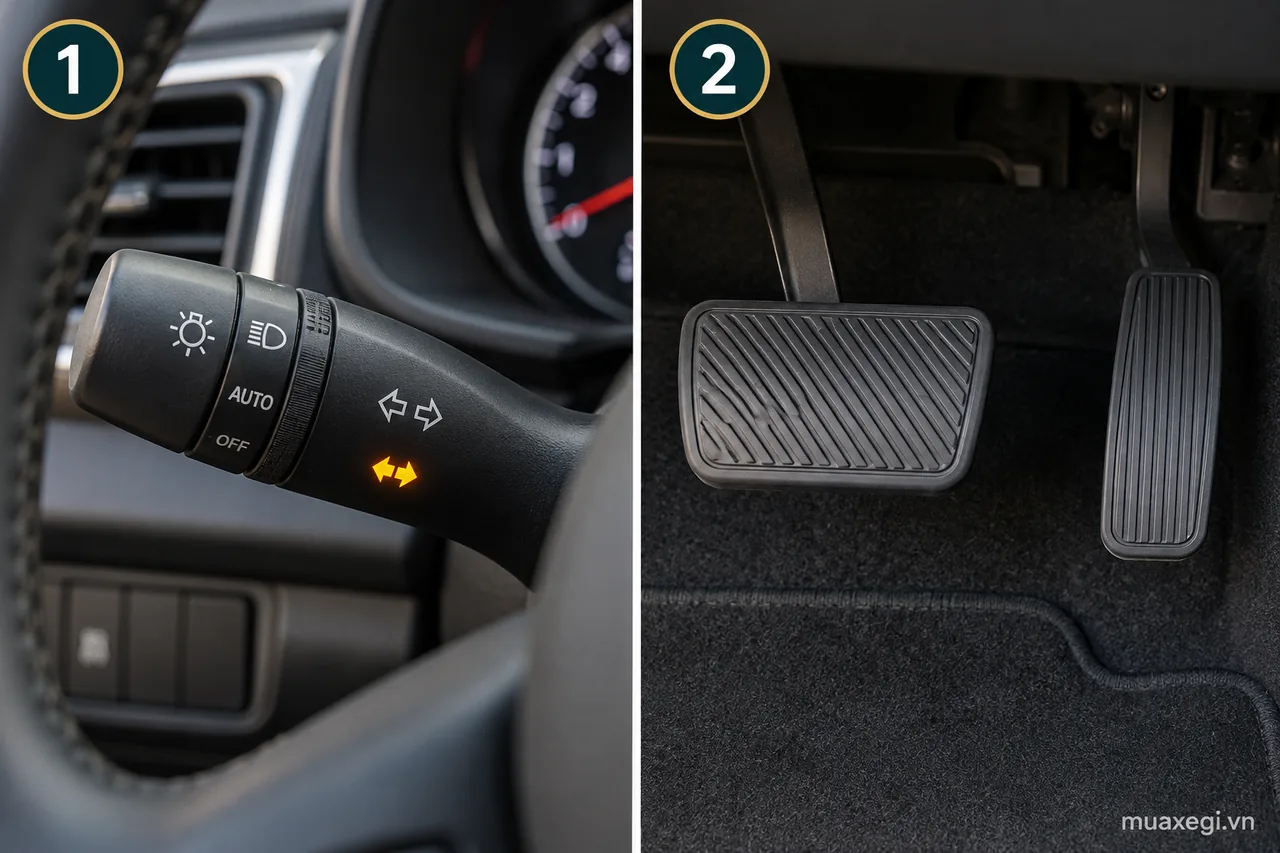
- “Bóp thắng/đạp thắng” means braking; xi-nhan means the indicator. Signalling an intention is not immediate permission to turn.
- “Tấp vô bên lề” means moving towards the roadside. Stopping or parking still requires a permitted, safe place.
- “Bùng binh/vòng xoay” suggests traffic around an island. The roundabout yielding rule depends on the instructions, not simply a planted circle.
- “Sa hình” is a bird’s-eye traffic diagram. Imagine sitting in each driver’s seat: the driver’s right is not necessarily the right of the page.
Sources: [1] Road Traffic Order and Safety Law — consolidated 55/VBHN-VPQH; Articles 2, 11, 13–18, 22, 24–27, 34, 57 and 89 · [2] QCVN 41:2024/BGTVT — Road signs and signals; terms, signs and markings
1.2. Xe cơ giới: more than cars, more precise than “has an engine”
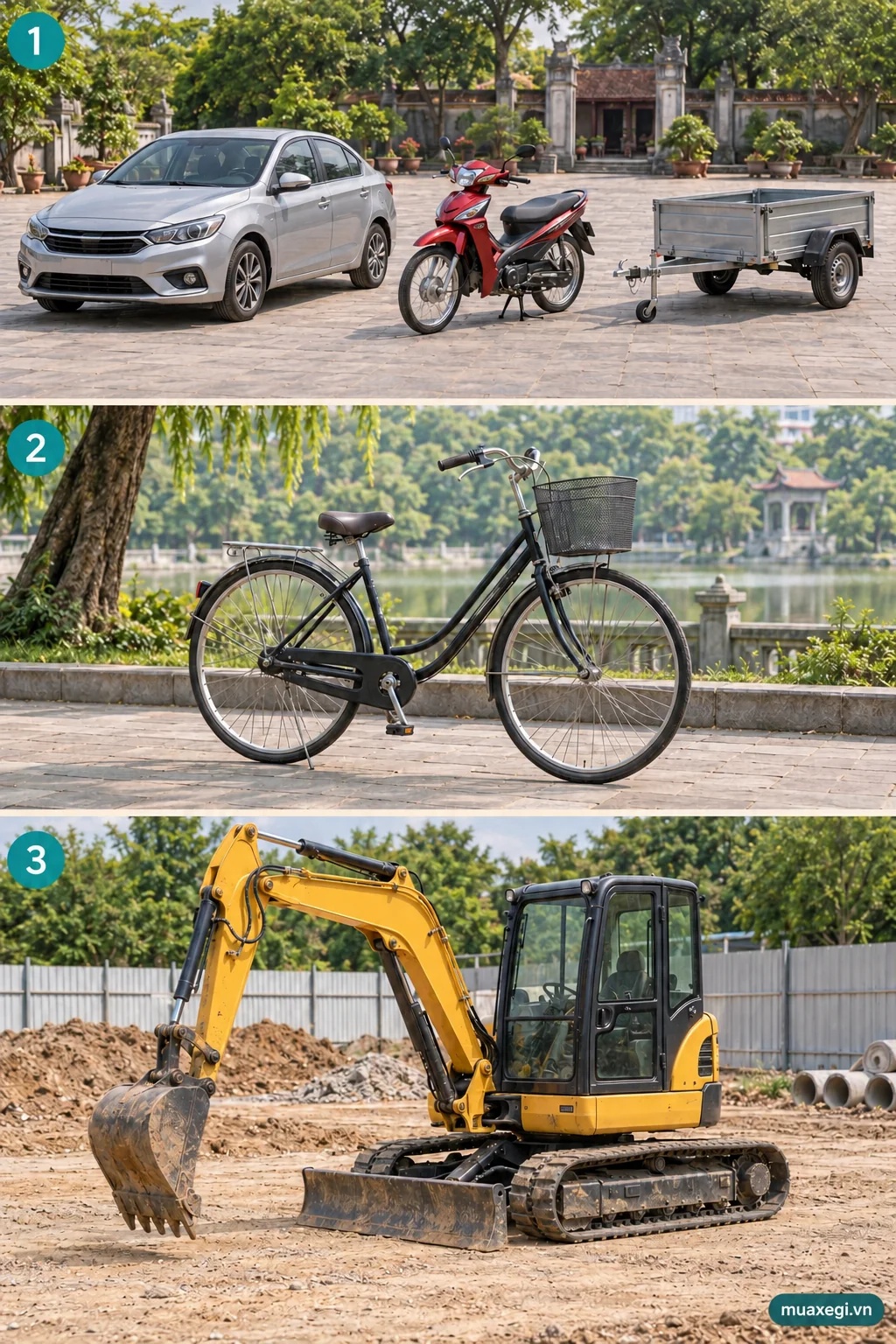
Start with familiar examples: cars, motorcycles and mopeds belong to the motor-vehicle group, “xe cơ giới”. The legal category differs from the shortcut “has an engine”: a trailer towed by a car belongs to this group despite having no engine of its own; a construction excavator belongs to the separate special-purpose machinery group, “xe máy chuyên dùng”.
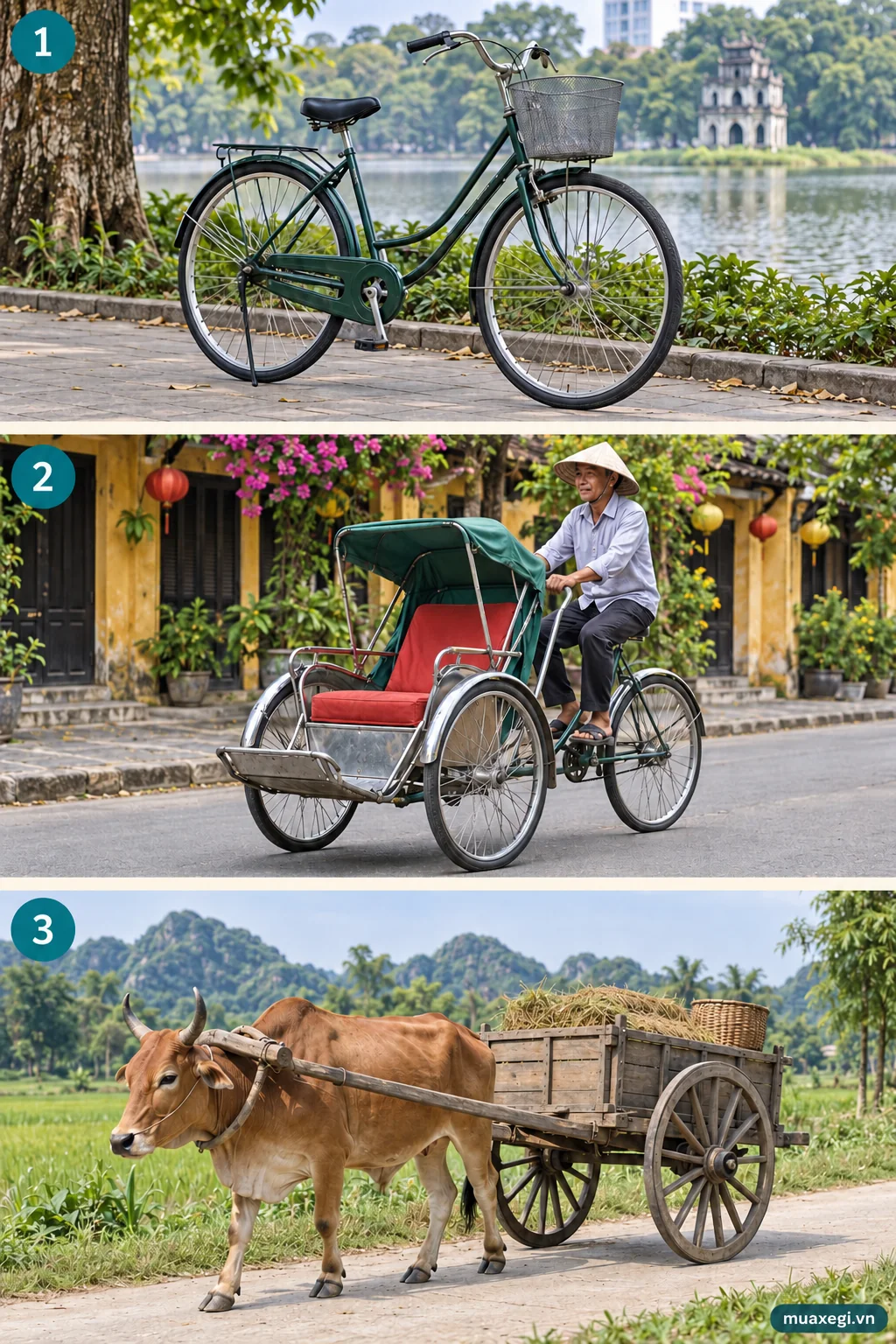
Bicycles and cyclos are easy examples of “xe thô sơ”, the non-motor-vehicle group. A pedal-assist bicycle whose motor cuts out when you stop pedalling or reach 25 km/h also belongs to that legal group. Two-wheelers sold as “electric bikes” can belong to different legal categories.
Sources: [1] Road Traffic Order and Safety Law — consolidated 55/VBHN-VPQH; Articles 2, 11, 13–18, 22, 24–27, 34, 57 and 89 · [6] Consolidated Circular 75/2026/VBHN-TT-BXD — vehicle classification; Articles 3–4 and Annexes V, VI, IX, X
Try covering the group headings, naming each vehicle and sorting it. Then ask yourself: “Why is a trailer a motor vehicle even without an engine?” Explaining this helps you remember the classification.
1.3. Xe máy, motorcycles, mopeds and the 125 cc licence boundary
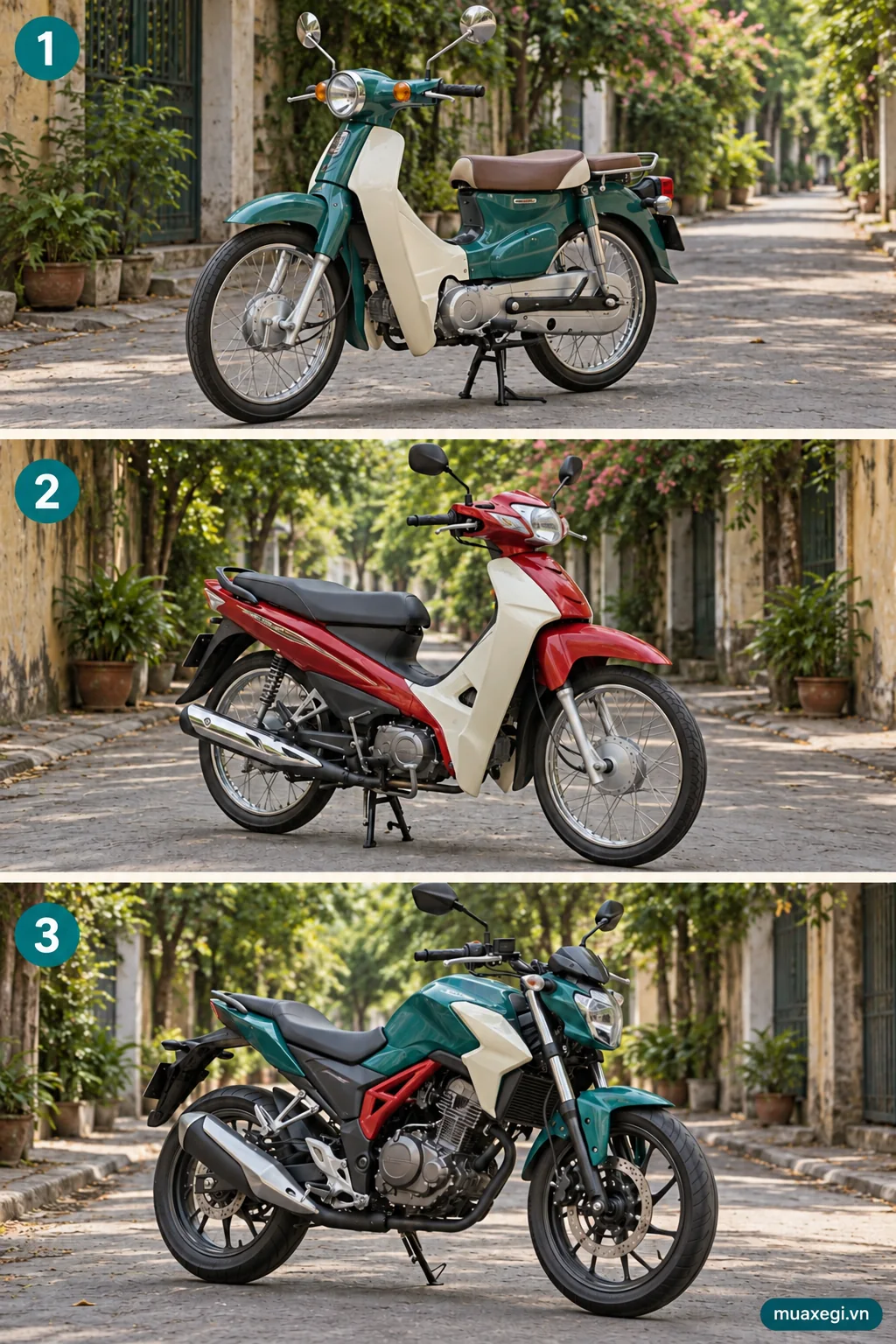
In everyday Vietnamese, xe máy covers step-through bikes, scooters and other powered two-wheelers. In a test, distinguish a motorcycle (mô tô) from a moped (xe gắn máy). A moped has two or three wheels and a design speed no higher than 50 km/h, with an internal-combustion engine no larger than 50 cc or an electric motor no more powerful than 4 kW. Both design speed and engine specifications matter; riding slowly does not change the vehicle’s category.
A 110 cc two-wheeler is a motorcycle, as are 125 cc and 150 cc bikes. Under the new licensing system, A1 covers two-wheeled motorcycles up to 125 cc or electric motors up to 11 kW; above those thresholds, category A applies. “Which licence?” is a different question from “Which vehicle category?”. Licences issued before 1 January 2025 have separate transitional provisions; a new category name does not automatically alter an older licence’s scope.
1.4. Three-wheeled motorcycles and xe lam: classification by specifications and documents
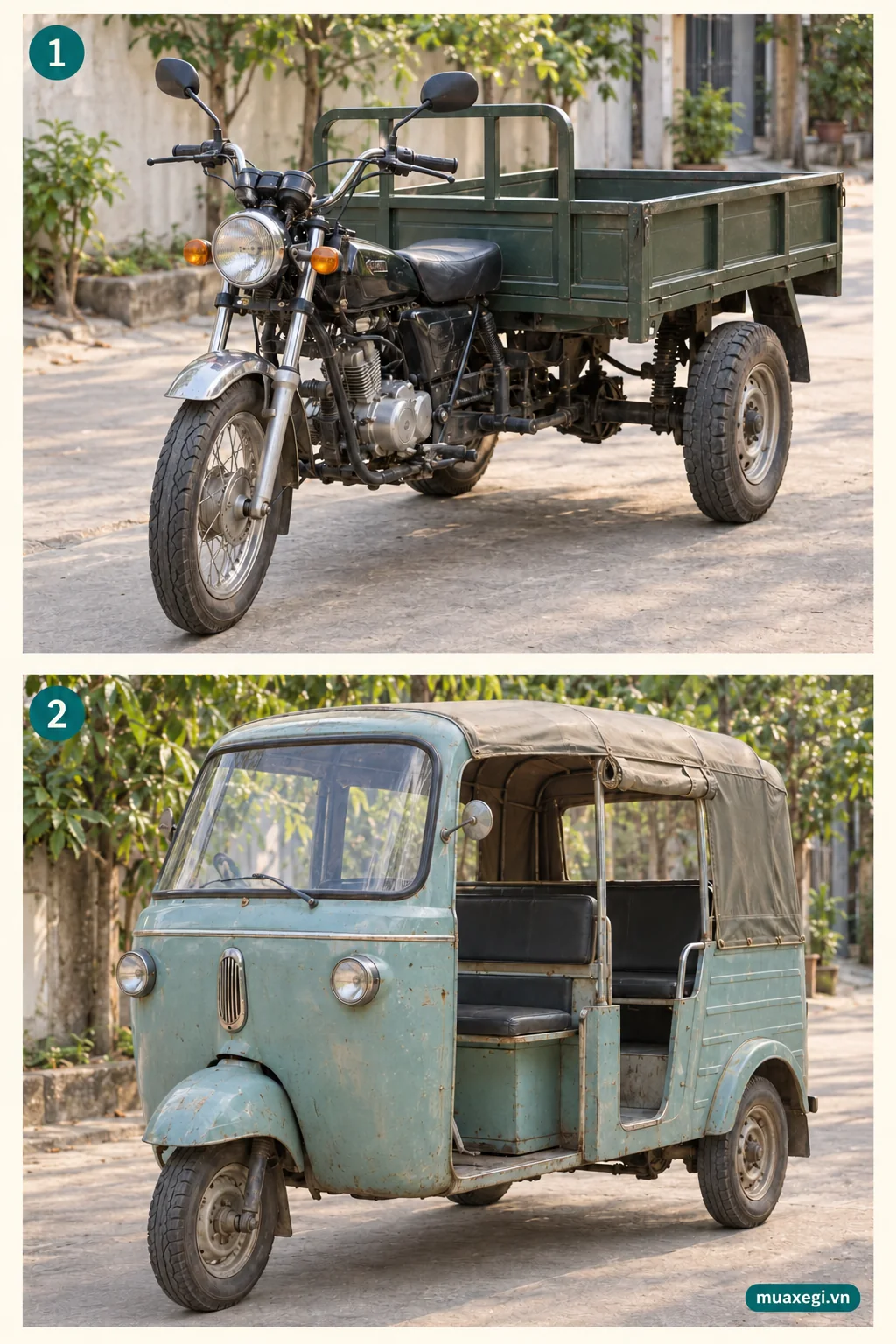
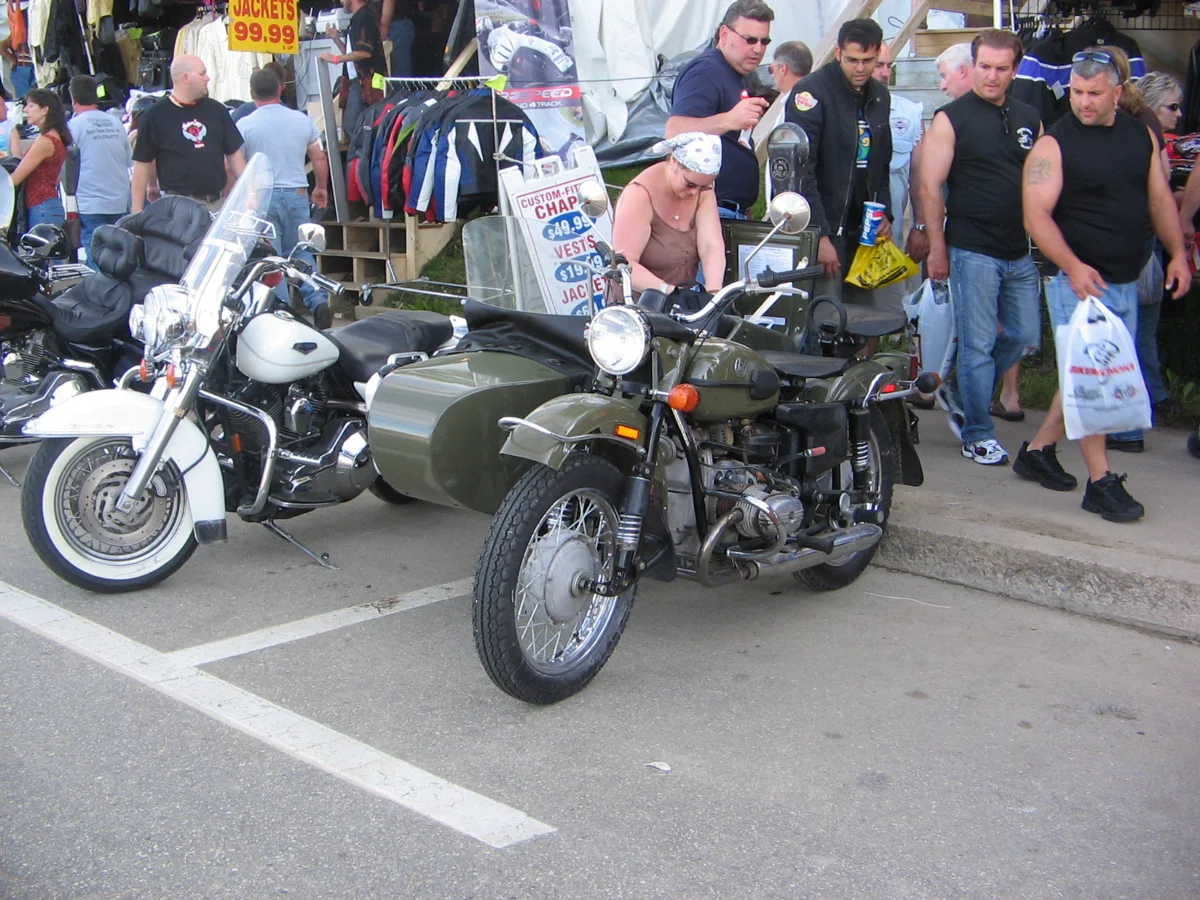
A three-wheeled motorcycle is an engine-powered three-wheeler in the motorcycle category, with an unladen mass no greater than 400 kg, excluding mopeds. There are passenger, goods and disability-use types. Picture a three-wheeler with motorcycle-style controls. A three-wheeler with an unladen mass above 400 kg falls within the automobile definition. Unladen mass is a vehicle specification, not the vehicle plus its current load.
Sources: [1] Road Traffic Order and Safety Law — consolidated 55/VBHN-VPQH; Articles 2, 11, 13–18, 22, 24–27, 34, 57 and 89 · [6] Consolidated Circular 75/2026/VBHN-TT-BXD — vehicle classification; Articles 3–4 and Annexes V, VI, IX, X
Xe lam is a familiar name for certain three-wheel passenger vehicles. The nickname alone does not establish whether a particular vehicle is a motorcycle or an automobile: its specifications and documentation matter. In the new licence system, B1 covers three-wheeled motorcycles and vehicles within A1’s scope; it is not another name for the old B1 car licence. A useful order is vehicle category first, licence category second.
Sources: [1] Road Traffic Order and Safety Law — consolidated 55/VBHN-VPQH; Articles 2, 11, 13–18, 22, 24–27, 34, 57 and 89 · [6] Consolidated Circular 75/2026/VBHN-TT-BXD — vehicle classification; Articles 3–4 and Annexes V, VI, IX, X
Sources: [1] Road Traffic Order and Safety Law — consolidated 55/VBHN-VPQH; Articles 2, 11, 13–18, 22, 24–27, 34, 57 and 89 · [6] Consolidated Circular 75/2026/VBHN-TT-BXD — vehicle classification; Articles 3–4 and Annexes V, VI, IX, X
Sources: [7] Ural with sidecar photograph — Malber, Wikimedia Commons · [8] Photograph licence: Creative Commons Attribution–ShareAlike 3.0
1.5. Non-motor vehicles: bicycles, cyclos and animal-drawn carts
An ox cart is pulled by an ox; a horse cart is another animal-drawn vehicle. Both belong to xe thô sơ, alongside bicycles and cyclos. The legal definition determines this category: qualifying pedal-assist cycles also belong here, while an old motorcycle remains a motor vehicle. When looking at a picture, identify what propels the vehicle, then check the definition.
1.6. Special-purpose machines versus special-purpose automobiles
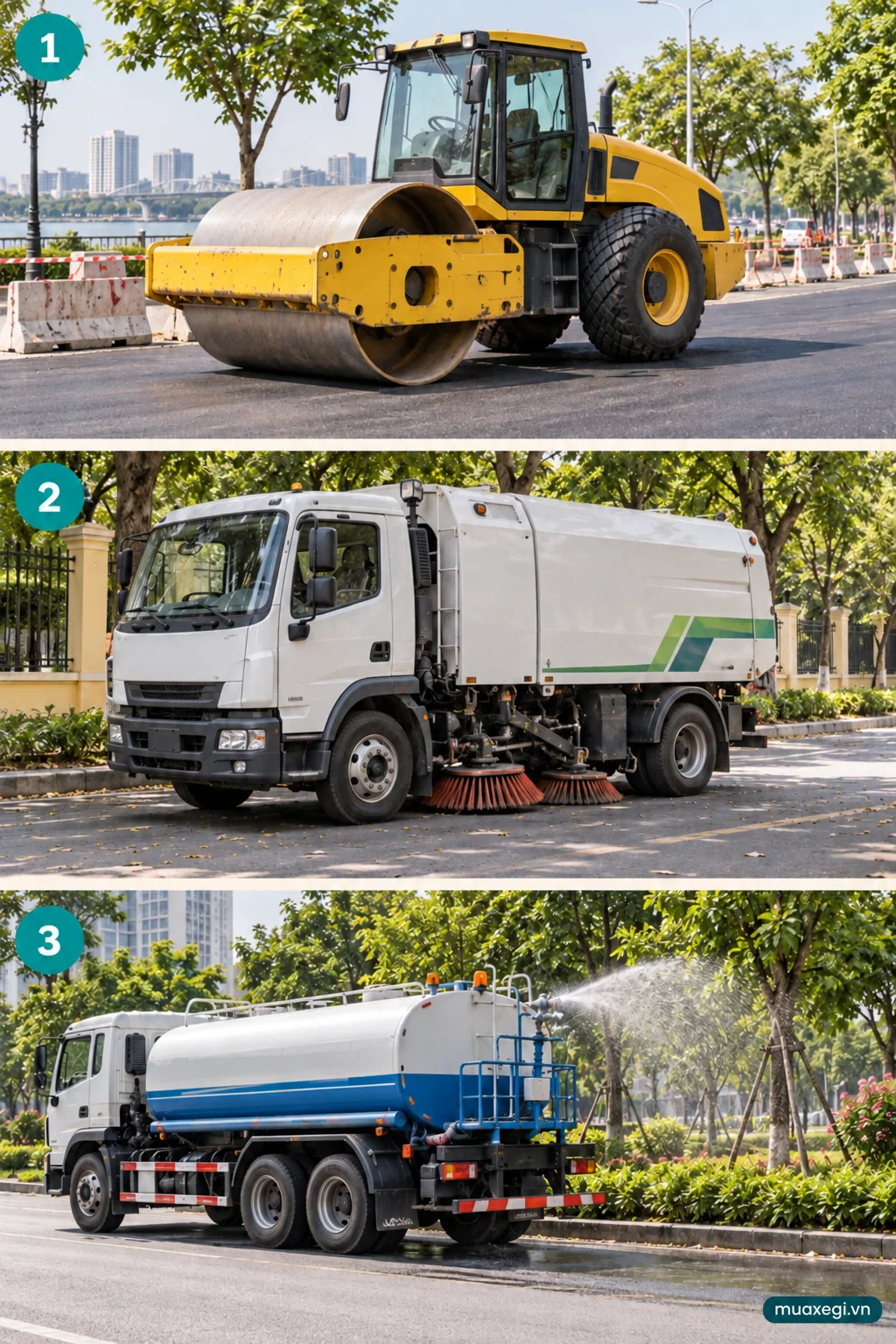
A road roller with a heavy steel drum compacting the ground, or an excavator digging soil, makes xe máy thi công—construction machinery—easy to picture. These belong to xe máy chuyên dùng. Here, xe máy refers to specialised machinery. You can picture a mobile working machine, then confirm its category in the classification rules.
Sources: [1] Road Traffic Order and Safety Law — consolidated 55/VBHN-VPQH; Articles 2, 11, 13–18, 22, 24–27, 34, 57 and 89 · [6] Consolidated Circular 75/2026/VBHN-TT-BXD — vehicle classification; Articles 3–4 and Annexes V, VI, IX, X
Public-cleaning and watering vehicles need a closer look. The classification lists both road-sweeping automobiles under special-purpose automobiles and road-sweeping machines under special-purpose machinery. A water-spraying tanker automobile belongs to special-purpose goods automobiles; liquid-spraying machines also appear in the machinery list. “It sweeps or waters” tells you the job, not the legal category. The pictures deliberately distinguish a road roller, a road-sweeping automobile and a water-spraying tanker automobile; an actual vehicle must be checked against its classification documents.
Sources: [1] Road Traffic Order and Safety Law — consolidated 55/VBHN-VPQH; Articles 2, 11, 13–18, 22, 24–27, 34, 57 and 89 · [6] Consolidated Circular 75/2026/VBHN-TT-BXD — vehicle classification; Articles 3–4 and Annexes V, VI, IX, X
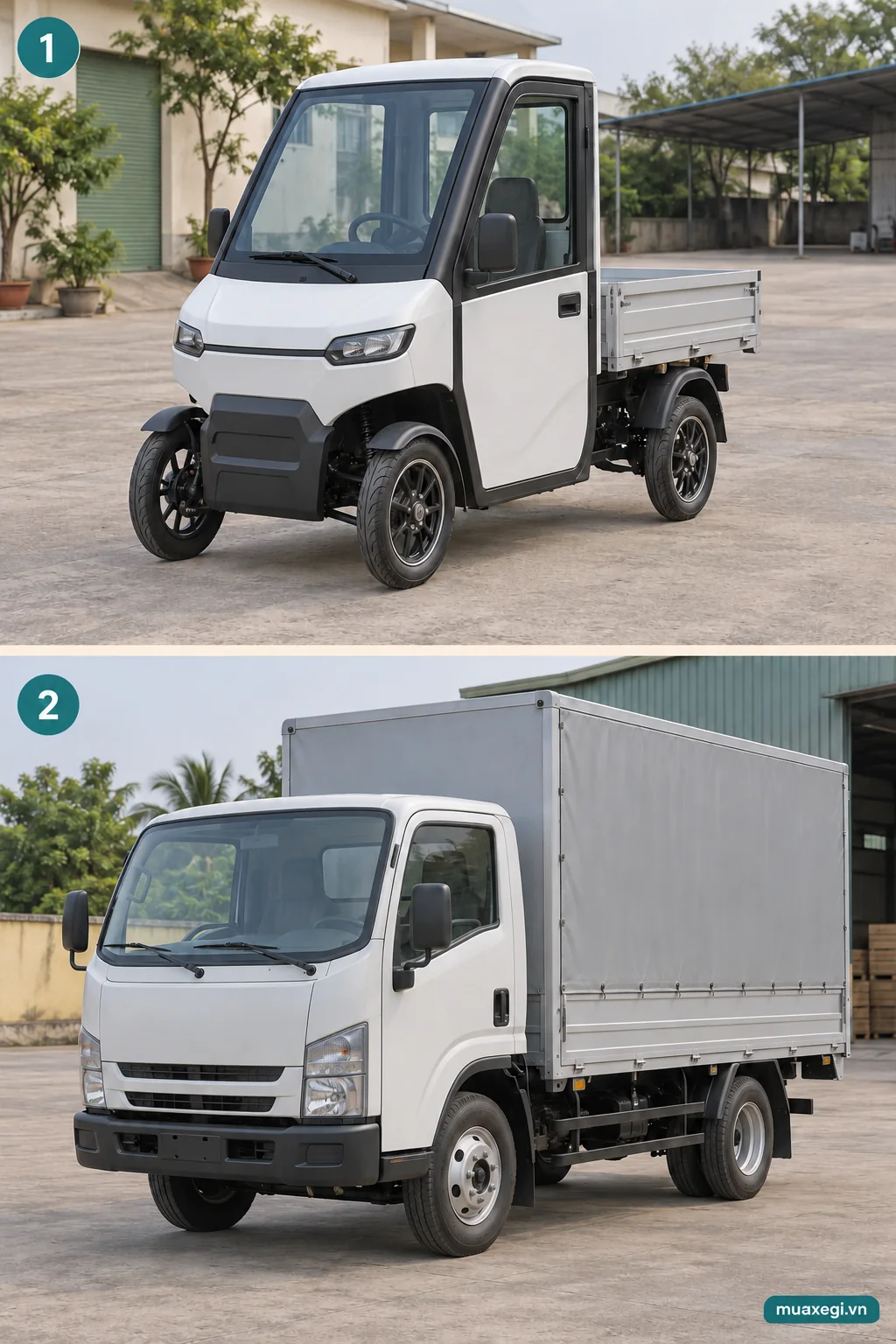
1.7. Is a four-wheel powered goods vehicle just an ordinary truck?
No. Xe chở hàng bốn bánh có gắn động cơ is a distinct category: engine and goods body on one chassis, no more than two seat rows and five people excluding the driver, design speed no higher than 60 km/h and unladen mass no greater than 550 kg; an electric version has a motor no more powerful than 15 kW.
An ordinary light truck remains a goods automobile even if it is small and has four wheels. Read its recorded category and design specifications. For the separate four-wheel powered goods category above, the operating maximum within its permitted area and time is 50 km/h, distinct from the 60 km/h design threshold. “What is it designed to do?” and “What speed is allowed here?” are different questions.
Sources: [1] Road Traffic Order and Safety Law — consolidated 55/VBHN-VPQH; Articles 2, 11, 13–18, 22, 24–27, 34, 57 and 89 · [5] Consolidated 74/2026/VBHN-TT-BXD — speeds and safe following distances; Articles 3–11
Sources: [1] Road Traffic Order and Safety Law — consolidated 55/VBHN-VPQH; Articles 2, 11, 13–18, 22, 24–27, 34, 57 and 89 · [5] Consolidated 74/2026/VBHN-TT-BXD — speeds and safe following distances; Articles 3–11
1.8. Small phrases that change the whole question
- “Khu đông dân cư”: identify the built-up area using its start and end signs.
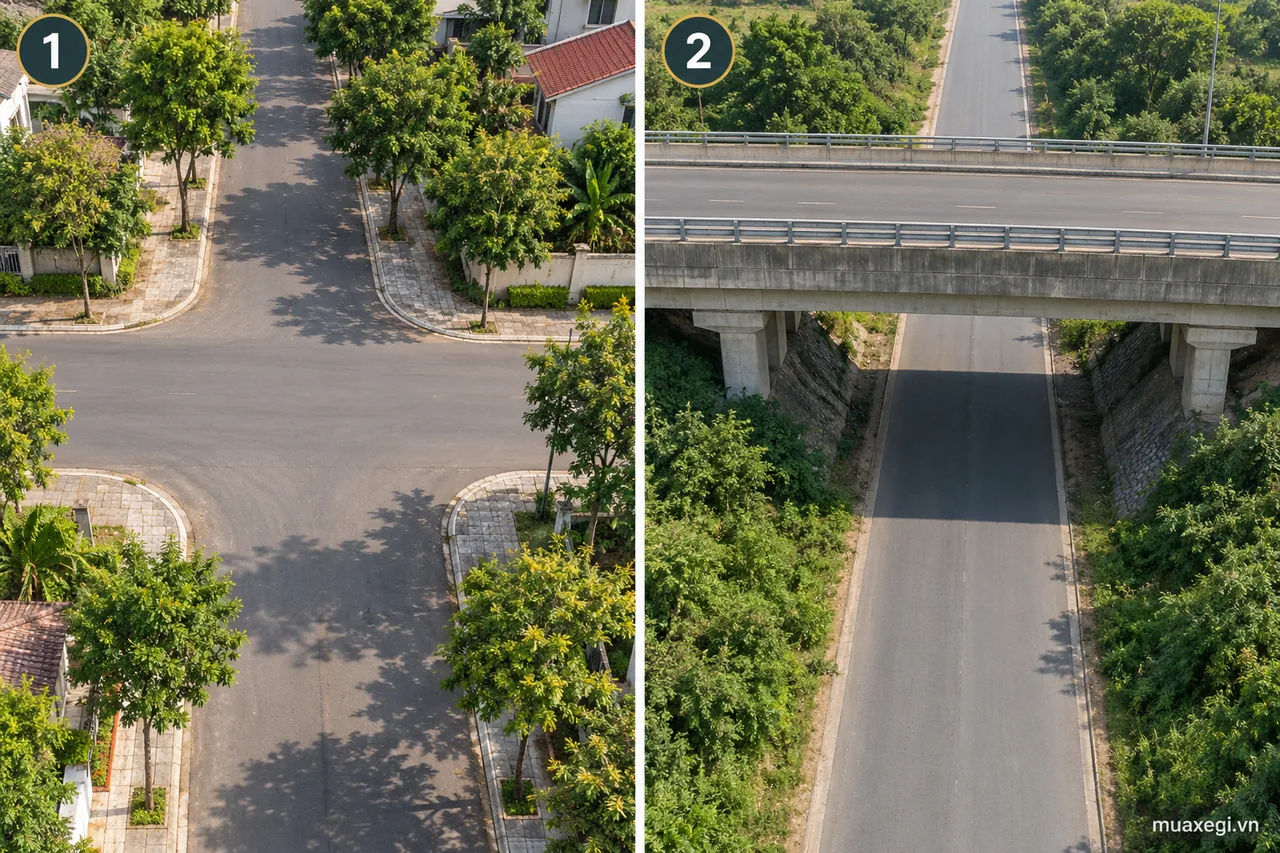
- “Giao nhau cùng mức”: roads meeting at the same level, such as a crossroads. A bridge carrying one road over another is a grade-separated example; inspect any separate entry and exit points.
- “Không kể người lái”: exclude the driver when counting. “8 seats excluding the driver” means eight passengers plus one driver, not eight people altogether.
- “Được”, “phải”, “không được”, “trừ”: permitted, required, prohibited and except. Read these together with the rest of the sentence.
Sources: [1] Road Traffic Order and Safety Law — consolidated 55/VBHN-VPQH; Articles 2, 11, 13–18, 22, 24–27, 34, 57 and 89 · [2] QCVN 41:2024/BGTVT — Road signs and signals; terms, signs and markings
1.9. Understand these unfamiliar terms before memorising numbers
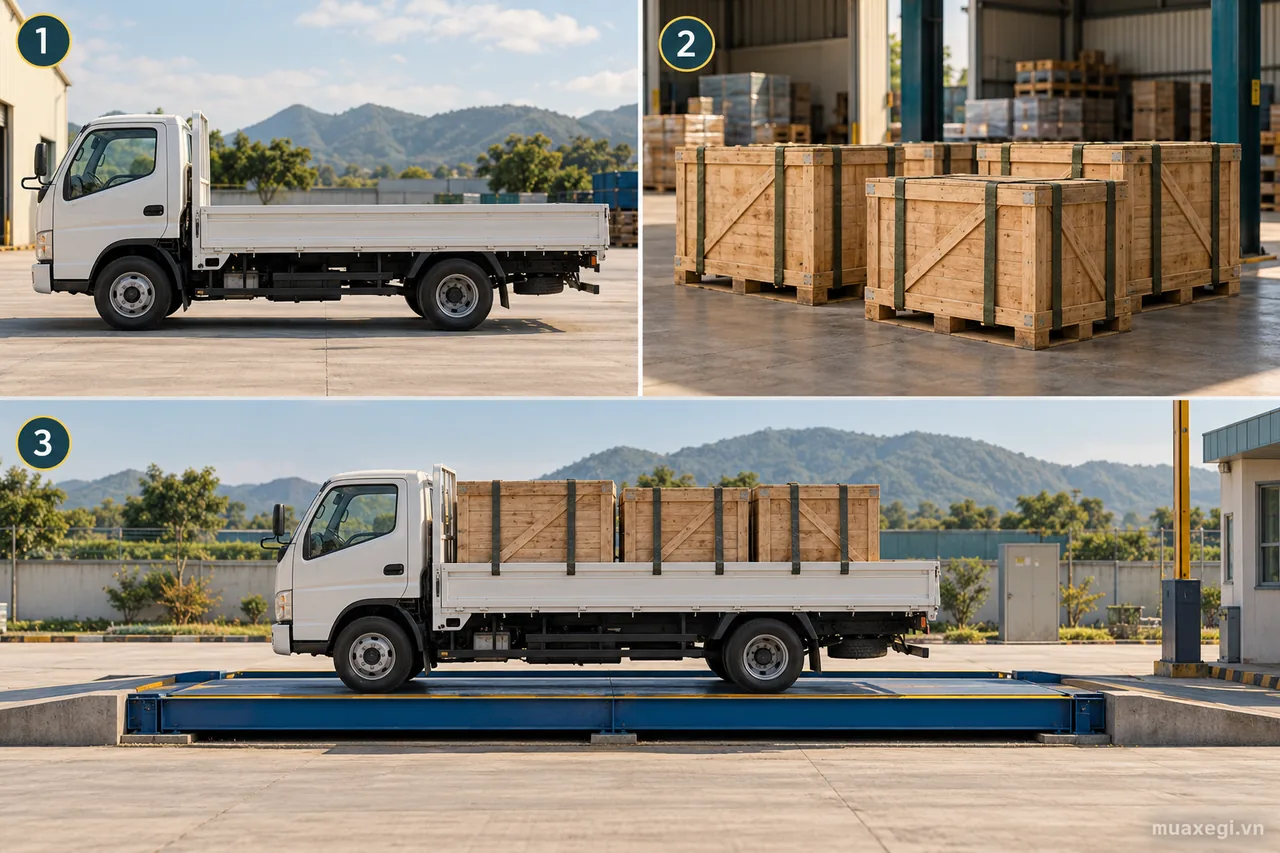
- Payload (trọng tải): in the speed regulation, the permitted goods load recorded in the technical documents, not the whole vehicle’s weight. Driving empty does not change its permitted payload.
- Unladen versus total mass: the vehicle itself versus the vehicle including people, luggage and goods. Also read “design”, “permitted” or “actual”: these are not interchangeable. P.115 concerns the whole vehicle, not only its cargo.
- Trailer versus semitrailer: neither propels itself with an engine. A trailer carries most of its weight on its own wheels; a semitrailer places a significant share on the tractor unit.
- Restricted visibility: a bend, crest or obstruction prevents you from seeing enough road ahead. “I cannot see a vehicle” is not the same as “there is no vehicle”.
- Yielding: change your movement so the vehicle being given way does not need to swerve or brake suddenly. Flashing lights or waving alone does not accomplish this.
- At-grade versus grade-separated: roads at the same level can intersect; an overpass above another road is different. Separate connecting ramps and merging points still need their own assessment.
- Training / testing / licence exchange: learning, assessment and an administrative licence procedure. A renamed category does not automatically mean everyone must retake a test.
Sources: [1] Road Traffic Order and Safety Law — consolidated 55/VBHN-VPQH; Articles 2, 11, 13–18, 22, 24–27, 34, 57 and 89 · [2] QCVN 41:2024/BGTVT — Road signs and signals; terms, signs and markings · [5] Consolidated 74/2026/VBHN-TT-BXD — speeds and safe following distances; Articles 3–11
Sources: [1] Road Traffic Order and Safety Law — consolidated 55/VBHN-VPQH; Articles 2, 11, 13–18, 22, 24–27, 34, 57 and 89 · [2] QCVN 41:2024/BGTVT — Road signs and signals; terms, signs and markings
2. Read the road: directions, lanes and overtaking
2.1. Đường đôi or đường hai chiều? Look at the middle first
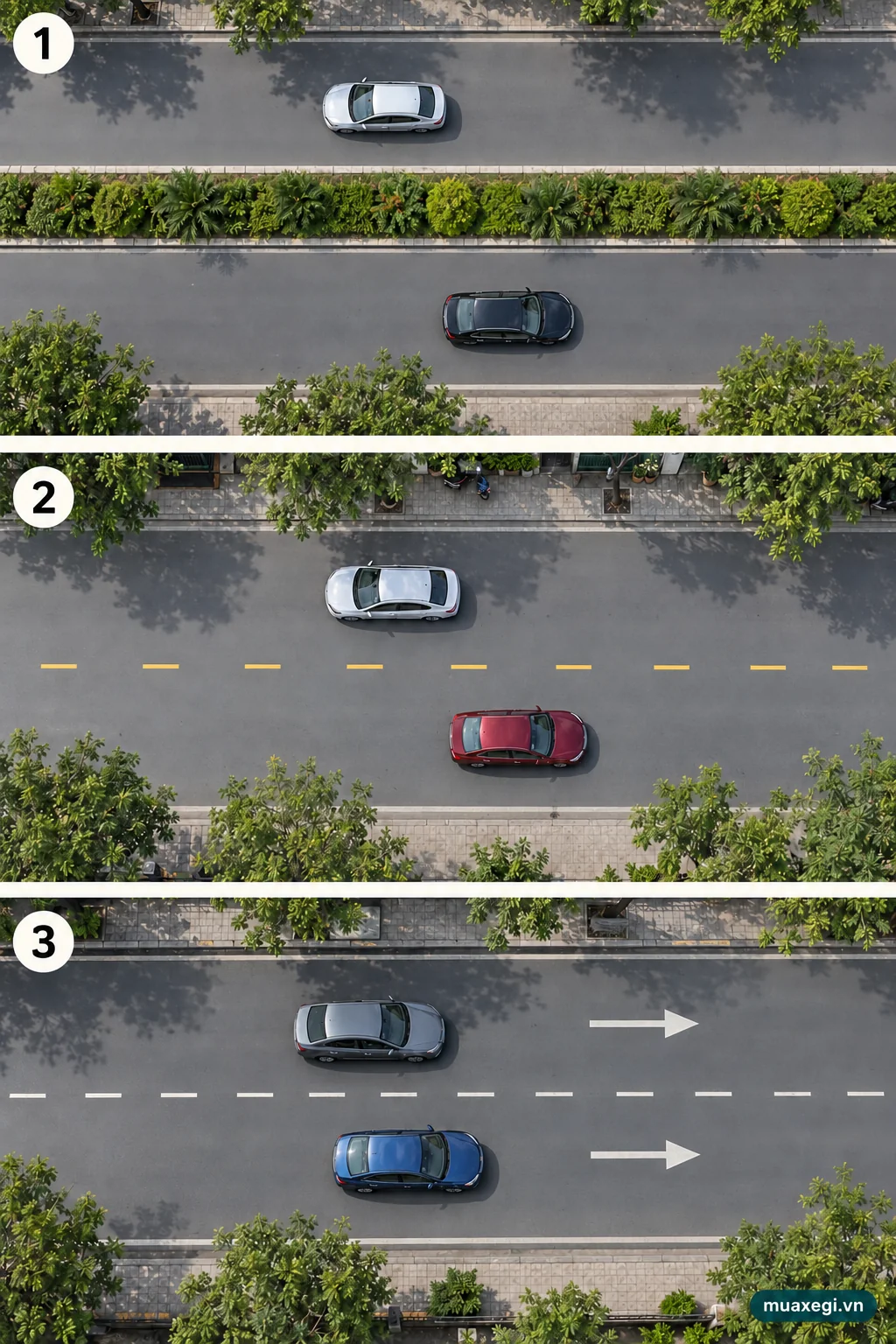
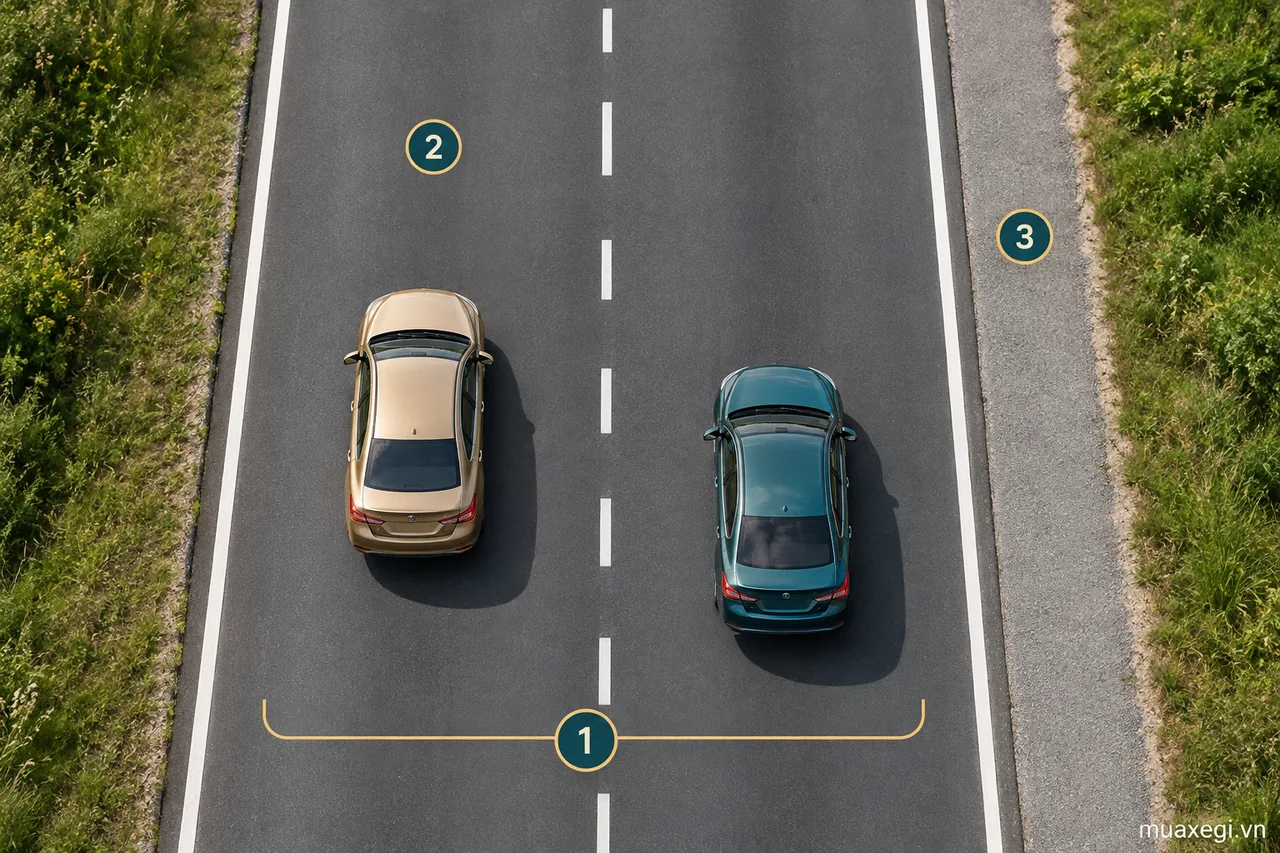
The everyday Vietnamese phrase “a two-way road with a con lươn”—a raised divider—is a useful starting picture for “đường đôi”, a divided road. Keep the exam term in mind: a median separates opposing traffic. Paint alone, even two painted lines, does not make it a divided road. “Đường hai chiều” is an undivided two-way road: both directions share a carriageway without a central median.
Sources: [2] QCVN 41:2024/BGTVT — Road signs and signals; terms, signs and markings
A one-way road, “đường một chiều”, allows traffic in one direction and can have one lane or several. A median is not limited to the familiar concrete divider. Equally, a separator between vehicle groups travelling in the same direction does not by itself establish a divided road: look at what it separates.
Sources: [2] QCVN 41:2024/BGTVT — Road signs and signals; terms, signs and markings
Sources: [2] QCVN 41:2024/BGTVT — Road signs and signals; terms, signs and markings
Change one detail: remove the median in the first picture and replace it with paint. The road category changes even though traffic still travels both ways. To determine the appropriate speed, consider the road category, signs, vehicle type, location and driving conditions.
Sources: [2] QCVN 41:2024/BGTVT — Road signs and signals; terms, signs and markings · [5] Consolidated 74/2026/VBHN-TT-BXD — speeds and safe following distances; Articles 3–11
2.2. Carriageway, lane and shoulder: three different things
Think of “phần đường xe chạy”, the carriageway, as the part used by traffic. Divide it lengthways into strips wide enough for safe travel and you have “làn đường”, lanes. “Lề đường”, the shoulder, lies alongside the carriageway; it is not a lane for passing a queue. “Use the correct carriageway” and “change lanes” refer to different parts of this picture.
Remember it as a whole area and a strip within it. On a road with several same-direction lanes, change only where permitted and into one adjacent lane at a time. Signal first and check ahead, behind and to both sides for safe spacing. Your indicator communicates your intention; it does not make everyone else give way immediately.
Try two short questions: “Which directions does the divider separate? Which lanes does the paint mark?” As a passenger, name a road section, then redraw its two direction arrows at home. If you must reverse an arrow to match the scene, you have found the detail you missed.
2.3. Is moving ahead of another car always “vượt xe”?
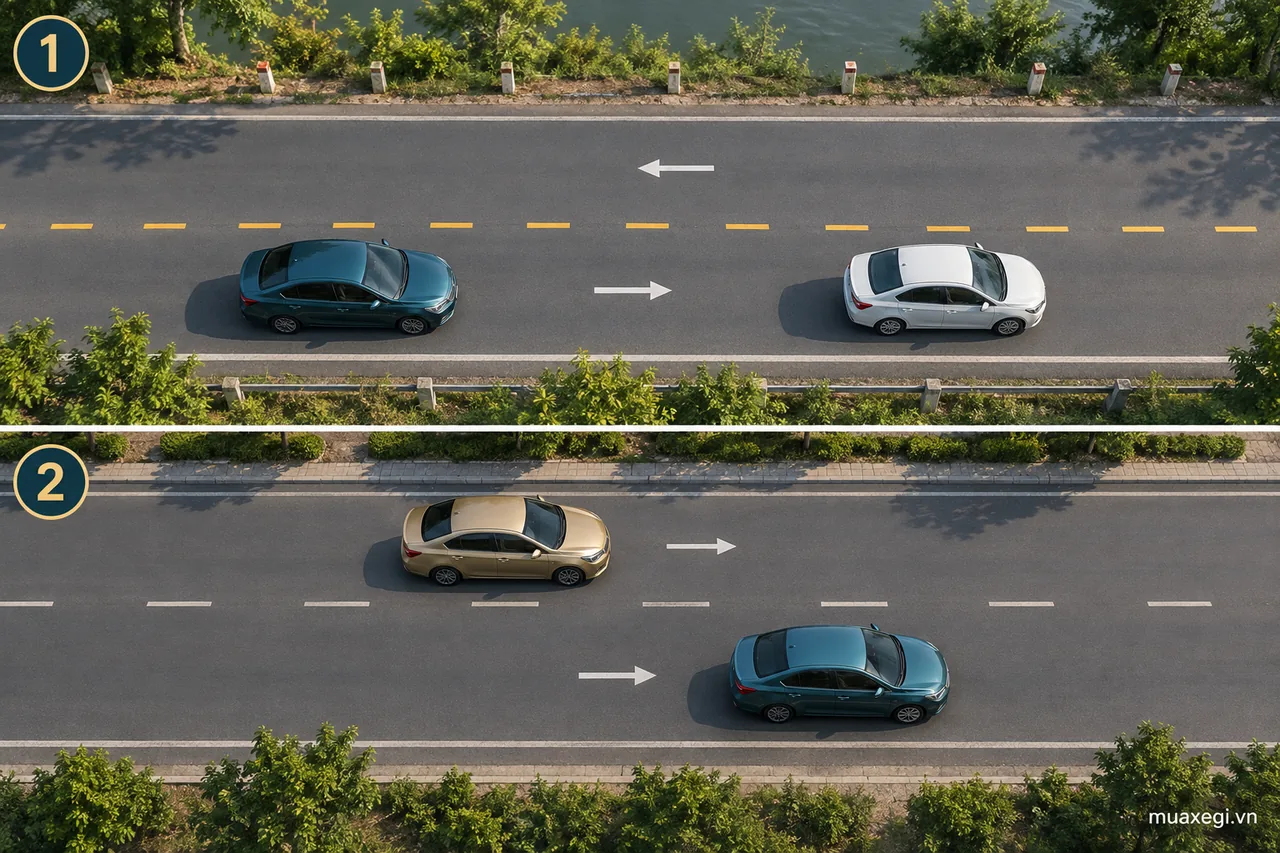
Everyday speech and the legal wording differ here. Article 14 uses “vượt xe” for overtaking on a road with one motor-vehicle lane in each direction, where the following vehicle moves left to pass. Where there are two or more marked motor-vehicle lanes in the same direction, moving ahead is governed by lane-use rules.
Count the lanes in your direction before reading the choices. Whatever you call the manoeuvre, it does not permit weaving, cutting someone off or entering a prohibited lane. On a one-lane-each-way road, a bend hiding the view can change the overtaking decision: you cannot see whether the road ahead is genuinely clear.
3. Read main signs, supplementary plates and restrictions
Signs are normally on the right or above the carriageway; additional left-side signs are used in some situations. Read the signs facing your traffic stream and any arrows, lane, vehicle or time qualifications. An overhead sign may apply specifically to the lane beneath it.
Sources: [2] QCVN 41:2024/BGTVT — Road signs and signals; terms, signs and markings
3.1. Prohibition signs: identify the code and official name before applying the rule
A car symbol does not necessarily mean passenger cars alone, and a motorcycle symbol does not mean every powered vehicle. I suggest four questions: what is the code, what is the official name, which vehicles or manoeuvres does it cover, and what location, time or exceptions qualify it? There is no universal rule that banning a smaller vehicle also bans larger ones.
Sources: [2] QCVN 41:2024/BGTVT — Road signs and signals; terms, signs and markings
In the names below, “xe máy” on P.104 refers to motorcycles and must be distinguished from “xe gắn máy”, the moped category. Where an exception covers vehicles with statutory priority, the vehicle, duty and conditions for exercising that priority must qualify. Vietnamese names are retained as the official labels; the English descriptions explain their meaning.
Sources: [1] Road Traffic Order and Safety Law — consolidated 55/VBHN-VPQH; Articles 2, 11, 13–18, 22, 24–27, 34, 57 and 89 · [2] QCVN 41:2024/BGTVT — Road signs and signals; terms, signs and markings

3.2. Automobile and motorcycle bans: short names, different scopes
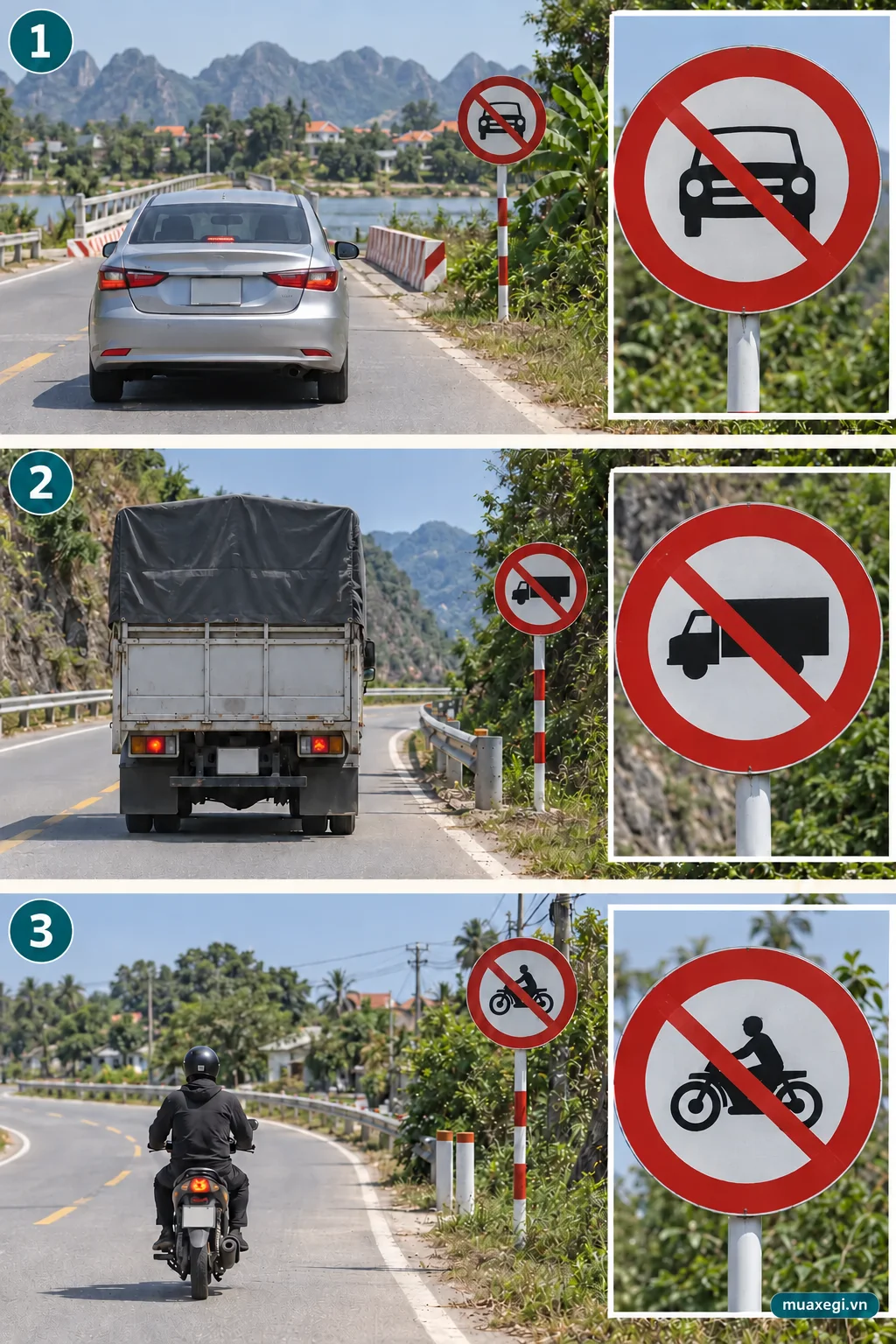
- P.103a — “Cấm xe ô tô” (automobiles prohibited): its scope covers motor vehicles, explicitly including three-wheeled motorcycles with a sidecar/body, except two-wheeled motorcycles, mopeds and vehicles with statutory priority. Passenger cars, trucks and the specified three-wheeled motorcycles are therefore covered. The label “passenger cars prohibited” would incorrectly narrow its scope.
- P.104 — “Cấm xe máy” (motorcycles prohibited): prohibits motorcycles, except vehicles with statutory priority; it does not prohibit people walking and pushing a motorcycle. It is not the moped prohibition, and it does not prohibit automobiles merely because they are larger than motorcycles.
- P.111a — “Cấm xe gắn máy” (mopeds prohibited): prohibits vehicles in the moped category; it does not apply to bicycles. Distinguish this code from P.104 — “Cấm xe máy”, even though everyday Vietnamese may call both categories “xe máy”.
Sources: [1] Road Traffic Order and Safety Law — consolidated 55/VBHN-VPQH; Articles 2, 11, 13–18, 22, 24–27, 34, 57 and 89 · [2] QCVN 41:2024/BGTVT — Road signs and signals; terms, signs and markings
To identify a moped, read “50” together with the specification it describes. It must have two or three wheels and a design speed no greater than 50 km/h. A combustion engine must have a working or equivalent capacity no greater than 50 cm³; an electric motor must have power no greater than 4 kW. The moped category excludes motor-assisted bicycles. A 50 cm³ machine designed for 60 km/h therefore does not meet the moped definition, and an electric scooter is not automatically a moped.
Sources: [2] QCVN 41:2024/BGTVT — Road signs and signals; terms, signs and markings
3.3. Truck signs: separate vehicle category, certified payload and actual total weight
- P.106a — “Cấm xe ô tô tải” (trucks prohibited): prohibits trucks, except vehicles with statutory priority, and also prohibits tractors and special-purpose machines from entering the signed section. The truck symbol has no tonnage, so the sign sets no 2.5 t or 3.5 t threshold. An empty truck remains a truck.
- P.106b — “Cấm xe ô tô tải” (trucks prohibited, with a payload threshold): carries a white tonnage on the truck symbol. For trucks, compare it with the payload stated on the technical safety and environmental inspection certificate; a greater certified payload is prohibited. Today’s cargo, unladen weight and total vehicle weight are different quantities from the certified payload. The sign also prohibits tractors and special-purpose machines; the truck-payload comparison creates no exception for light tractors.
- P.115 — “Hạn chế trọng tải toàn bộ xe” (total vehicle weight limit): prohibits motor and non-motor vehicles, including vehicles with statutory priority, whose actual combined weight of vehicle, people, luggage and cargo exceeds the posted tonnage. It is not a certified cargo-payload limit. At 3.5 t, an actual total of 3.6 t exceeds the threshold; exactly 3.5 t does not exceed this sign’s threshold.
Sources: [2] QCVN 41:2024/BGTVT — Road signs and signals; terms, signs and markings
Both P.106b — “Cấm xe ô tô tải” and P.115 — “Hạn chế trọng tải toàn bộ xe” use a strictly greater-than threshold, not “at or above”. What differs is the quantity being compared. Passing one comparison does not override other signs, axle limits, bridge restrictions or loading rules.
Sources: [2] QCVN 41:2024/BGTVT — Road signs and signals; terms, signs and markings
Sources: [2] QCVN 41:2024/BGTVT — Road signs and signals; terms, signs and markings
3.4. How does a left-turn ban differ from a U-turn ban?
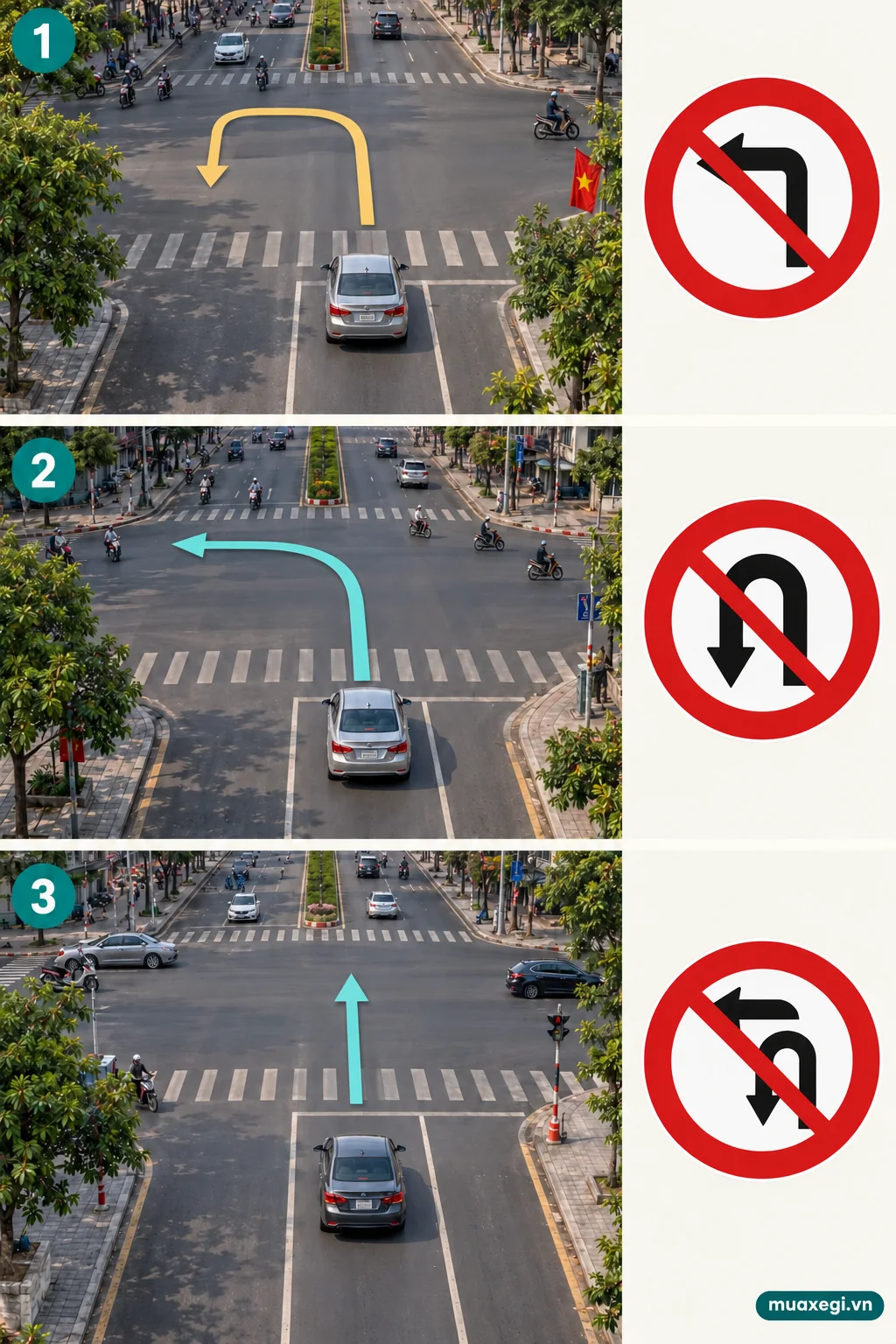
A left turn takes you into a different road direction on your left; a U-turn reverses your direction of travel. Look at the arrow crossed out on the sign. A ban on one manoeuvre does not automatically ban both.
Sources: [2] QCVN 41:2024/BGTVT — Road signs and signals; terms, signs and markings
- P.123a — “Cấm rẽ trái” (no left turn): prohibits motor and non-motor vehicles from turning left at the junction covered by the sign, except vehicles with statutory priority. It does not prohibit U-turns.
- P.124a — “Cấm quay đầu xe” (no U-turn): prohibits motor and non-motor vehicles from making a U-turn in the arrow’s direction, except vehicles with statutory priority. It does not prohibit turning left into a different road direction.
- P.124b — “Cấm ô tô quay đầu xe” (no automobile U-turn): covers automobiles and three-wheeled motorcycles with a sidecar, except vehicles with statutory priority. It does not prohibit left turns.
- P.124c — “Cấm rẽ trái và quay đầu xe” (no left turn or U-turn): prohibits both manoeuvres for all vehicle types. Its symbol combines a left-turn branch and a U-turn branch; it is not just another drawing of a single-manoeuvre prohibition.
Sources: [2] QCVN 41:2024/BGTVT — Road signs and signals; terms, signs and markings
Sources: [2] QCVN 41:2024/BGTVT — Road signs and signals; terms, signs and markings
“This sign does not prohibit it” is not “do it immediately”. Before turning or making a U-turn, observe, maintain a safe distance from the vehicle behind, slow down, signal throughout the manoeuvre and move gradually into the lane nearest the intended turn. Yield to pedestrians, non-motor vehicles and oncoming traffic; turn only without obstructing or endangering others. Signals, road markings and other signs still apply.
Article 15 also prohibits U-turns on pedestrian crossings; on bridges, at bridge ends, beneath flyovers and at road fords; at level crossings with railways; on narrow roads, sloping roads and bends with obstructed visibility; and on expressways, in road tunnels and on one-way roads. Its stated exception is a traffic controller’s direction or temporary-sign instruction. P.123a — “Cấm rẽ trái” does not cancel these U-turn prohibitions.
Sources: [1] Road Traffic Order and Safety Law — consolidated 55/VBHN-VPQH; Articles 2, 11, 13–18, 22, 24–27, 34, 57 and 89 · [2] QCVN 41:2024/BGTVT — Road signs and signals; terms, signs and markings
3.5. Supplementary plates: distance ahead, section length and operating times
- S.502 — “Khoảng cách đến đối tượng báo hiệu” (distance to the indicated object): gives the actual distance from the sign to the object ahead. Under an advance prohibition sign, 200 m means the prohibition starts 200 m ahead; it does not mean a restriction lasting only 200 m.
- S.501 — “Phạm vi tác dụng của biển” (length of the applicable section): states the length of a hazard, prohibition, mandatory instruction or restriction for an appropriate main sign. The 800 m between two arrows means an 800 m section; it does not allow another 800 m before compliance.
- S.508a, S.508b — “Biểu thị thời gian” (times of application): qualify when the prohibition or mandatory sign above applies. Read every time window, odd/even date, weekday or other stated time condition. A plate showing only 06:00–09:00 does not automatically include 16:00–19:00.
- S.503a, S.503b, S.503c, S.503d, S.503e, S.503f — “Hướng tác dụng của biển” (direction of application): identify the exact variant. The a/b/c group indicates application perpendicular to travel; d/e/f are used with the specified U-turn, stopping and parking prohibitions to show application parallel to travel. S.503e beneath a repeated stopping/parking prohibition indicates application both before and after the sign; it is not an instruction to turn.
Sources: [2] QCVN 41:2024/BGTVT — Road signs and signals; terms, signs and markings
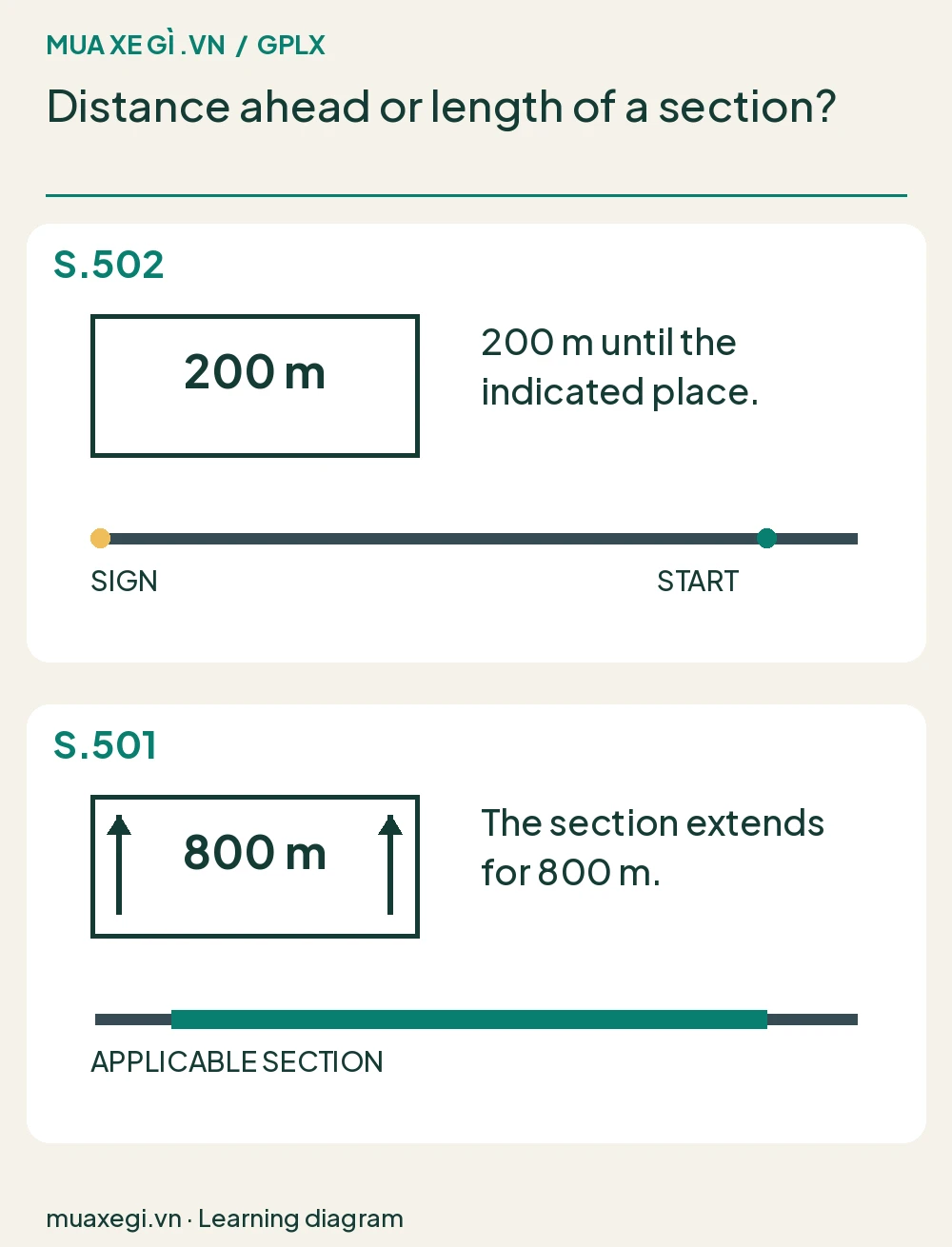
Sources: [2] QCVN 41:2024/BGTVT — Road signs and signals; terms, signs and markings
A prohibition normally begins at its sign in the applicable direction; an advance sign must be read with S.502 — “Khoảng cách đến đối tượng báo hiệu”. P.123a — “Cấm rẽ trái” concerns the signed location. For P.124a — “Cấm quay đầu xe”, P.124b — “Cấm ô tô quay đầu xe” and P.124c — “Cấm rẽ trái và quay đầu xe”, consider the junction, median opening or corresponding extent instructions. The extent “until the next junction” applies only where that sign’s rules specify it.
Sources: [2] QCVN 41:2024/BGTVT — Road signs and signals; terms, signs and markings
For the vehicle, dimension and weight prohibition group P.101–P.120, the regulation does not require a defined extent or an end-of-prohibition sign. This group includes P.103a, P.104, P.106a, P.106b, P.111a and P.115, explained above.
Sources: [2] QCVN 41:2024/BGTVT — Road signs and signals; terms, signs and markings
3.6. Read the full names on speed, stopping and parking pairs
- P.127 — “Tốc độ tối đa cho phép” (maximum permitted speed): prohibits motor vehicles from exceeding the posted km/h, except vehicles with statutory priority. The number is a ceiling, not a target; weather, road surface and traffic may require a lower speed.
- R.306 — “Tốc độ tối thiểu cho phép” (minimum permitted speed): motor vehicles must travel at no less than the posted km/h when traffic conditions are favourable and safe. Vehicles whose manufacturer-specified maximum cannot reach that speed may not enter.
- DP.134 — “Hết tốc độ tối đa cho phép” (end of the posted maximum speed): ends the preceding P.127 — “Tốc độ tối đa cho phép”. The general limits appropriate to the vehicle and road, and other applicable signs, still govern; it does not mean unlimited speed.
- R.307 — “Hết tốc độ tối thiểu” (end of minimum speed): ends R.306 — “Tốc độ tối thiểu cho phép”. You may travel below the minimum that has ended, but must not obstruct other vehicles.
- P.130 — “Cấm dừng xe và đỗ xe” (no stopping or parking): prohibits motor vehicles from stopping or parking on the signed side, except vehicles with statutory priority; scheduled buses are directed to an appropriate stopping position. Its red X distinguishes it from a parking-only prohibition.
- P.131a — “Cấm đỗ xe” (no parking): prohibits motor vehicles from parking on the signed side, except vehicles with statutory priority. Its single red diagonal does not itself prohibit stopping, but stopping must still satisfy the general location and safety rules.
Sources: [1] Road Traffic Order and Safety Law — consolidated 55/VBHN-VPQH; Articles 2, 11, 13–18, 22, 24–27, 34, 57 and 89 · [2] QCVN 41:2024/BGTVT — Road signs and signals; terms, signs and markings
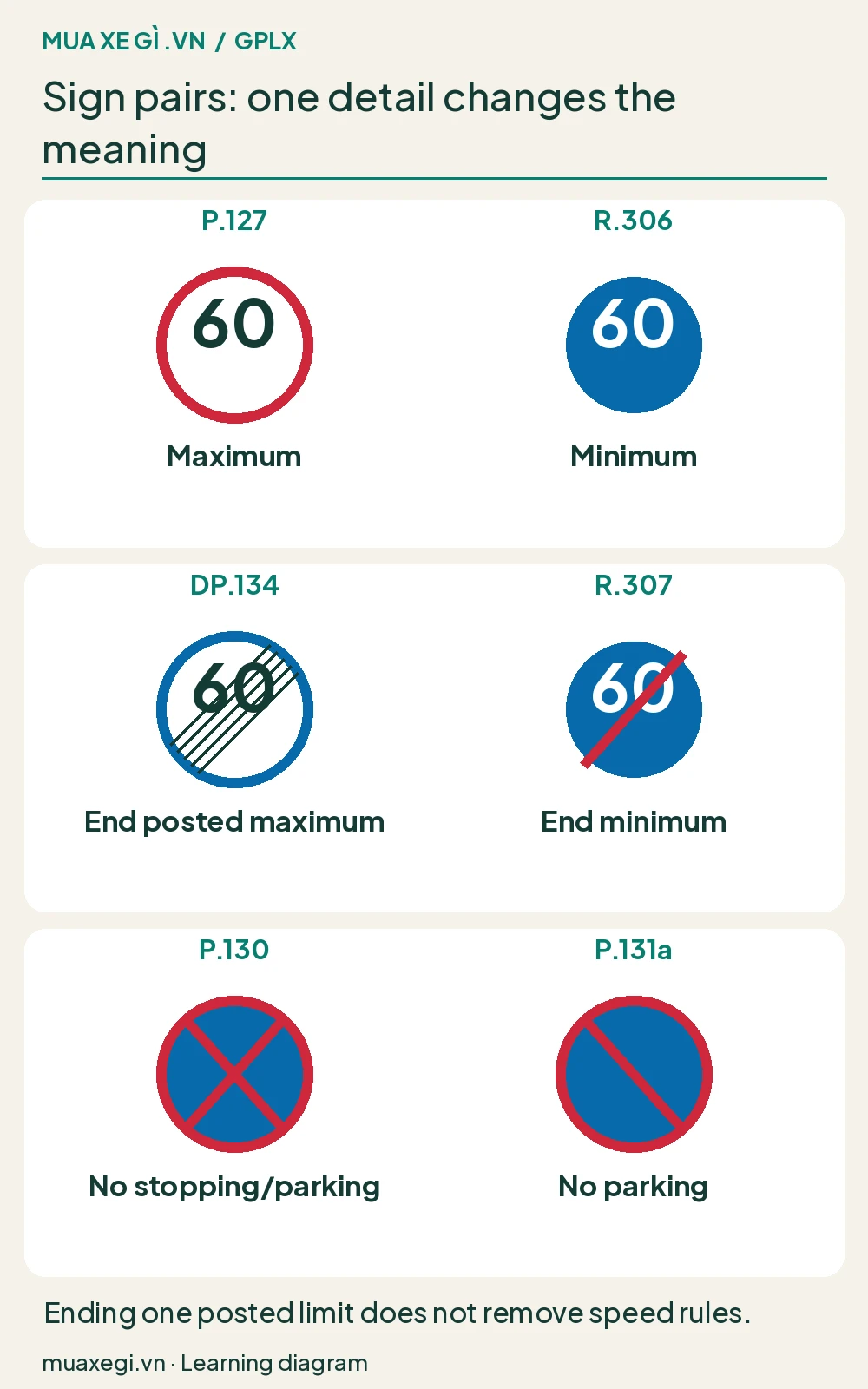
Sources: [2] QCVN 41:2024/BGTVT — Road signs and signals; terms, signs and markings
P.130 — “Cấm dừng xe và đỗ xe” and P.131a — “Cấm đỗ xe” normally apply from the sign to a junction or designated stopping/parking location; read any supplementary plates or applicable cancellation signs as well. Alleys, gateways and property access points do not automatically count as junctions that cancel the restriction. When a restriction continues across a junction, it must be repeated afterwards, subject to specific provisions or supplementary plates.
Sources: [2] QCVN 41:2024/BGTVT — Road signs and signals; terms, signs and markings
3.7. Four adapted questions: change the facts and test the sign’s scope
These are four original, adapted exam-style situations, not verbatim official questions or verified question-bank IDs. Unless stated otherwise, assume no vehicle is exercising statutory priority, no other traffic instruction changes the answer and the vehicles meet all remaining conditions for travel. Choose before reading the explanation.

3.8. Question 1 — Two entrances, the same four vehicles
Entrance A has P.103a — “Cấm xe ô tô”; entrance B has P.104 — “Cấm xe máy”. The vehicles are a passenger car, a two-wheeled 125 cm³ motorcycle, a two-wheeled 50 cm³ moped designed for 45 km/h, and a three-wheeled motorcycle with a sidecar. Considering only those signs, which statement is correct?
Sources: [1] Road Traffic Order and Safety Law — consolidated 55/VBHN-VPQH; Articles 2, 11, 13–18, 22, 24–27, 34, 57 and 89 · [2] QCVN 41:2024/BGTVT — Road signs and signals; terms, signs and markings
- A. Entrance A prohibits only the car; entrance B prohibits all four because larger vehicles are also banned.
- B. Entrance A prohibits the car and sidecar motorcycle; entrance B prohibits the 125 cm³ motorcycle and sidecar motorcycle.
- C. Entrance A prohibits every powered vehicle; entrance B prohibits every powered two-wheeler.
Answer B. P.103a — “Cấm xe ô tô” has a broad scope but excludes two-wheeled motorcycles and mopeds. P.104 — “Cấm xe máy” covers motorcycles, not automobiles or mopeds by extension. The 45 km/h design speed together with 50 cm³ identifies the moped. Its current speed does not determine its category.
Sources: [1] Road Traffic Order and Safety Law — consolidated 55/VBHN-VPQH; Articles 2, 11, 13–18, 22, 24–27, 34, 57 and 89 · [2] QCVN 41:2024/BGTVT — Road signs and signals; terms, signs and markings
Sources: [2] QCVN 41:2024/BGTVT — Road signs and signals; terms, signs and markings
3.9. Question 2 — Tonnes of what?
Consider two independent routes: X has P.106b — “Cấm xe ô tô tải” displaying 2.5 t; Y has P.115 — “Hạn chế trọng tải toàn bộ xe” displaying 3.5 t. Truck A has a certified payload of 4 t and an actual total of 2.8 t; B has 2 t and 3.8 t respectively; C has 2.5 t and 3.5 t. Actual totals already include the vehicle, people, luggage and cargo. Which option correctly identifies the prohibited trucks?
Sources: [2] QCVN 41:2024/BGTVT — Road signs and signals; terms, signs and markings
- A. X prohibits A; Y prohibits B.
- B. X prohibits A and C; Y prohibits B and C.
- C. Both routes prohibit only B because it is currently the heaviest.
Answer A. On X, A’s certified 4 t exceeds 2.5 t even though it is currently light; B and C do not exceed the certified-payload threshold. On Y, B’s actual 3.8 t exceeds 3.5 t; A and C do not exceed the total-weight threshold. C is exactly at both limits, so neither threshold alone prohibits it. Unloading can change the result under P.115 — “Hạn chế trọng tải toàn bộ xe”, but does not change the certified payload used for P.106b — “Cấm xe ô tô tải”.
Sources: [2] QCVN 41:2024/BGTVT — Road signs and signals; terms, signs and markings
Sources: [2] QCVN 41:2024/BGTVT — Road signs and signals; terms, signs and markings
3.10. Question 3 — Read the location, length and time together
At metre 0, P.130 — “Cấm dừng xe và đỗ xe” is accompanied by S.502 — “Khoảng cách đến đối tượng báo hiệu” showing 200 m and S.508a — “Biểu thị thời gian” showing 06:00–09:00. At metre 200, P.130 is repeated with S.501 — “Phạm vi tác dụng của biển” showing 800 m and the same time window. There is no intervening junction or other endpoint. A car wants to stop voluntarily to collect a passenger at metre 500 on the signed side. Which statement is correct?
Sources: [2] QCVN 41:2024/BGTVT — Road signs and signals; terms, signs and markings
- A. The prohibition lasts only 200 m, so metre 500 is always outside it.
- B. The restricted section runs from metre 200 to metre 1,000 during 06:00–09:00; collecting a passenger at metre 500 at 07:30 is prohibited.
- C. At 10:00 you may stop anywhere because the sign’s hours have ended.
Answer B. S.502 — “Khoảng cách đến đối tượng báo hiệu” gives the distance to the start; S.501 — “Phạm vi tác dụng của biển” gives the length from the stated start: 200 + 800 = 1,000 m. S.508a — “Biểu thị thời gian” limits the operating hours. At 10:00 this sign assembly alone does not prohibit stopping, but stopping remains prohibited wherever the law or other instructions prohibit it.
Sources: [1] Road Traffic Order and Safety Law — consolidated 55/VBHN-VPQH; Articles 2, 11, 13–18, 22, 24–27, 34, 57 and 89 · [2] QCVN 41:2024/BGTVT — Road signs and signals; terms, signs and markings
Sources: [2] QCVN 41:2024/BGTVT — Road signs and signals; terms, signs and markings
3.11. Question 4 — U-turn conditions: check the sign and the location
Three separate junctions display P.123a — “Cấm rẽ trái”, P.124a — “Cấm quay đầu xe” and P.124c — “Cấm rẽ trái và quay đầu xe” respectively. First consider only the manoeuvres each sign prohibits. Then, at the first junction, a driver proposes a U-turn directly on a pedestrian crossing, with no traffic-controller direction or temporary sign allowing otherwise. Which option is correct?
Sources: [1] Road Traffic Order and Safety Law — consolidated 55/VBHN-VPQH; Articles 2, 11, 13–18, 22, 24–27, 34, 57 and 89 · [2] QCVN 41:2024/BGTVT — Road signs and signals; terms, signs and markings
- A. The first sign does not prohibit U-turns, so a U-turn directly on the pedestrian crossing is allowed.
- B. The second sign prohibits U-turns and therefore also left turns; the third merely repeats that rule.
- C. The first prohibits left turns, the second U-turns, and the third both; nevertheless, the proposed U-turn on the pedestrian crossing is prohibited by law.
Answer C. Separate “which manoeuvre does this sign prohibit?” from “does another rule prohibit that manoeuvre here?”. P.123a — “Cấm rẽ trái” does not prohibit a U-turn, but Article 15 still prohibits the proposed U-turn on the pedestrian crossing.
Sources: [1] Road Traffic Order and Safety Law — consolidated 55/VBHN-VPQH; Articles 2, 11, 13–18, 22, 24–27, 34, 57 and 89 · [2] QCVN 41:2024/BGTVT — Road signs and signals; terms, signs and markings
Sources: [2] QCVN 41:2024/BGTVT — Road signs and signals; terms, signs and markings
4. Work through junctions: signals, movements and priority
4.1. A priority road is different from a priority vehicle
A priority road, “đường ưu tiên”, is identified through road signs, not simply its width or traffic volume. A priority vehicle, “xe ưu tiên”, involves the vehicle and the conditions of its duty. For example, an ambulance on an emergency mission with the required priority signals is different from a vehicle merely carrying ambulance markings. Read those conditions in the question.
Sources: [1] Road Traffic Order and Safety Law — consolidated 55/VBHN-VPQH; Articles 2, 11, 13–18, 22, 24–27, 34, 57 and 89 · [2] QCVN 41:2024/BGTVT — Road signs and signals; terms, signs and markings
Before deciding which vehicle is on the right, look for a traffic officer, lights and signs. An officer’s directions take precedence over lights; lights over signs; signs over road markings and other surface indications. That is why “the vehicle on the right always goes first” cannot explain every junction.
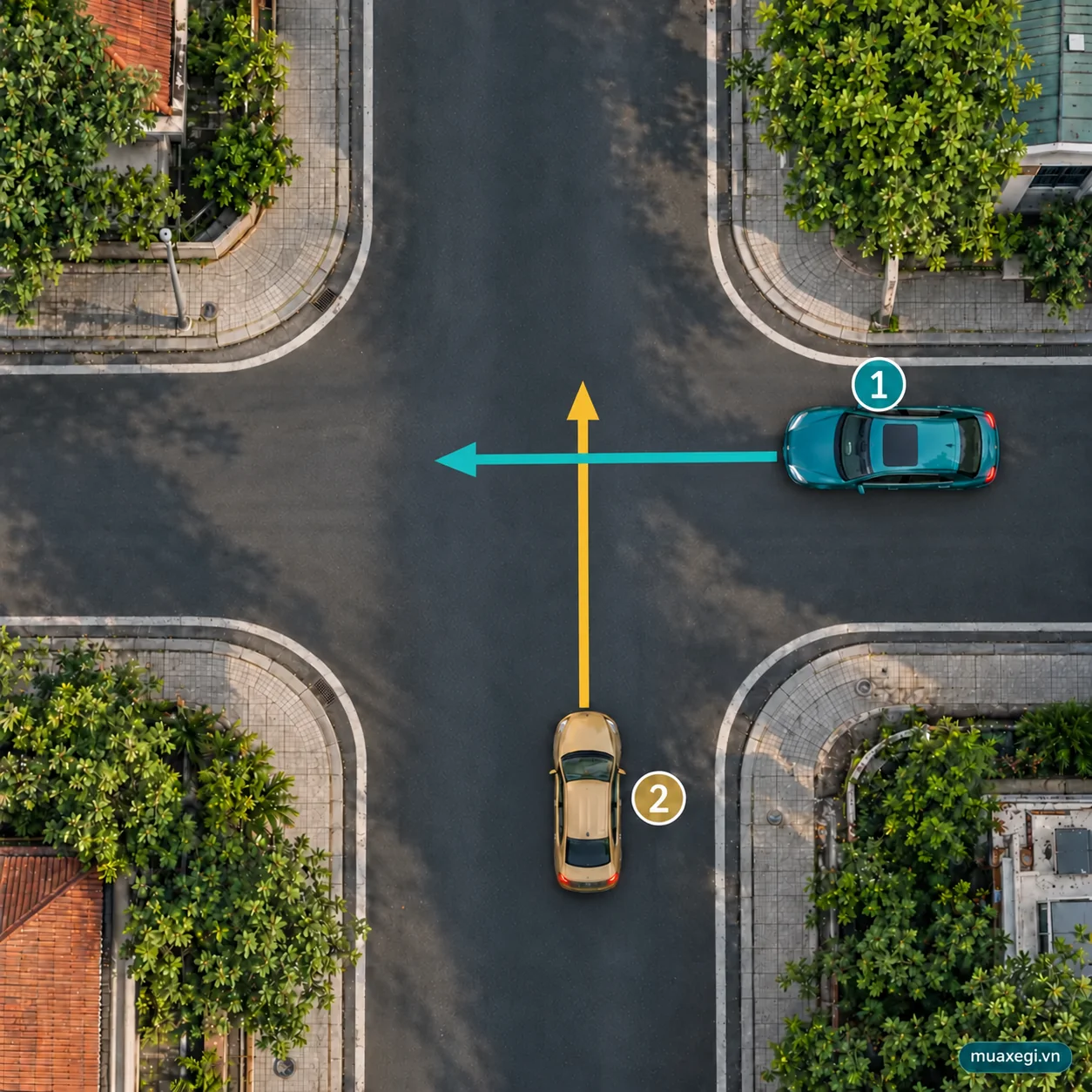
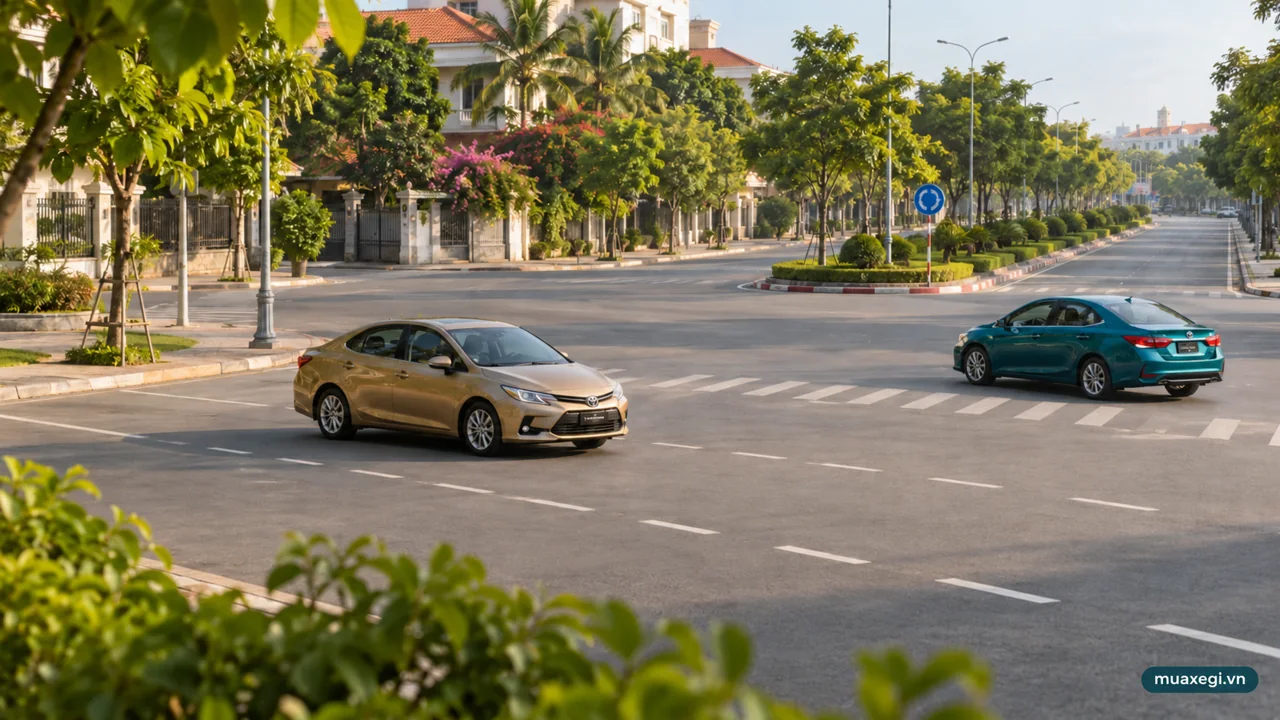
In this example, A slows and yields to B approaching from the right. If signs make A’s road the priority road, reassess the situation using those signs. At a junction with roundabout instructions, yield to traffic approaching from the left.
4.2. T-junctions and crossroads: who goes first, and why?
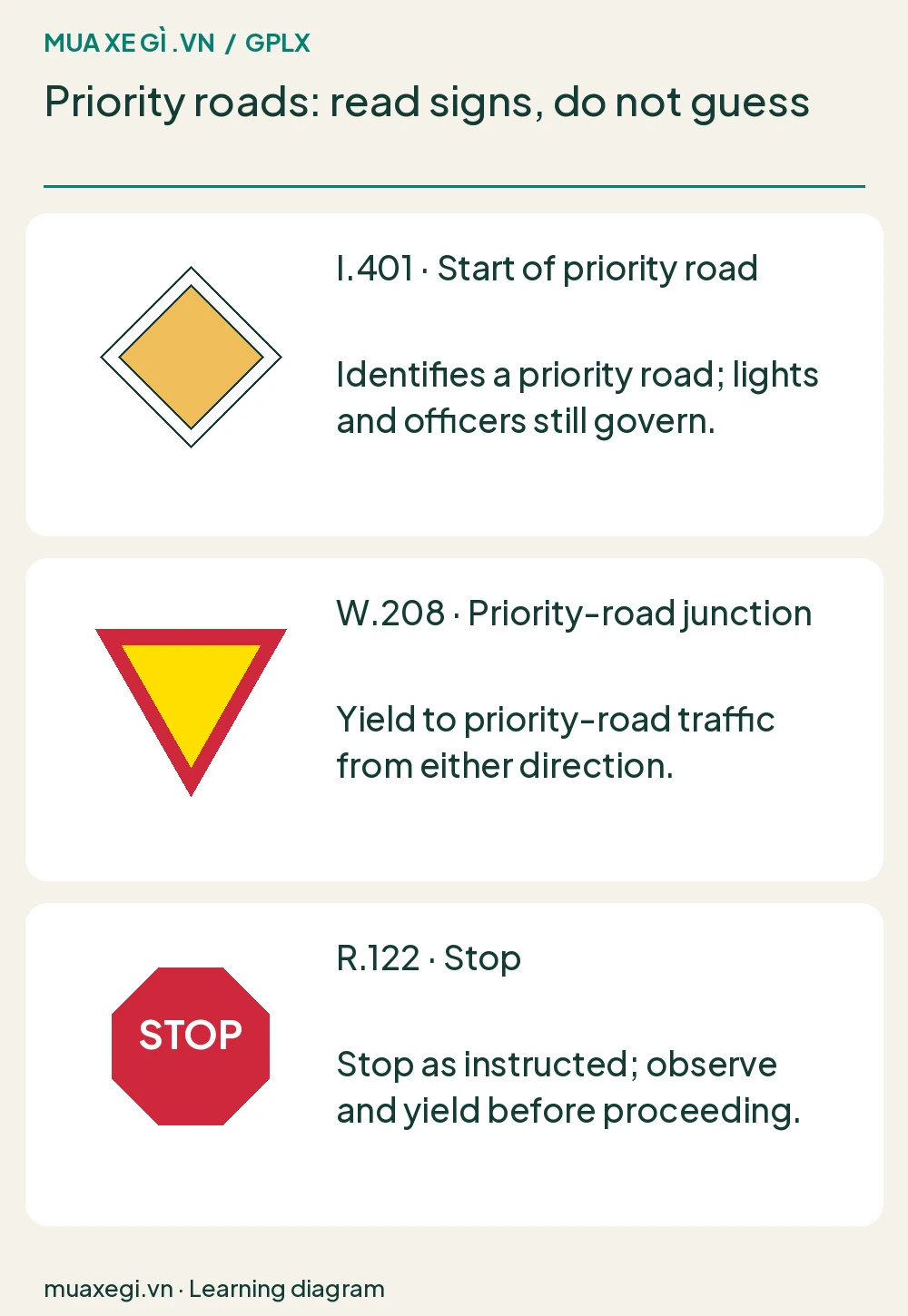
Sources: [1] Road Traffic Order and Safety Law — consolidated 55/VBHN-VPQH; Articles 2, 11, 13–18, 22, 24–27, 34, 57 and 89 · [2] QCVN 41:2024/BGTVT — Road signs and signals; terms, signs and markings
I start a diagram with four tasks: find the traffic officer and instructions; identify qualifying priority vehicles; establish any priority or main road; then consider movements and yielding rules.
Sources: [1] Road Traffic Order and Safety Law — consolidated 55/VBHN-VPQH; Articles 2, 11, 13–18, 22, 24–27, 34, 57 and 89 · [2] QCVN 41:2024/BGTVT — Road signs and signals; terms, signs and markings
- With an officer directing traffic, follow the officer even if a light differs. With working lights, follow them; when the light permits you to proceed, you must still observe and yield as the situation requires.
- At a priority/main road, a vehicle entering from a non-priority/branch road yields to vehicles on the priority/main road from either direction. Inverted triangle W.208 indicates a junction with a priority road; STOP R.122 requires stopping, not merely easing off the accelerator.
- At an equal-priority T-junction or crossroads without roundabout instructions or other controlling directions, yield to traffic from the driver’s right. A long straight line on a diagram does not by itself make that road the main road.
- When turning left, right or making a U-turn, also yield to pedestrians, non-motor vehicles and oncoming traffic, and turn only without obstructing or endangering others. If two opposing vehicles may proceed and one turns left across the straight-ahead vehicle’s path, the left-turning vehicle yields.
Sources: [1] Road Traffic Order and Safety Law — consolidated 55/VBHN-VPQH; Articles 2, 11, 13–18, 22, 24–27, 34, 57 and 89 · [2] QCVN 41:2024/BGTVT — Road signs and signals; terms, signs and markings
4.3. Crossroads: change the signs and the order can reverse
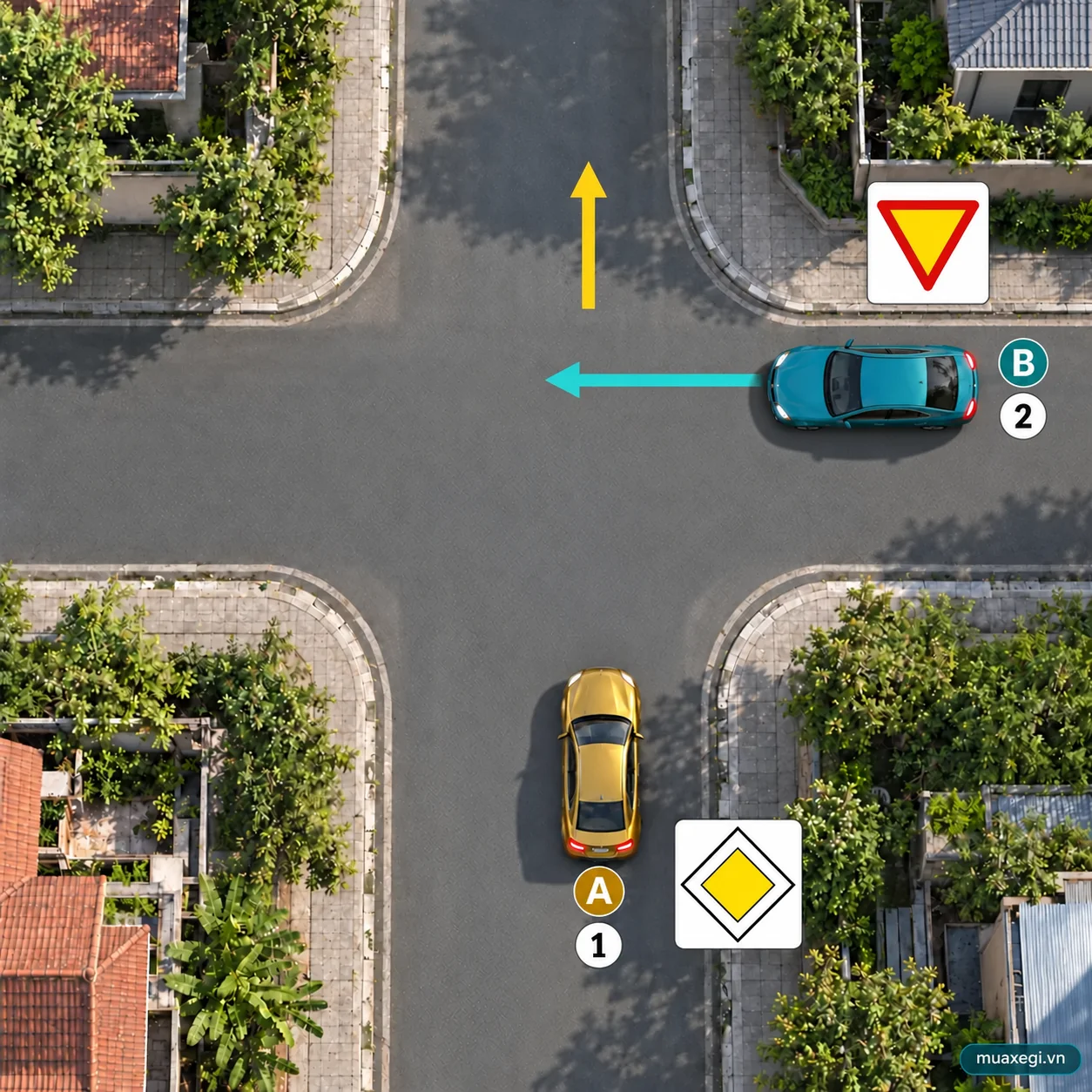
Sources: [1] Road Traffic Order and Safety Law — consolidated 55/VBHN-VPQH; Articles 2, 11, 13–18, 22, 24–27, 34, 57 and 89 · [2] QCVN 41:2024/BGTVT — Road signs and signals; terms, signs and markings
The priority signs change the answer. At the equal-priority junction, gold yields right. With priority-road signs, teal yields to the priority road. Cover the 1–2 labels and explain why before looking again.
Sources: [1] Road Traffic Order and Safety Law — consolidated 55/VBHN-VPQH; Articles 2, 11, 13–18, 22, 24–27, 34, 57 and 89 · [2] QCVN 41:2024/BGTVT — Road signs and signals; terms, signs and markings
4.4. Two similar T-junctions, different facts to read
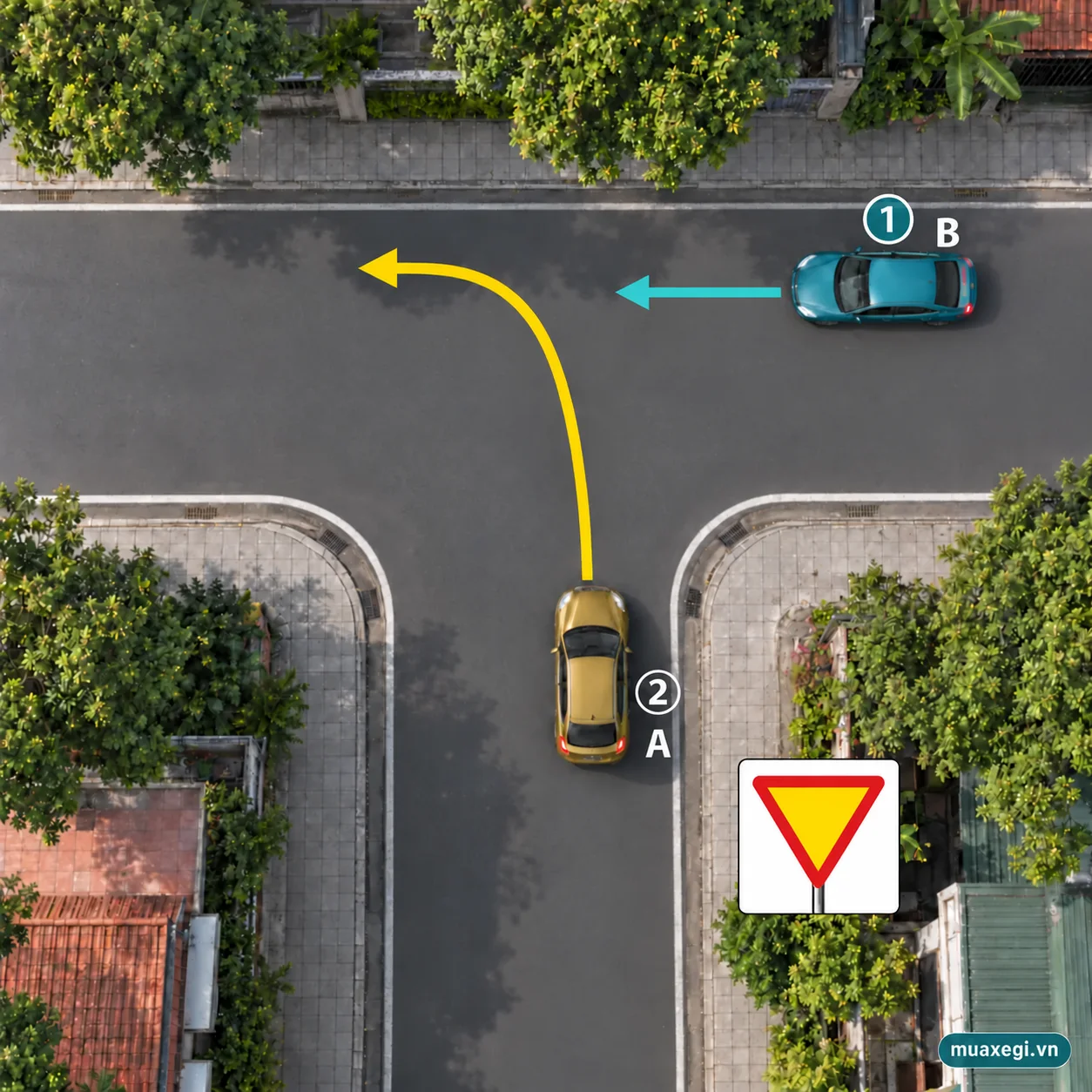
Sources: [1] Road Traffic Order and Safety Law — consolidated 55/VBHN-VPQH; Articles 2, 11, 13–18, 22, 24–27, 34, 57 and 89 · [2] QCVN 41:2024/BGTVT — Road signs and signals; terms, signs and markings
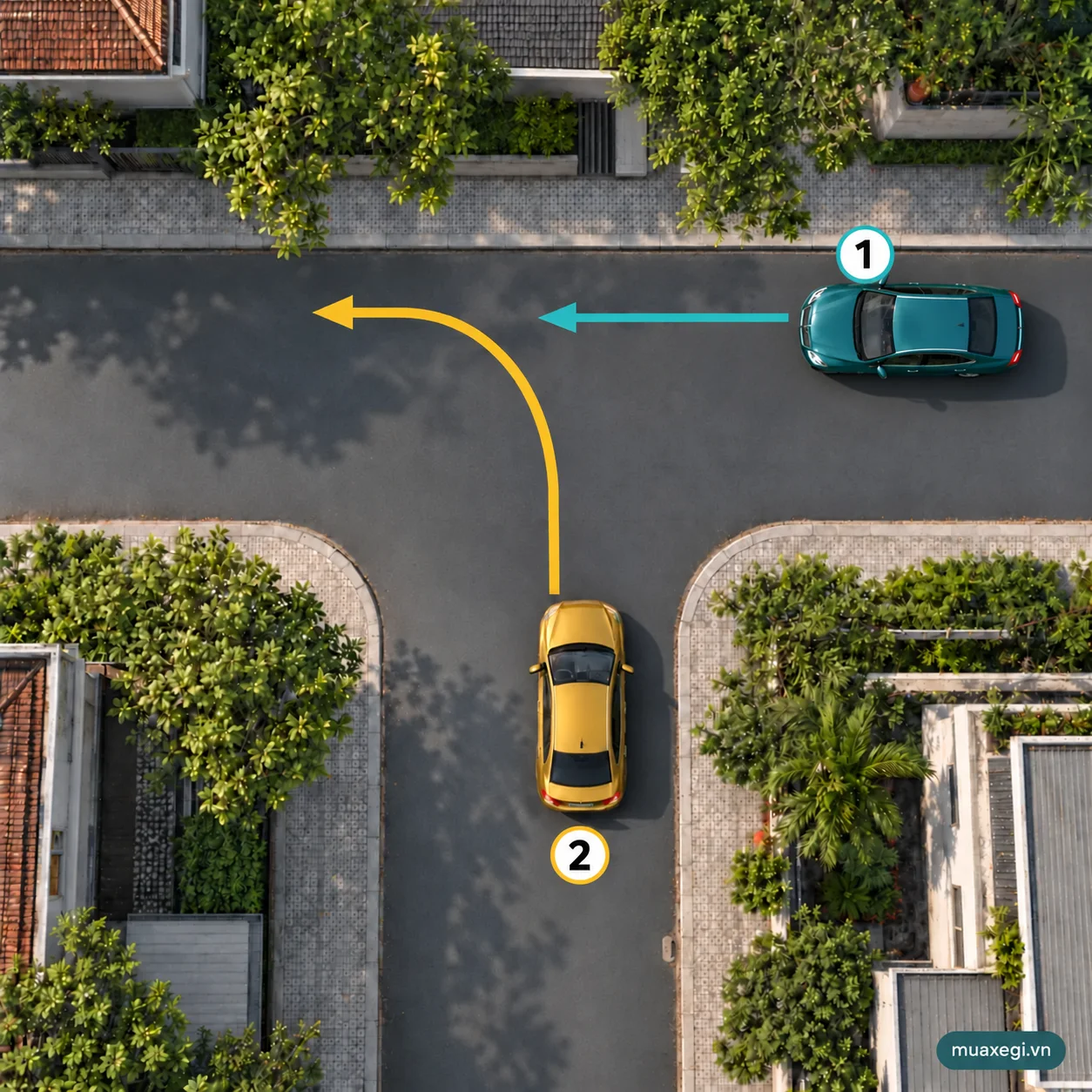
4.5. What if a vehicle is already in the junction?
Before ordering the vehicles, look for one already inside the intersection. A vehicle that entered lawfully and is clearing it is in a different position from one still waiting outside. If its exit is clear, allow it to clear safely and keep its path open. In a theory diagram, consider both the vehicle’s current position and its type.
Sources: [1] Road Traffic Order and Safety Law — consolidated 55/VBHN-VPQH; Articles 2, 11, 13–18, 22, 24–27, 34, 57 and 89 · [2] QCVN 41:2024/BGTVT — Road signs and signals; terms, signs and markings
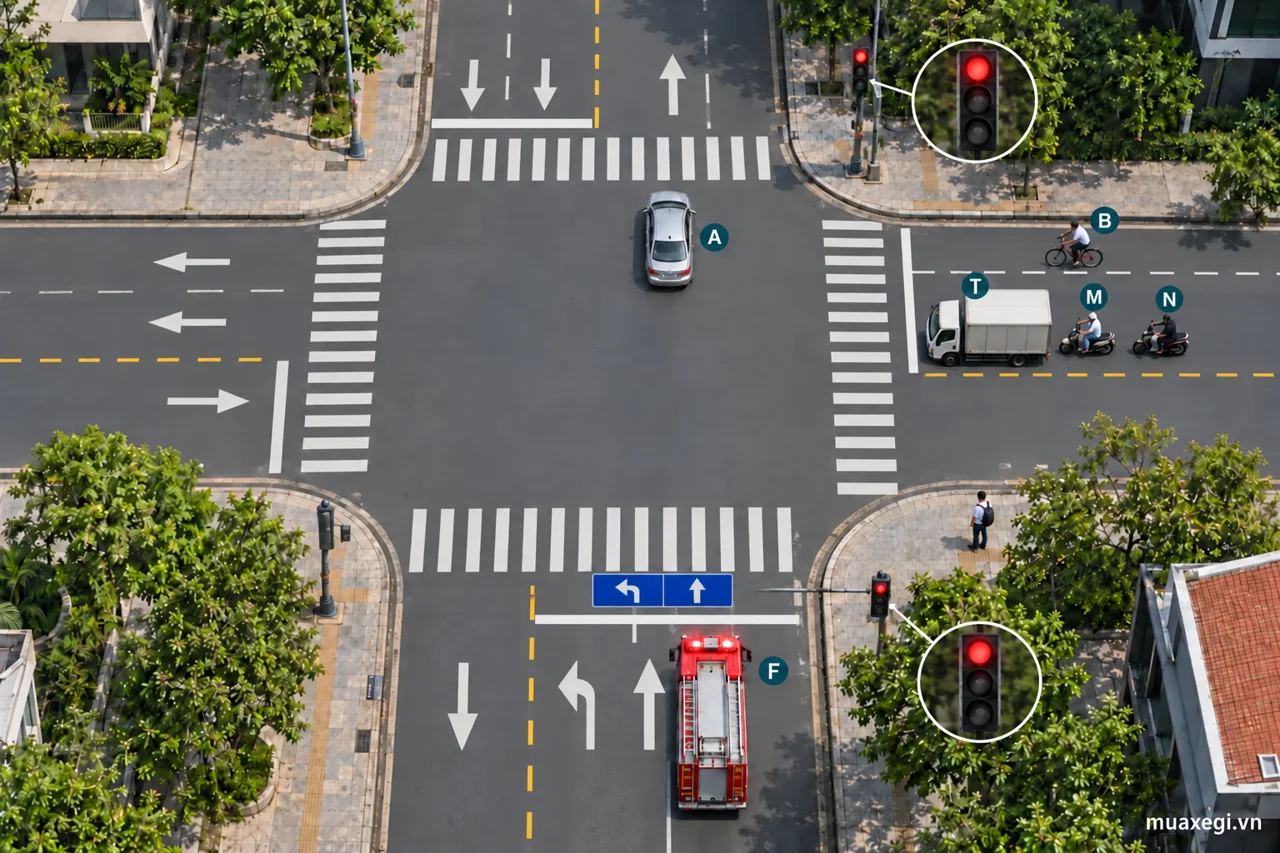
The claim “edge in first and you outrank a fire engine” conflicts with Article 27: qualifying priority vehicles have the right to go first, and others must yield when their signals are operating. If you are already inside the intersection, clear the way safely according to the situation and any officer’s directions; if you are outside, give way to the priority vehicle. This duty also applies when you entered the junction first.
Sources: [1] Road Traffic Order and Safety Law — consolidated 55/VBHN-VPQH; Articles 2, 11, 13–18, 22, 24–27, 34, 57 and 89 · [2] QCVN 41:2024/BGTVT — Road signs and signals; terms, signs and markings
4.6. Signed roundabout or an unsigned island: which side matters?
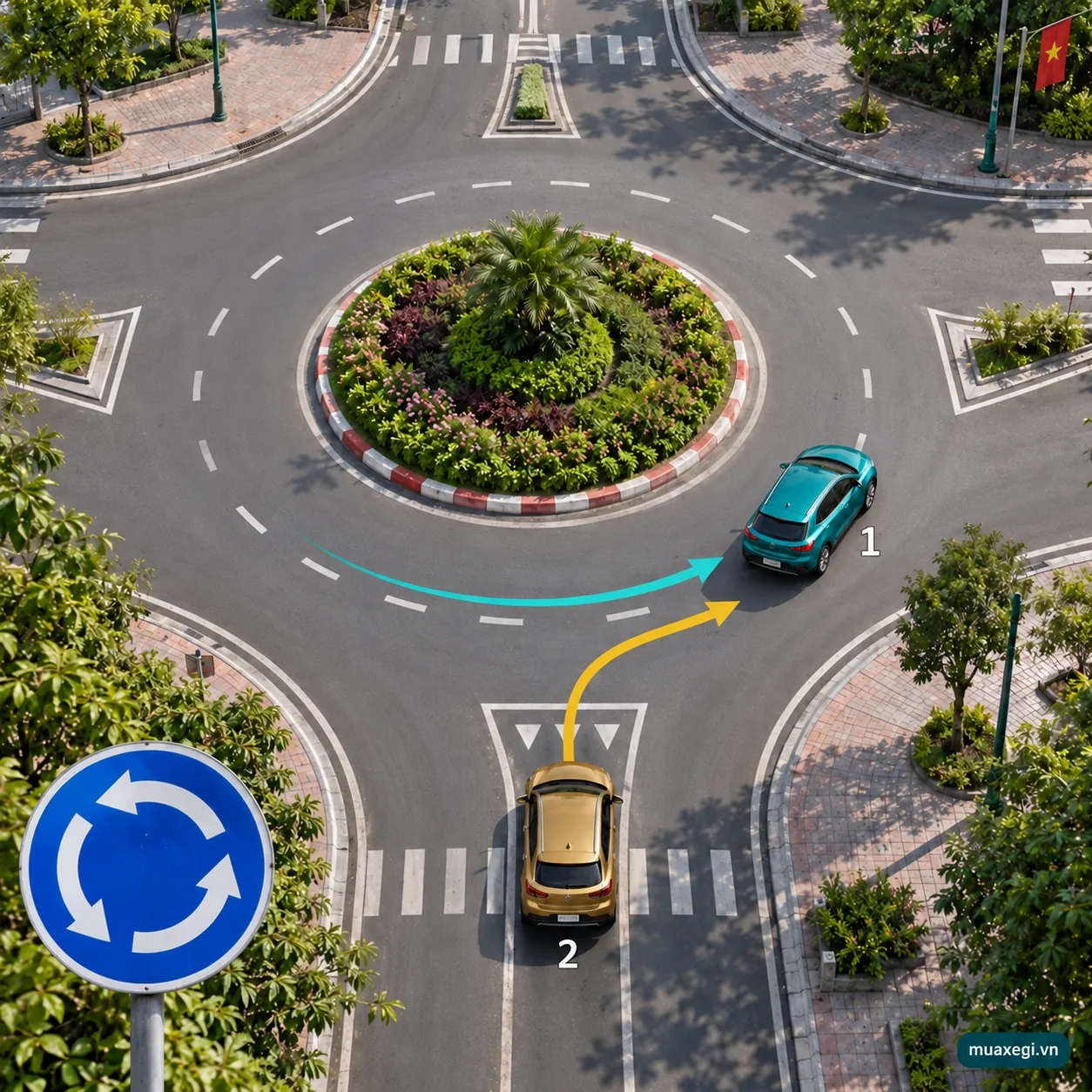
Where roundabout circulation is indicated—commonly by blue circular R.303 with circulating arrows—yield to traffic approaching from your left. When entering, this is often circulating traffic reaching your entry. “Traffic inside goes first” can help you picture it, but the rule’s wording is traffic approaching from the left, conditional on roundabout instructions.
Sources: [1] Road Traffic Order and Safety Law — consolidated 55/VBHN-VPQH; Articles 2, 11, 13–18, 22, 24–27, 34, 57 and 89 · [2] QCVN 41:2024/BGTVT — Road signs and signals; terms, signs and markings
At a round planted island without roundabout instructions, yielding depends on road priority and other traffic instructions. If the roads are equal-priority and nothing else controls the junction, yield to the right; if priority roads, lights or an officer are present, apply those instructions. You can remember it this way: a roundabout sign prompts a left-side check; without it, reassess road priority and the right-side rule.
Sources: [1] Road Traffic Order and Safety Law — consolidated 55/VBHN-VPQH; Articles 2, 11, 13–18, 22, 24–27, 34, 57 and 89 · [2] QCVN 41:2024/BGTVT — Road signs and signals; terms, signs and markings
Sources: [1] Road Traffic Order and Safety Law — consolidated 55/VBHN-VPQH; Articles 2, 11, 13–18, 22, 24–27, 34, 57 and 89 · [2] QCVN 41:2024/BGTVT — Road signs and signals; terms, signs and markings
4.7. Which vehicles have priority? Does an ambulance always come first?
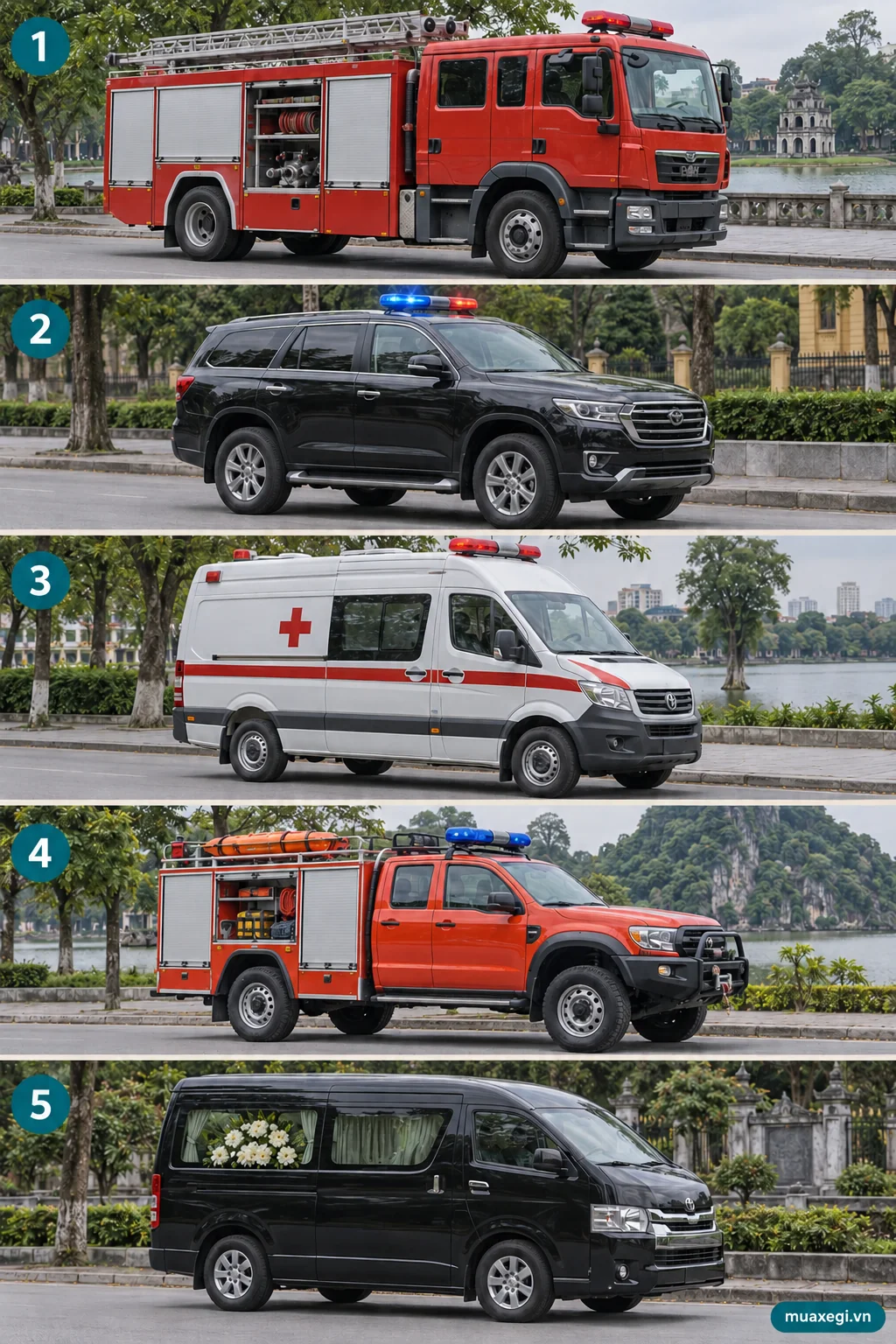
At a junction, the law gives priority to the following groups in this order. Groups 1–4 require the specified duty and legally required priority signals.
- 1. Fire engines responding to a fire.
- 2. Military, police and procuracy vehicles on urgent duty; convoys with a traffic-police escort.
- 3. Ambulances on emergency medical duty.
- 4. Vehicles on dyke-protection duty; rescue, disaster or epidemic response vehicles, or vehicles on a legally defined emergency mission.
- 5. Funeral processions.
If a responding fire engine and an emergency ambulance reach a junction together and both qualify, the fire engine precedes the ambulance. Funeral processions are listed but do not receive the red-light exemption granted to groups 1–4. Priority vehicles must still obey traffic officers and temporary signs. As an ordinary driver, you must slow down, move close to the right-hand edge or stop to give way when priority signals approach; stay calm and steer smoothly.
4.8. Military trucks and missile transporters: duty and signal conditions
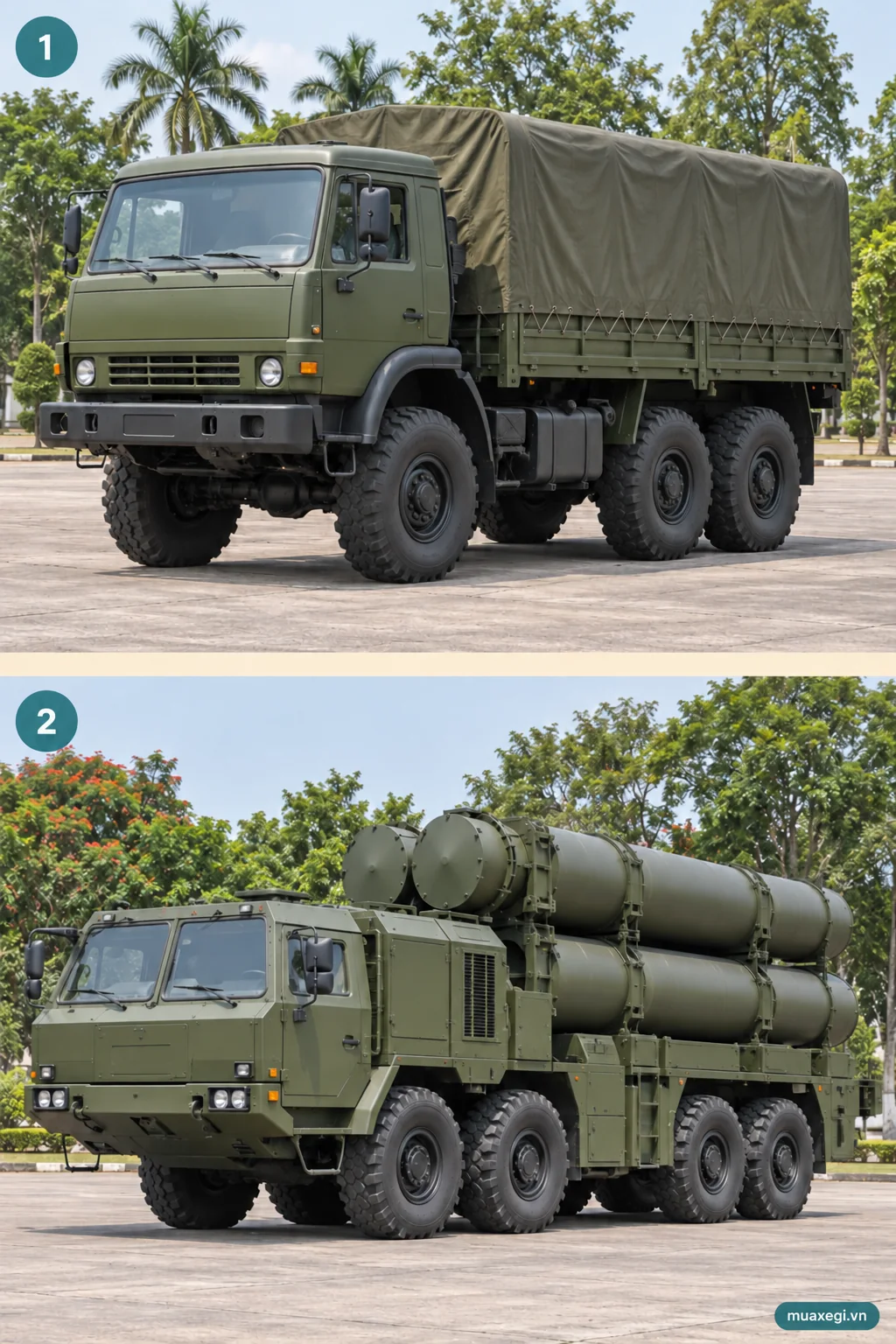
Whether it is a military cargo truck or a missile-system transporter, read the conditions. Military vehicles qualify for priority on urgent duty with the required signals; ordinary travel does not automatically permit crossing a red light. If a question says only “military vehicle”, you still need its duty and signal conditions to determine priority.
4.9. A busy junction: being already inside does not outrank a fire engine
This example assumes an all-red clearance phase. A entered lawfully during the previous phase and is clearing north, towards the top of the image, with its exit unobstructed. F is on a qualifying firefighting duty and using all prescribed priority signals. No traffic controller or temporary sign gives a different instruction. T, M, N and B are waiting before the stop line on the right-hand approach.
Sources: [1] Road Traffic Order and Safety Law — consolidated 55/VBHN-VPQH; Articles 2, 11, 13–18, 22, 24–27, 34, 57 and 89 · [2] QCVN 41:2024/BGTVT — Road signs and signals; terms, signs and markings
Sources: [1] Road Traffic Order and Safety Law — consolidated 55/VBHN-VPQH; Articles 2, 11, 13–18, 22, 24–27, 34, 57 and 89 · [2] QCVN 41:2024/BGTVT — Road signs and signals; terms, signs and markings
F has the priority rights in Article 27: it may cross despite the red light, while still obeying traffic controllers and temporary signs. Other vehicles must yield without obstructing it. The visible priority lights are illustrative; a qualifying firefighting duty and all required signals, including the audible signal, are stated conditions of this example.
A does not outrank F because it is already inside the junction. In the stated situation, A continues safely north to clear the path rather than stopping across the fire engine’s route. This is a way to yield and avoid a collision, not a rule that the first vehicle inside always has priority. A must not reverse within the junction or continue in a way that obstructs F.
R.411, “Hướng đi trên mỗi làn đường phải theo” (Mandatory direction of travel for each lane), works with road arrows to show the lane for your intended movement. This example indicates one left-turn lane and one straight-ahead lane. Priority still follows the applicable priority rules. Ordinary vehicles must not cross a red light or go straight from a turn-only lane, even when the lane is empty.
Sources: [1] Road Traffic Order and Safety Law — consolidated 55/VBHN-VPQH; Articles 2, 11, 13–18, 22, 24–27, 34, 57 and 89 · [2] QCVN 41:2024/BGTVT — Road signs and signals; terms, signs and markings
T, M, N and B all keep waiting before the stop line because their approach has a red light, while also yielding to F. F passing does not release the waiting vehicles: they may move only when the controls permit it and their paths are safe. The image does not specify the next signal phase or each intended turn, so it establishes no subsequent order between the truck, motorcycles and bicycle. Vehicle size or category alone does not decide priority.
Sources: [1] Road Traffic Order and Safety Law — consolidated 55/VBHN-VPQH; Articles 2, 11, 13–18, 22, 24–27, 34, 57 and 89 · [2] QCVN 41:2024/BGTVT — Road signs and signals; terms, signs and markings
5. Speed and following gaps: conditions before numbers
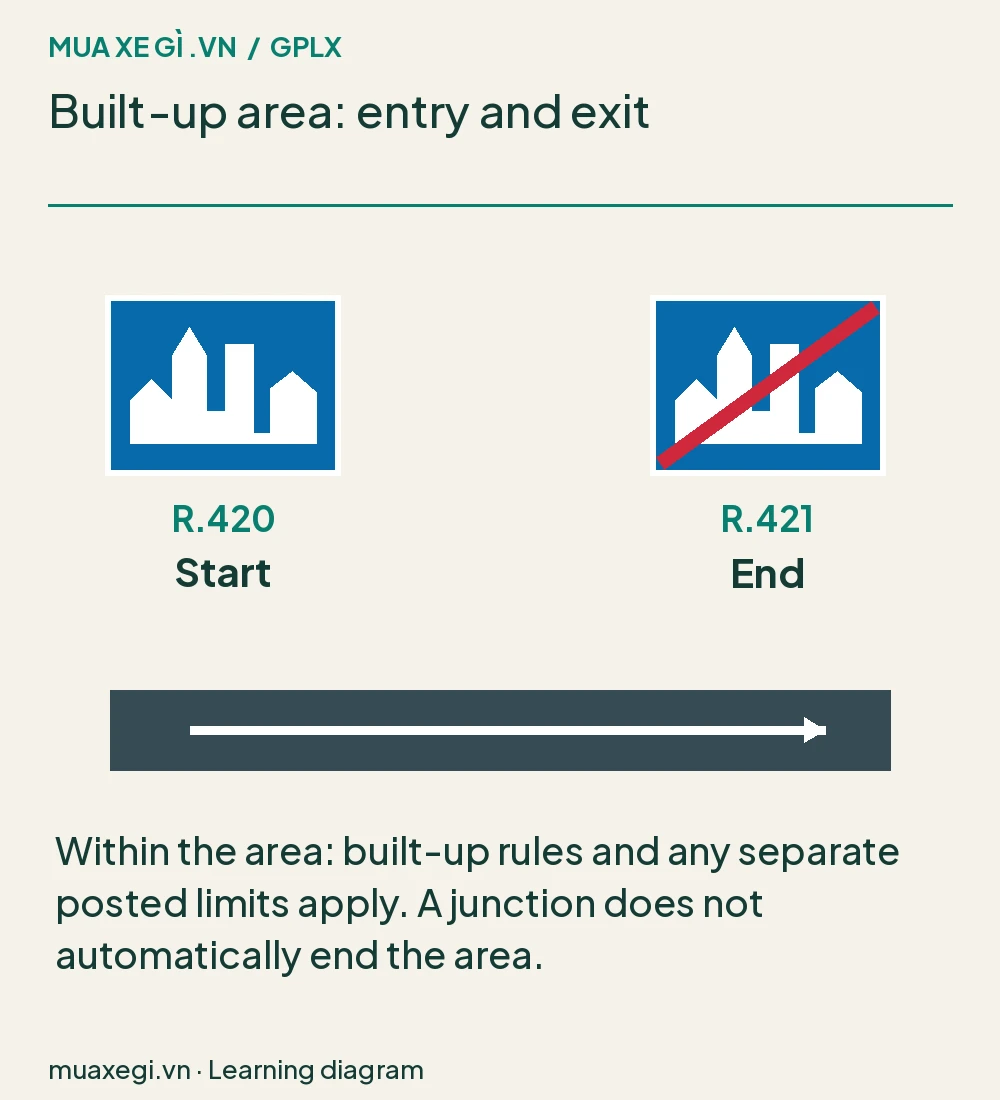
A built-up area begins at R.420 and ends at R.421, including when you pass a junction or see fewer houses. Within that area, you must obey any applicable separate speed sign.
Sources: [2] QCVN 41:2024/BGTVT — Road signs and signals; terms, signs and markings · [5] Consolidated 74/2026/VBHN-TT-BXD — speeds and safe following distances; Articles 3–11
Sources: [2] QCVN 41:2024/BGTVT — Road signs and signals; terms, signs and markings
5.1. Maximum speeds inside and outside built-up areas
For a family passenger car, the four limits below apply when you are off an expressway and there is no separately posted maximum. Use the signs to identify the built-up area, then choose the limit for the road type.
Sources: [5] Consolidated 74/2026/VBHN-TT-BXD — speeds and safe following distances; Articles 3–11
- Inside a built-up area: divided road, or one-way road with at least two motor-vehicle lanes — maximum 60 km/h.
- Inside a built-up area: undivided two-way road, or one-way road with one motor-vehicle lane — maximum 50 km/h.
- Outside a built-up area: divided road, or one-way road with at least two motor-vehicle lanes — passenger-car maximum 90 km/h.
- Outside a built-up area: undivided two-way road, or one-way road with one motor-vehicle lane — passenger-car maximum 80 km/h.
Sources: [5] Consolidated 74/2026/VBHN-TT-BXD — speeds and safe following distances; Articles 3–11
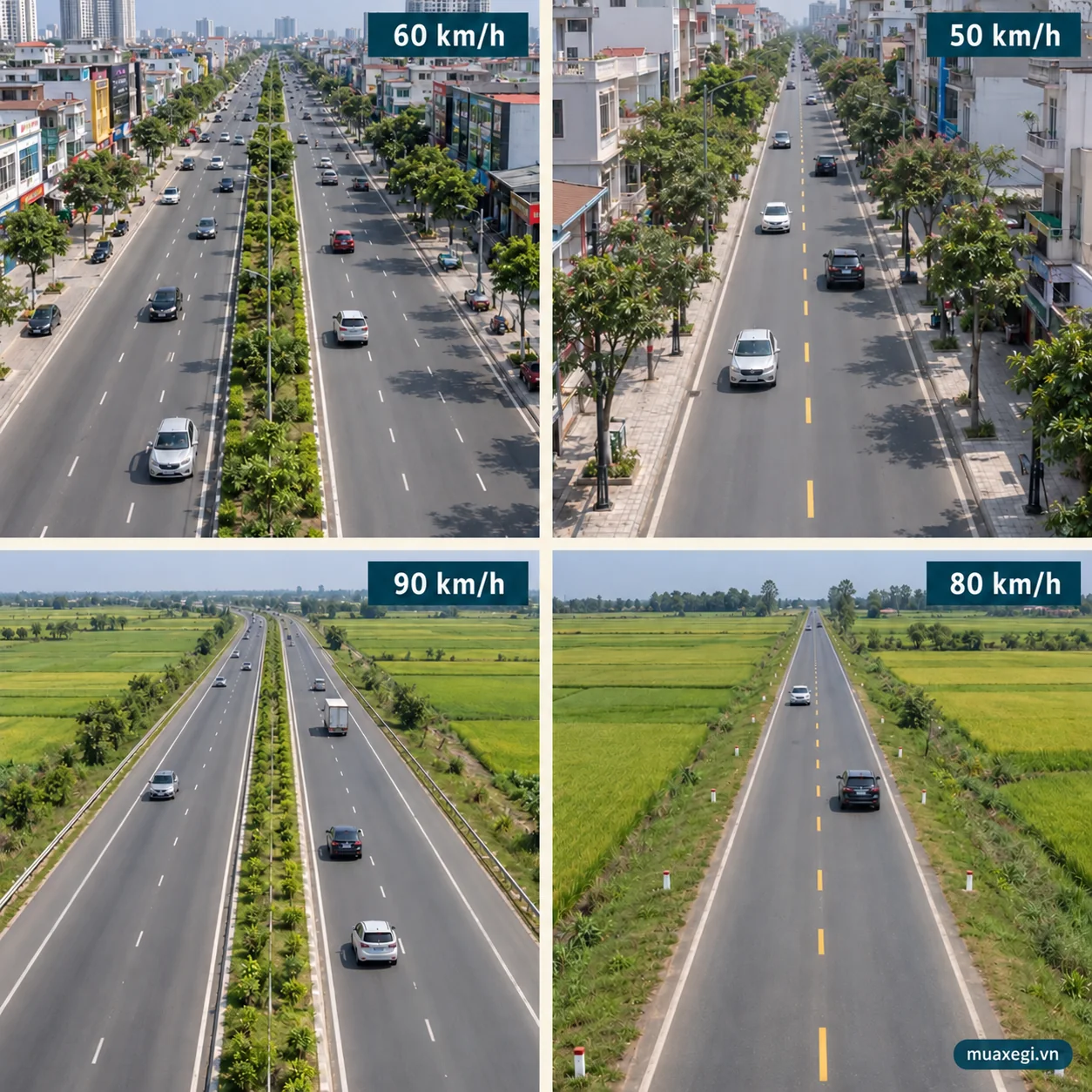
Sources: [5] Consolidated 74/2026/VBHN-TT-BXD — speeds and safe following distances; Articles 3–11
You can remember “inside 60–50, outside 90–80” after identifying that you are driving a passenger car and matching each column to the correct road type. If an applicable separate sign says 40, you must follow it instead of the table’s 60. In rain, with pedestrians crossing or in poor visibility, you must slow to a safe speed, even well below the maximum.
Sources: [1] Road Traffic Order and Safety Law — consolidated 55/VBHN-VPQH; Articles 2, 11, 13–18, 22, 24–27, 34, 57 and 89 · [2] QCVN 41:2024/BGTVT — Road signs and signals; terms, signs and markings · [5] Consolidated 74/2026/VBHN-TT-BXD — speeds and safe following distances; Articles 3–11
For other vehicles outside built-up areas, read each pair as “divided or one-way with at least two motor lanes / undivided two-way or one-way with one motor lane”. Without a separately posted maximum, the groups are:
Sources: [5] Consolidated 74/2026/VBHN-TT-BXD — speeds and safe following distances; Articles 3–11
- 90/80 km/h: passenger automobiles up to 28 seats excluding the driver, except buses; goods automobiles with permitted payload no greater than 3.5 tonnes.
- 80/70 km/h: passenger automobiles above 28 seats excluding the driver, except buses; goods automobiles over 3.5 tonnes, except tankers.
- 70/60 km/h: buses; motorcycles; tractor-semitrailer combinations except tankers; special-purpose automobiles except mortar and mobile concrete mixers.
- 60/50 km/h: automobiles towing trailers or other vehicles; mortar and mobile concrete mixers; tanker automobiles, tractor-semitrailer tankers and automobiles towing tanker trailers.
Sources: [5] Consolidated 74/2026/VBHN-TT-BXD — speeds and safe following distances; Articles 3–11
Mopeds, special-purpose machines and similar vehicles have a 40 km/h maximum off expressways. That is why distinguishing a moped from a motorcycle matters. The separate powered four-wheel passenger category has a 30 km/h maximum, and the powered four-wheel goods category 50 km/h, within their permitted area and time; these are not limits for all electric cars.
Sources: [5] Consolidated 74/2026/VBHN-TT-BXD — speeds and safe following distances; Articles 3–11
5.2. Is there a universal minimum speed in built-up areas?
There is no universal 30 or 40 km/h minimum for all roads in built-up areas, nor a single minimum for all roads outside them. Blue circular R.306 with a white number sets the minimum for the applicable section: you must not travel below it when traffic conditions are favourable and safe. The sign standard places it on certain higher-speed sections outside built-up areas. If traffic queues ahead, you must adjust your speed to respond safely; the conditions for the minimum no longer hold.
Sources: [2] QCVN 41:2024/BGTVT — Road signs and signals; terms, signs and markings · [5] Consolidated 74/2026/VBHN-TT-BXD — speeds and safe following distances; Articles 3–11
Expressways must have maximum- and minimum-speed signs. The regulation sets an upper ceiling of 120 km/h and a 60 km/h minimum, with an approved-traffic-plan exception to the minimum for expressways designed for 60 km/h. The 120 km/h figure is the overall ceiling; you must follow the signs on each section and entry or exit ramp for the applicable limits.
Sources: [5] Consolidated 74/2026/VBHN-TT-BXD — speeds and safe following distances; Articles 3–11
Sources: [2] QCVN 41:2024/BGTVT — Road signs and signals; terms, signs and markings
5.3. Following distance: use your actual speed and leave room to react
Article 11(1) — editorial translation of the Vietnamese excerpt: “must keep a distance no smaller than the value shown on the sign.”
Sources: [5] Consolidated 74/2026/VBHN-TT-BXD — speeds and safe following distances; Articles 3–11
If the vehicle ahead brakes suddenly, you need time to react and space to slow down. Your safe following distance is measured to the vehicle immediately ahead, in the same lane or road space and travelling in the same direction.
Sources: [5] Consolidated 74/2026/VBHN-TT-BXD — speeds and safe following distances; Articles 3–11
Where no separate minimum-gap sign applies, the figures below apply to motor vehicles and special-purpose machinery vehicles on a dry, non-slippery surface, with no fog, a straight, level road and adequate visibility. Choose the band using your actual travelling speed.
Sources: [5] Consolidated 74/2026/VBHN-TT-BXD — speeds and safe following distances; Articles 3–11
- Exactly 60 km/h: leave at least 35 m.
- Above 60, up to and including 80 km/h: at least 55 m.
- Above 80, up to and including 100 km/h: at least 70 m.
- Above 100, up to and including 120 km/h: at least 100 m.
Sources: [5] Consolidated 74/2026/VBHN-TT-BXD — speeds and safe following distances; Articles 3–11
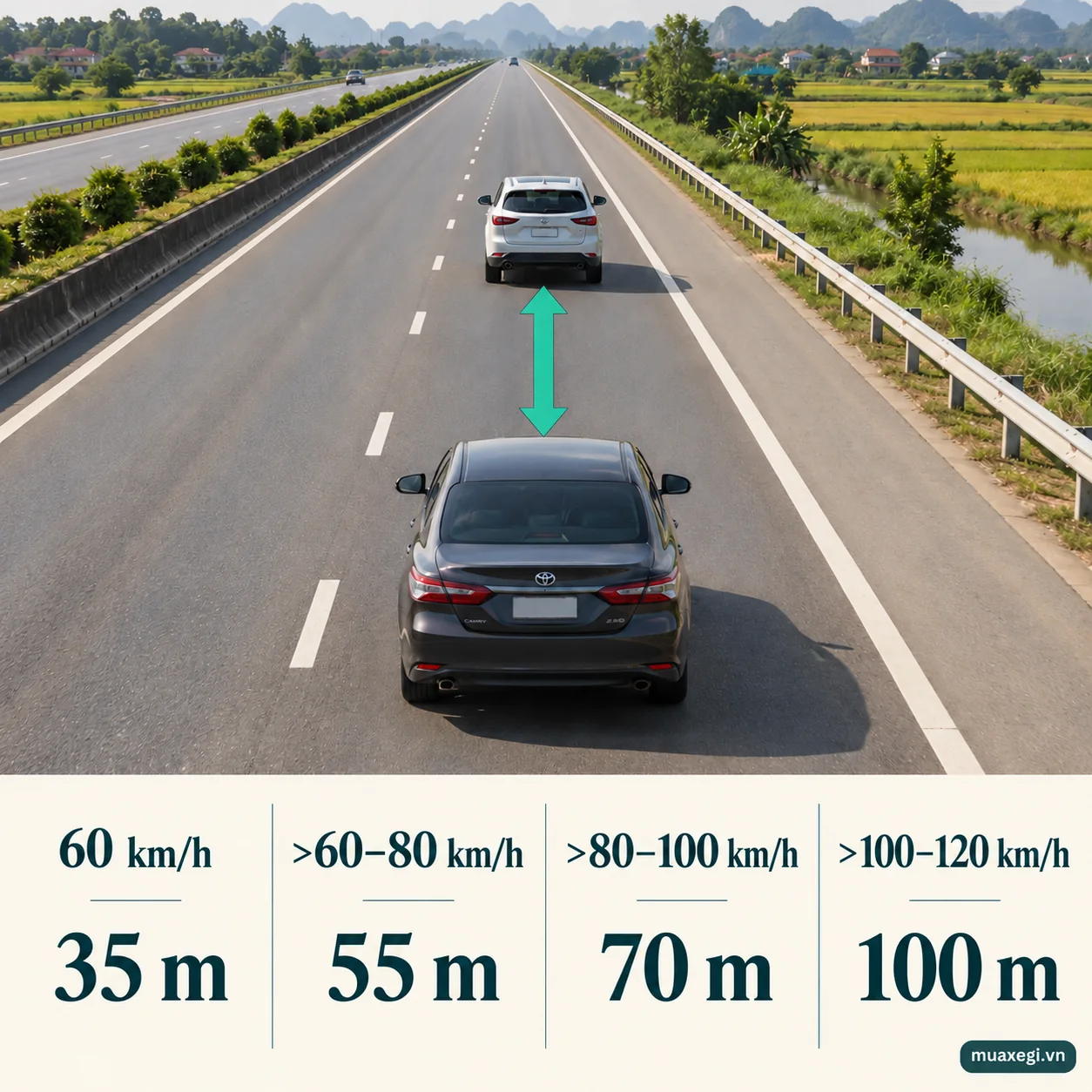
Sources: [5] Consolidated 74/2026/VBHN-TT-BXD — speeds and safe following distances; Articles 3–11
The boundary matters: 80 km/h still falls in the 55 m band, while 81 km/h moves into the 70 m band. Below 60 km/h, this table does not prescribe one universal distance. You must still choose a safe gap for the traffic density and actual conditions.
Sources: [5] Consolidated 74/2026/VBHN-TT-BXD — speeds and safe following distances; Articles 3–11
If a P.121 minimum-distance sign applies, your gap must not be smaller than the number of metres shown. In rain, fog, slippery conditions, on winding or mountain roads, or with restricted visibility, you must increase the gap beyond the applicable signed or tabulated figure to suit the actual conditions.
Sources: [2] QCVN 41:2024/BGTVT — Road signs and signals; terms, signs and markings · [5] Consolidated 74/2026/VBHN-TT-BXD — speeds and safe following distances; Articles 3–11
6. Stopping and parking: the right place and the right measurement
6.1. Stopping and parking: consider the purpose and use of the vehicle
“Dừng xe” is a temporary stop for the time needed for something such as passengers getting in or out, or loading. “Đỗ xe” is parking without a fixed time limit. There is no general “under five minutes counts as stopping” rule. Look at what the vehicle is doing, then whether stopping or parking is allowed there.
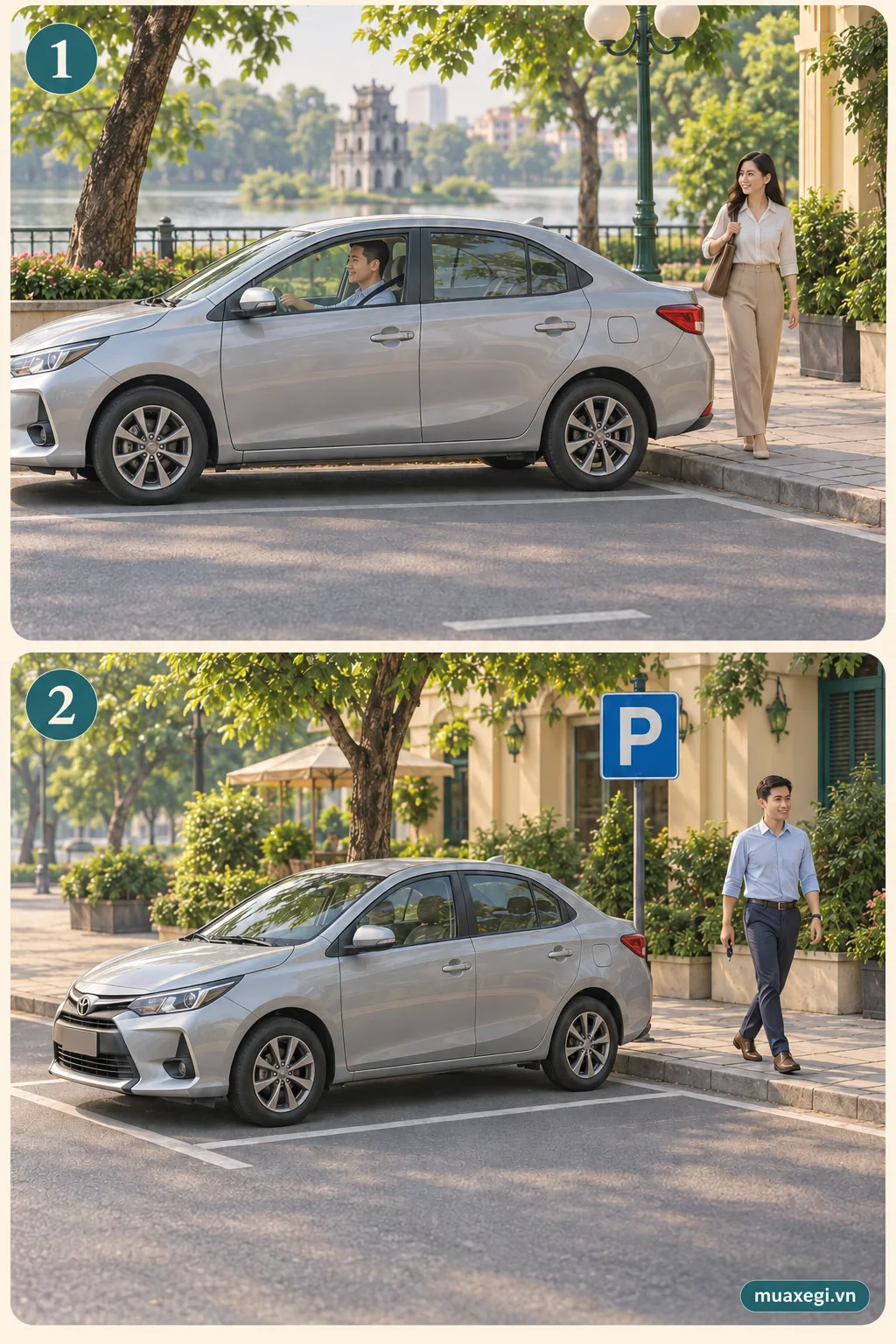
Sources: [1] Road Traffic Order and Safety Law — consolidated 55/VBHN-VPQH; Articles 2, 11, 13–18, 22, 24–27, 34, 57 and 89 · [2] QCVN 41:2024/BGTVT — Road signs and signals; terms, signs and markings
When stopping, you must not switch off the engine or leave the driving position, except for tasks such as opening a door, loading or checking the vehicle while securing it safely. When parking, you may leave only after securing the vehicle with the parking brake or another safety measure; on a slope, turn the wheels towards the roadside and chock them. In either case, you must not obstruct pedestrians or other traffic.
6.2. Stopping and parking: 25 cm to the kerb, 5 m from the junction edge
Article 18(4)(h) — editorial translation of the Vietnamese excerpt: “At road junctions and within 5 metres measured from the junction edge;”
On streets, you must choose a place where stopping or parking is permitted and position your vehicle along the right-hand road edge or kerb in your direction of travel. The distance from the nearest wheel to that edge or kerb must be no more than 0.25 m, or 25 cm. Your vehicle must not obstruct or endanger others.
- You must not stop or park at a junction or within 5 m of its edge. Choose a place outside that 5 m zone, measured from the junction edge.
- You must not stop or park in front of, or within 5 m on either side of, the gate of an agency or organisation’s premises where vehicles enter and exit. This applies to gates meeting those conditions, rather than imposing a blanket 5 m restriction around every residential gate.
- You must not stop or park less than 20 m from a car parked facing the opposite direction on a narrow street, or less than 40 m on a road with one motor-vehicle lane in each direction. Measure the distance to the car parked facing the opposite direction.
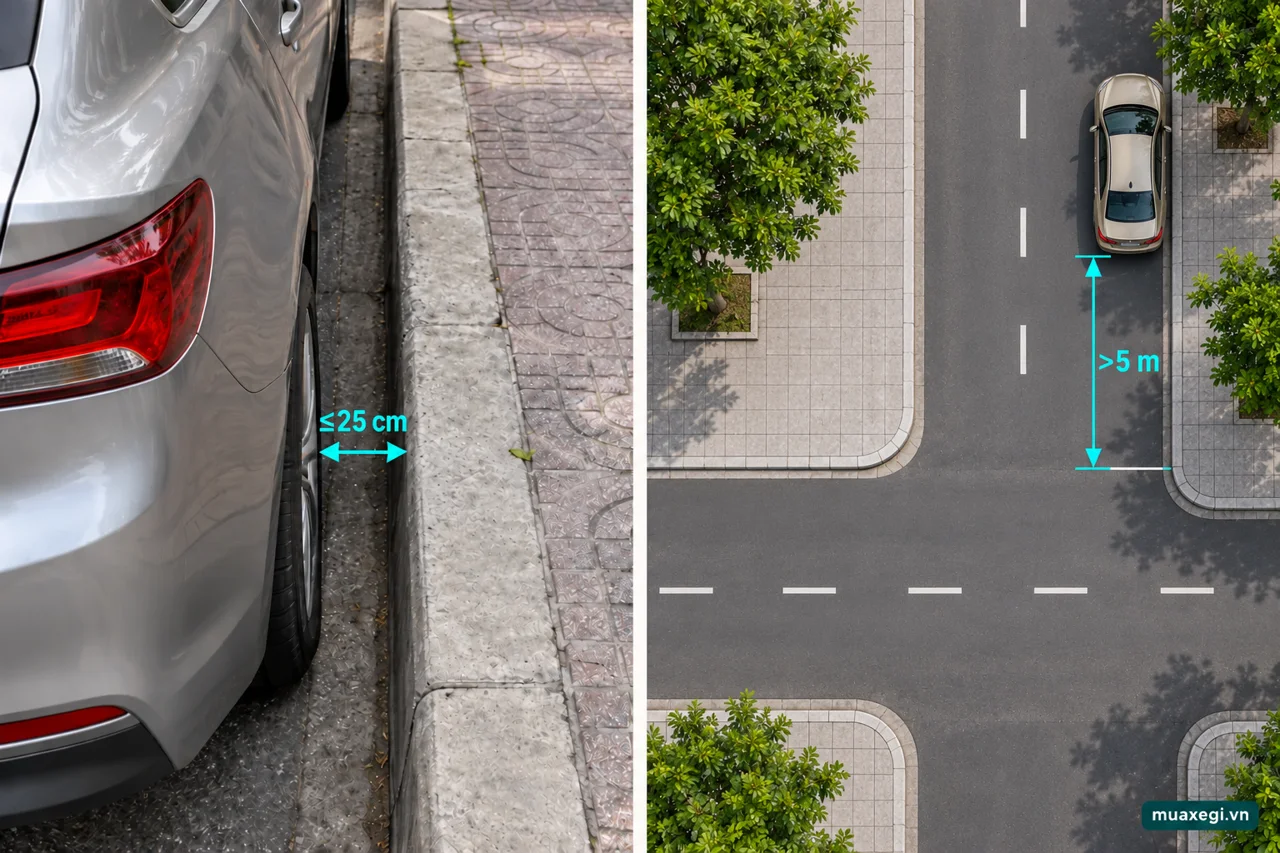
25 cm is the maximum wheel-to-kerb gap on streets; 5 m defines the no-stopping-or-parking zone measured from a junction edge. Even with enough clearance or your hazard lights on, you must not stop or park on pedestrian crossings, at passenger pick-up and drop-off points or in other prohibited locations, and you must obey the signs.
Sources: [1] Road Traffic Order and Safety Law — consolidated 55/VBHN-VPQH; Articles 2, 11, 13–18, 22, 24–27, 34, 57 and 89 · [2] QCVN 41:2024/BGTVT — Road signs and signals; terms, signs and markings
7. Narrow bridges, tunnels, railway crossings and expressways
7.1. Narrow bridges: priority still means waiting for a vehicle already on the bridge
You reach a bridge with room for only one car, and an opposing vehicle is already on it. Wait outside the narrow section and leave room for that vehicle to exit. Even if your approach has sign I.406, you must yield to an opposing vehicle already inside the narrow section, including a non-motorised vehicle.
Sources: [2] QCVN 41:2024/BGTVT — Road signs and signals; terms, signs and markings
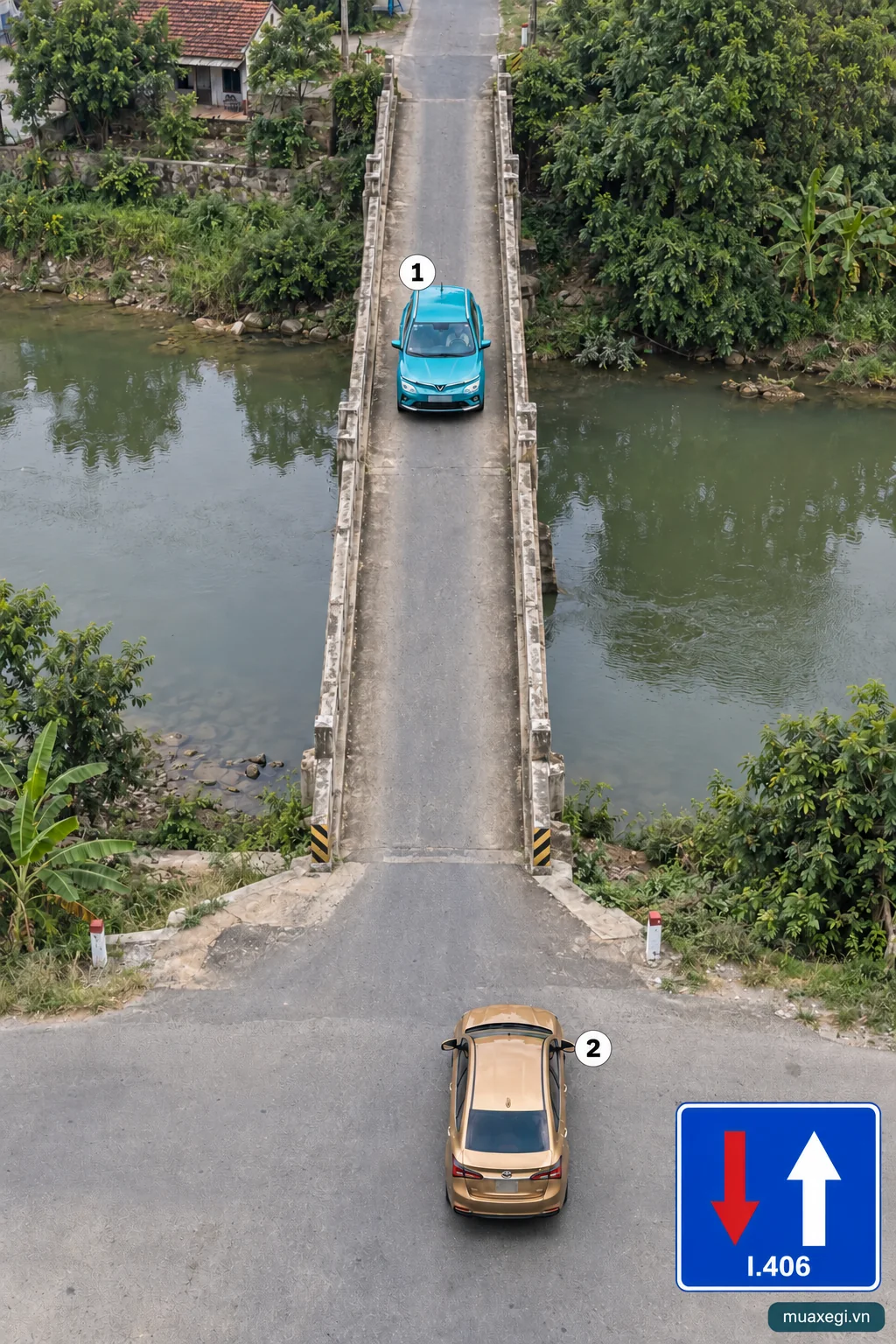
Sources: [2] QCVN 41:2024/BGTVT — Road signs and signals; terms, signs and markings
The two signs are P.132, “Nhường đường cho xe cơ giới đi ngược chiều qua đường hẹp” (Give way to oncoming motor vehicles through a narrow section), and I.406, “Được ưu tiên qua đường hẹp” (Priority through a narrow section). At P.132, stop in a suitable place to yield when a motor vehicle is approaching from the opposite direction; the standard explicitly includes priority vehicles. I.406 gives your direction priority, but an opposing vehicle already inside must still be allowed to clear. Where I.406 is installed, P.132 must be installed for the opposite direction.
Sources: [2] QCVN 41:2024/BGTVT — Road signs and signals; terms, signs and markings
W.212, “Cầu hẹp” (Narrow bridge), warns of the bridge without assigning priority to either direction. Slow down, look ahead and make space for one another. On a section wide enough for only one vehicle with a passing place, the vehicle nearer that space must pull into it. A downhill vehicle yields to an uphill vehicle, and a vehicle facing an obstruction yields to one with a clear path. If a vehicle is already on the bridge, you must wait for it to clear the narrow section. You must not overtake on a narrow, single-lane bridge.
Sources: [1] Road Traffic Order and Safety Law — consolidated 55/VBHN-VPQH; Articles 2, 11, 13–18, 22, 24–27, 34, 57 and 89 · [2] QCVN 41:2024/BGTVT — Road signs and signals; terms, signs and markings
7.2. In tunnels: use dipped headlights and know what to do if you break down
Cars and specialised vehicles must use dipped headlights inside a tunnel, even in daylight, with tunnel lighting or with daytime running lights already on. Non-motorised vehicles must use a light or a light-emitting warning device. W.240, “Đường hầm” (Tunnel), warns you to prepare before entering.
Sources: [1] Road Traffic Order and Safety Law — consolidated 55/VBHN-VPQH; Articles 2, 11, 13–18, 22, 24–27, 34, 57 and 89 · [2] QCVN 41:2024/BGTVT — Road signs and signals; terms, signs and markings
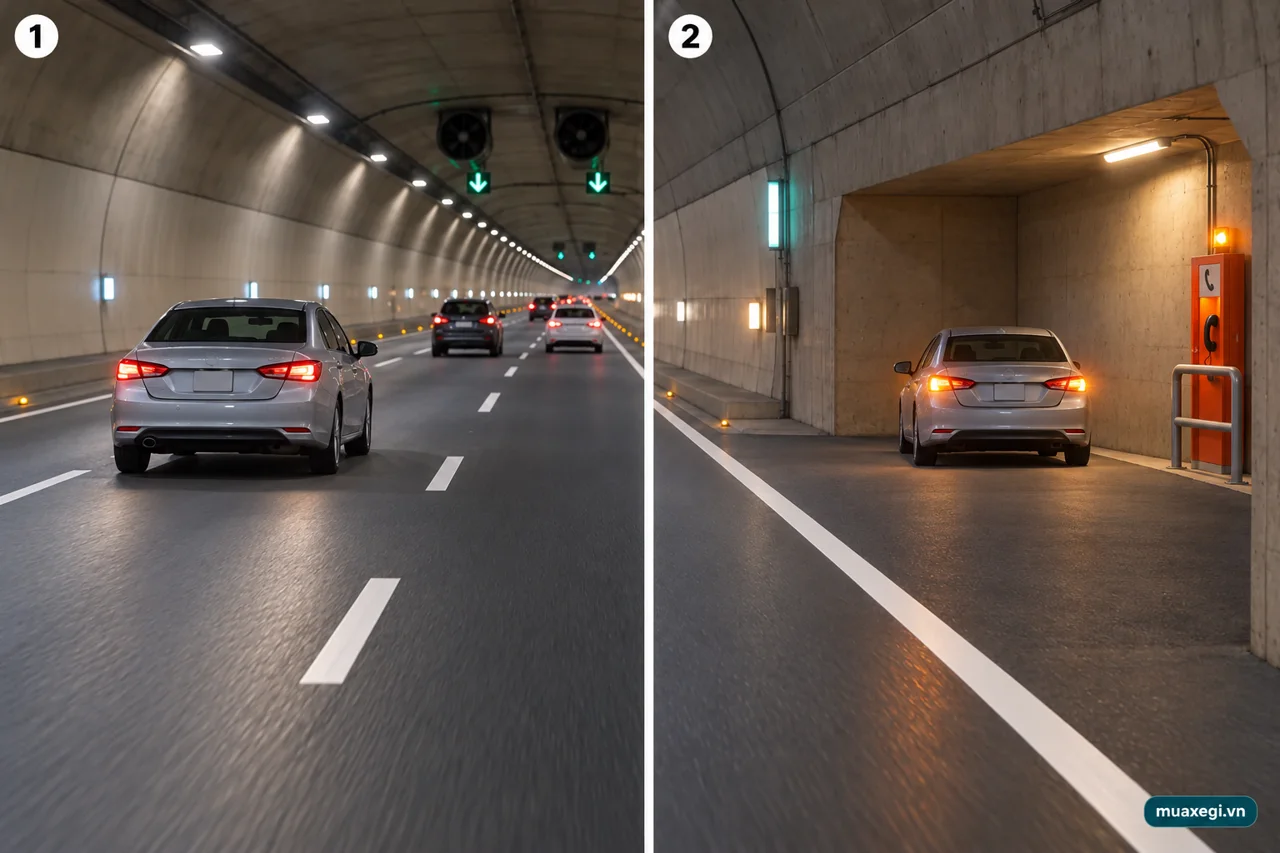
You must not stop or park in a tunnel to take a call or have a short break. If a technical failure or another unavoidable event forces you to stop, move into a designated emergency stopping area if your vehicle can still move. The area must be intended for emergency vehicle stops; a telephone recess or footway does not automatically qualify.
If your vehicle cannot move, you must use hazard lights, place a warning sign or warning light behind it at a safe distance, and promptly notify the traffic police responsible for the route or the tunnel operator. Article 26 requires a warning distance that is safe for the situation, without setting a universal 150 m figure; that figure belongs to the expressway rule for a vehicle unable to reach the emergency lane.
You must not reverse in a tunnel. You must not make a U-turn unless directed by a traffic controller or temporary signs. The law also prohibits overtaking in tunnels, using the specific definition in Article 14. Where there are two or more marked motor-vehicle lanes in the same direction, moving ahead of another vehicle is governed by the lane-use rules in Article 13. You must still obey signs and maintain safe spacing.
7.3. Railway crossings: stop before the line, look both ways and keep the tracks clear
At a protected crossing, you must stop on the right of your direction of travel before the stop line as soon as the crossing attendant orders you to stop, red lights flash, the bell sounds, or the barrier is moving or closed. You must not drive around the barrier’s end. After the train passes, you may proceed only when the signals allow it, the barrier is open and you can cross safely. Priority vehicles must also stop when the crossing displays a stop signal.
Sources: [1] Road Traffic Order and Safety Law — consolidated 55/VBHN-VPQH; Articles 2, 11, 13–18, 22, 24–27, 34, 57 and 89 · [9] Consolidated 72/2026/VBHN-TT-BXD — railway level crossings, stop lines and traffic operation
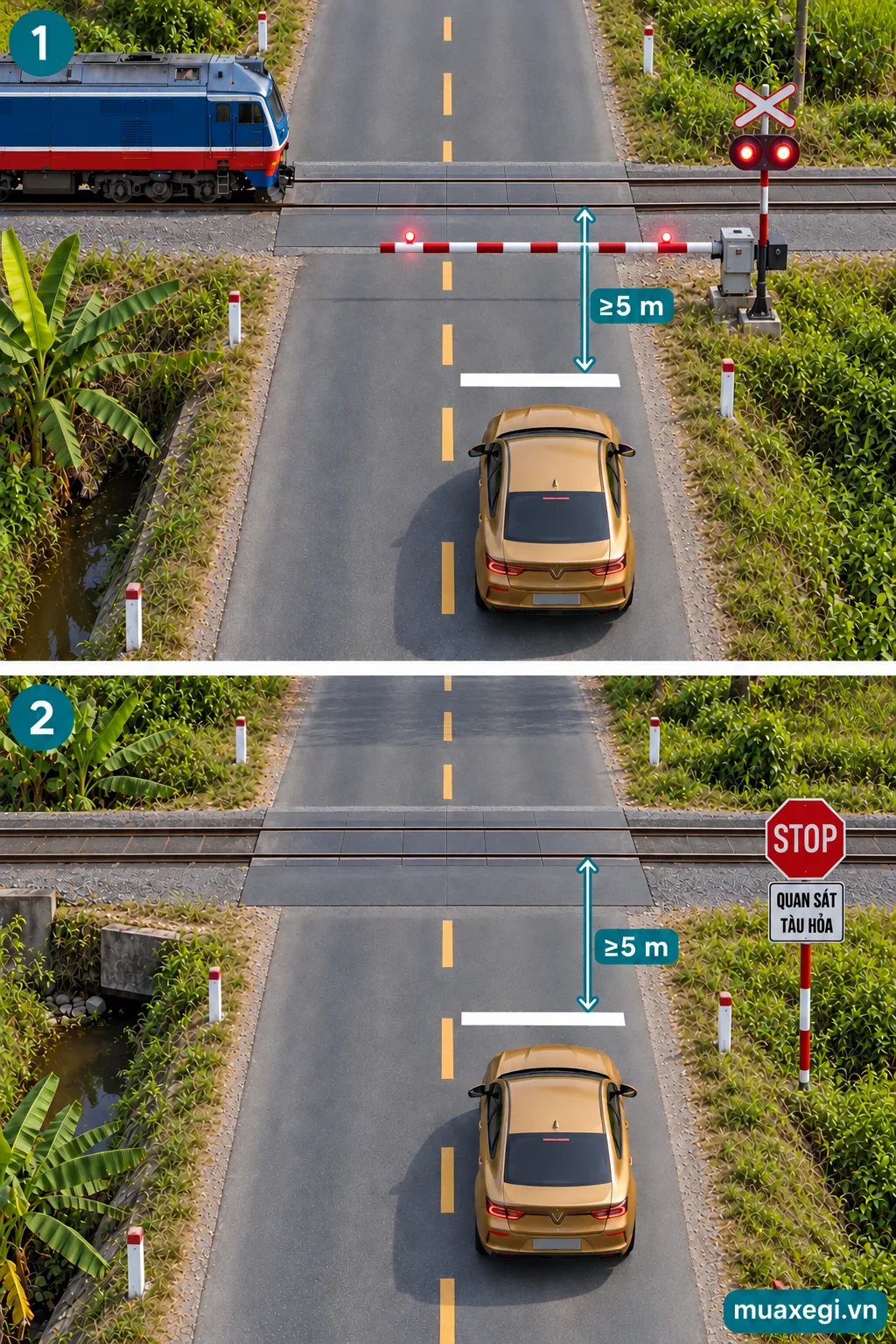
Sources: [1] Road Traffic Order and Safety Law — consolidated 55/VBHN-VPQH; Articles 2, 11, 13–18, 22, 24–27, 34, 57 and 89 · [2] QCVN 41:2024/BGTVT — Road signs and signals; terms, signs and markings · [9] Consolidated 72/2026/VBHN-TT-BXD — railway level crossings, stop lines and traffic operation
At a crossing protected only by signs, with no attendant, barrier, bell or traffic signals, you must come to a full stop before the line on the right of your direction of travel. Look both ways, listen and cross only when you are certain no train is approaching. If traffic is backed up beyond the crossing, you must wait outside it until there is enough room for your whole vehicle to clear the tracks. At a crossing without a barrier but with warning lights or a bell, you must obey those signals.
Sources: [1] Road Traffic Order and Safety Law — consolidated 55/VBHN-VPQH; Articles 2, 11, 13–18, 22, 24–27, 34, 57 and 89 · [9] Consolidated 72/2026/VBHN-TT-BXD — railway level crossings, stop lines and traffic operation
Article 21(3)(a) of consolidated text 72/2026/VBHN-TT-BXD requires the stop line to be at least 5 m from the nearest rail. The 5 m figure governs the line’s placement; you must stop before the marked line. The road traffic law prohibits stopping and parking within the railway safety area, and the crossing rules prohibit U-turns, stopping and parking between the two stop lines on opposite sides of the crossing.
Sources: [1] Road Traffic Order and Safety Law — consolidated 55/VBHN-VPQH; Articles 2, 11, 13–18, 22, 24–27, 34, 57 and 89 · [9] Consolidated 72/2026/VBHN-TT-BXD — railway level crossings, stop lines and traffic operation
Recognise these signs: W.210, “Giao nhau với đường sắt có rào chắn” (Railway crossing with barriers); W.211, “Giao nhau với đường sắt không có rào chắn” (Railway crossing without barriers); W.242a, “Nơi đường sắt giao vuông góc với đường bộ” (Railway crossing at right angles to the road), for a single track consisting of one pair of rails; and R.122, “Dừng lại” (Stop), the octagonal STOP sign. W.210 and W.211 warn of the crossing type ahead. W.242a identifies the single-track crossing and does not replace a stop instruction. R.122 requires a stop before the sign or stop line, followed by movement only when the controlling signals permit it or, where none operate, when it is safe.
Sources: [2] QCVN 41:2024/BGTVT — Road signs and signals; terms, signs and markings
QCVN places W.242a 10 m from the nearest rail, while the stop line must be at least 5 m from that rail. If your vehicle breaks down or becomes stuck on the crossing, urgently move everyone out of danger, alert railway staff if present and take action to signal the train to stop.
Sources: [1] Road Traffic Order and Safety Law — consolidated 55/VBHN-VPQH; Articles 2, 11, 13–18, 22, 24–27, 34, 57 and 89 · [2] QCVN 41:2024/BGTVT — Road signs and signals; terms, signs and markings · [9] Consolidated 72/2026/VBHN-TT-BXD — railway level crossings, stop lines and traffic operation
7.4. An ambulance travelling against expressway traffic: only in the emergency lane
May an ambulance travel against the normal direction on an expressway? Yes, but it must be responding to an emergency with the legally required priority signals, and it may travel against traffic only in the emergency lane. Article 27(4) does not allow an ambulance to drive the wrong way in the expressway’s regular traffic lanes.
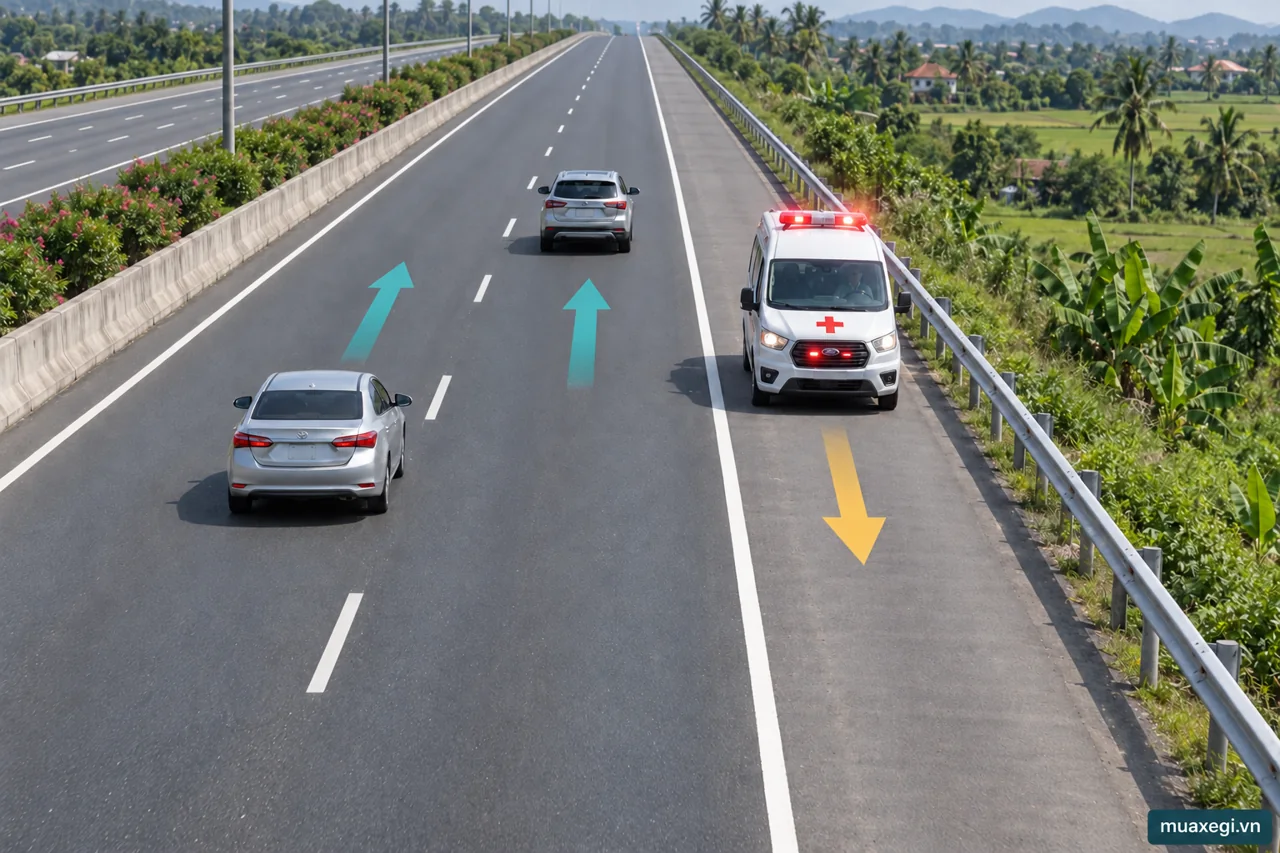
An ambulance’s priority rights depend on its duty and the prescribed signals; its appearance, lettering or lights alone are insufficient to establish those rights. Vehicles exercising Article 27(4) rights must still obey traffic controllers and temporary signs. An ambulance that is not responding to an emergency must not use this exception to travel against traffic.
If you are driving an ordinary vehicle, you must slow down and give way when a priority vehicle signals. Article 27(5) requires moving close to the right edge or stopping to yield without obstructing it. In this example, with the ambulance coming towards you in the emergency lane, check your surroundings to keep its path clear, maintain safe spacing and follow the traffic controller’s directions. Ordinary vehicles must not use the emergency lane to pass a queue, follow the ambulance through or drive against traffic themselves.
8. Practise difficult questions and learn from everyday situations
The following six examples adapt topics in the 2025 CSGT 600-question booklet, with question references so you can find the originals. Explanations and illustrations are created for this guide, not verbatim examination questions. Answer first, then identify the detail that determines the answer.
Sources: [10] CSGT — 2025 official 600-question driving-test booklet (PDF copy hosted by Báo Văn Hóa)
8.1. Example 1 — An unpowered trailer can still be a motor vehicle
Is an unpowered trailer towed by an automobile in the motor-vehicle category?
Yes. A trailer towed by an automobile is classified as a motor vehicle even without its own engine. The law places tractors and special-purpose machinery vehicles in a separate category.
Sources: [1] Road Traffic Order and Safety Law — consolidated 55/VBHN-VPQH; Articles 2, 11, 13–18, 22, 24–27, 34, 57 and 89 · [10] CSGT — 2025 official 600-question driving-test booklet (PDF copy hosted by Báo Văn Hóa)
Related to question 8 in the 2025 CSGT 600-question bank; question wording and explanation are adapted.
Sources: [10] CSGT — 2025 official 600-question driving-test booklet (PDF copy hosted by Báo Văn Hóa)
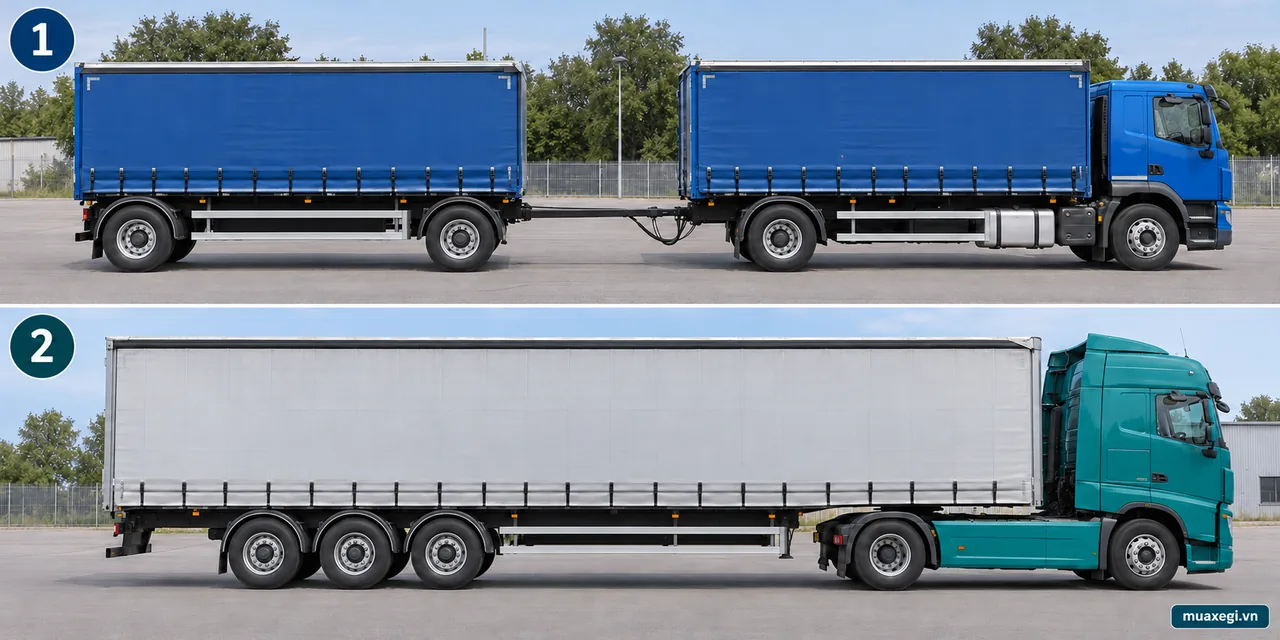
Sources: [1] Road Traffic Order and Safety Law — consolidated 55/VBHN-VPQH; Articles 2, 11, 13–18, 22, 24–27, 34, 57 and 89 · [10] CSGT — 2025 official 600-question driving-test booklet (PDF copy hosted by Báo Văn Hóa)
8.2. Example 2 — An assisted bicycle: check how assistance cuts out
Which category covers a bicycle whose electric assistance cuts out when you stop pedalling or it reaches 25 km/h?
The non-motorised category: it is a power-assisted bicycle, including an electric bicycle, as legally defined. You identify its category by how assistance works and when it cuts out. A shop’s “electric bike” label is a general name, and an assist motor alone is insufficient to classify it as a moped.
Sources: [1] Road Traffic Order and Safety Law — consolidated 55/VBHN-VPQH; Articles 2, 11, 13–18, 22, 24–27, 34, 57 and 89 · [10] CSGT — 2025 official 600-question driving-test booklet (PDF copy hosted by Báo Văn Hóa)
Related to question 9 in the 2025 CSGT 600-question bank; question wording and explanation are adapted.
Sources: [10] CSGT — 2025 official 600-question driving-test booklet (PDF copy hosted by Báo Văn Hóa)
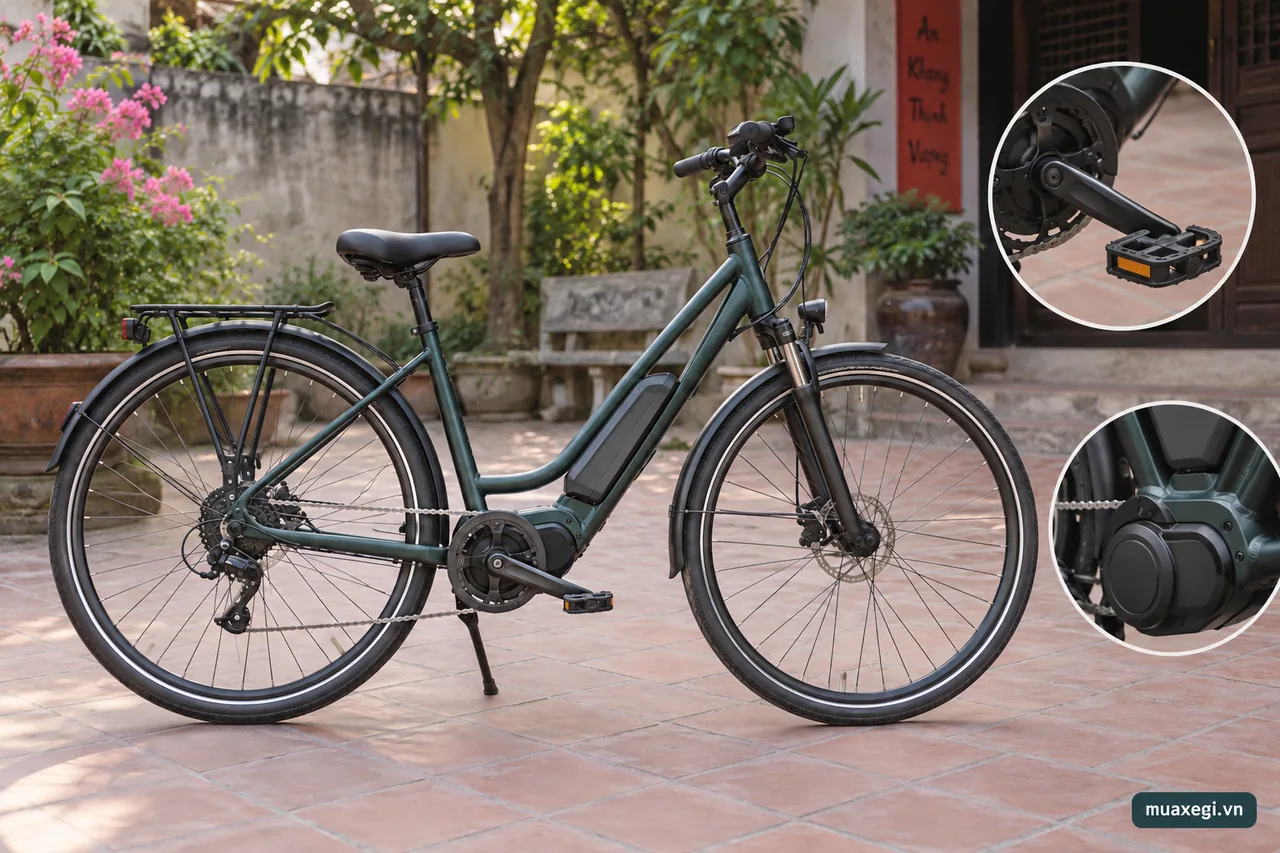
Sources: [1] Road Traffic Order and Safety Law — consolidated 55/VBHN-VPQH; Articles 2, 11, 13–18, 22, 24–27, 34, 57 and 89 · [10] CSGT — 2025 official 600-question driving-test booklet (PDF copy hosted by Báo Văn Hóa)
8.3. Example 3 — A two-way road with painted lines separating opposing traffic
You drive a passenger car on an undivided two-way road in a built-up area; opposing traffic is separated only by paint. It is not an expressway and has no separate maximum-speed sign. What is the limit?
50 km/h. A road with opposing traffic separated only by paint is an undivided two-way road, so you use that column in the speed table. The 50 km/h figure is the legal maximum; when hazards arise, you must travel more slowly.
Sources: [1] Road Traffic Order and Safety Law — consolidated 55/VBHN-VPQH; Articles 2, 11, 13–18, 22, 24–27, 34, 57 and 89 · [2] QCVN 41:2024/BGTVT — Road signs and signals; terms, signs and markings · [5] Consolidated 74/2026/VBHN-TT-BXD — speeds and safe following distances; Articles 3–11 · [10] CSGT — 2025 official 600-question driving-test booklet (PDF copy hosted by Báo Văn Hóa)
Related to question 146 in the 2025 CSGT 600-question bank; question wording and explanation are adapted.
Sources: [10] CSGT — 2025 official 600-question driving-test booklet (PDF copy hosted by Báo Văn Hóa)
Sources: [2] QCVN 41:2024/BGTVT — Road signs and signals; terms, signs and markings
8.4. Example 4 — What does 60 on a blue circle require?
What does a blue circular sign with a white 60 require when traffic conditions are favourable and safe?
Motor vehicles must travel at no less than 60 km/h. This is the R.306 minimum-speed sign; a maximum-speed sign has a red border. The requirement to reach 60 applies only when traffic conditions are favourable and safe. A vehicle whose manufacturer-specified maximum speed is below 60 must not enter this road.
Sources: [2] QCVN 41:2024/BGTVT — Road signs and signals; terms, signs and markings · [10] CSGT — 2025 official 600-question driving-test booklet (PDF copy hosted by Báo Văn Hóa)
Related to question 366 in the 2025 CSGT 600-question bank; question wording and explanation are adapted.
Sources: [10] CSGT — 2025 official 600-question driving-test booklet (PDF copy hosted by Báo Văn Hóa)
Sources: [2] QCVN 41:2024/BGTVT — Road signs and signals; terms, signs and markings
8.5. Example 5 — Exactly 60 km/h: which distance band?
There is no separate minimum-gap sign; the road is dry, non-slippery, fog-free, straight and level, with adequate visibility. At exactly 60 km/h, what minimum gap is required behind the vehicle ahead?
35 m, because your speed is “exactly 60”. The 55 m band starts only above 60 km/h. If conditions worsen, you must increase the gap beyond 35 m.
Sources: [5] Consolidated 74/2026/VBHN-TT-BXD — speeds and safe following distances; Articles 3–11 · [10] CSGT — 2025 official 600-question driving-test booklet (PDF copy hosted by Báo Văn Hóa)
Related to question 161 in the 2025 CSGT 600-question bank; question wording and explanation are adapted.
Sources: [10] CSGT — 2025 official 600-question driving-test booklet (PDF copy hosted by Báo Văn Hóa)
Sources: [5] Consolidated 74/2026/VBHN-TT-BXD — speeds and safe following distances; Articles 3–11
8.6. Example 6 — Exactly 80 km/h: have you entered the next band?
There is no separate minimum-gap sign; the road is dry, non-slippery, fog-free, straight and level, with adequate visibility. At exactly 80 km/h, what minimum gap is required behind the vehicle ahead?
55 m. The above-60-through-80 band includes 80. Above 80, for example at 81 km/h, you use the 70 m band. Choose the gap using your actual speed.
Sources: [5] Consolidated 74/2026/VBHN-TT-BXD — speeds and safe following distances; Articles 3–11 · [10] CSGT — 2025 official 600-question driving-test booklet (PDF copy hosted by Báo Văn Hóa)
Related to question 160 in the 2025 CSGT 600-question bank; question wording and explanation are adapted.
Sources: [10] CSGT — 2025 official 600-question driving-test booklet (PDF copy hosted by Báo Văn Hóa)
Sources: [5] Consolidated 74/2026/VBHN-TT-BXD — speeds and safe following distances; Articles 3–11
8.7. Turn a long question into four short questions
- Who? A car driver, motorcyclist, pedestrian or traffic officer?
- Where? What road, how many lanes, a junction or railway crossing?
- What conditions? Lights, signs, markings, direction, visibility, other traffic or time?
- What is being asked? What is allowed, required or prohibited?
Practice example: “May you change lanes immediately after switching on the indicator?” Try putting it into your own words: “I have signalled my intention, but have I checked properly and is there safe space?” You need to signal, check your surroundings and ensure there is safe space before changing lanes. The practice prompts here are teaching examples, not reproductions of official test questions.
8.8. Learn signs and critical questions through consequences
You can use a sign’s shape and colour to identify its initial group, then read the symbol and any supplementary plate. Place two easily confused signs side by side to identify the difference. Each sign’s scope and the question’s conditions determine the answer; there is no general rule that banning smaller vehicles bans every larger one, and “prohibited” must be read in context.
Sources: [2] QCVN 41:2024/BGTVT — Road signs and signals; terms, signs and markings
The 600-question bank introduced by the Traffic Police Department on 1 June 2025 includes 60 questions about seriously unsafe situations, commonly called “câu điểm liệt”, critical questions. I suggest learning the correct answer and making three notes for each question: the behaviour, the danger and the action to take. For alcohol, for example: you must not drive after drinking; arrange another driver or transport before you drink. Understanding the danger helps you apply the lesson on the road.
Sources: [1] Road Traffic Order and Safety Law — consolidated 55/VBHN-VPQH; Articles 2, 11, 13–18, 22, 24–27, 34, 57 and 89 · [3] Government Portal — Traffic Police guidance on the 600-question bank
8.9. Start early: each journey offers an example
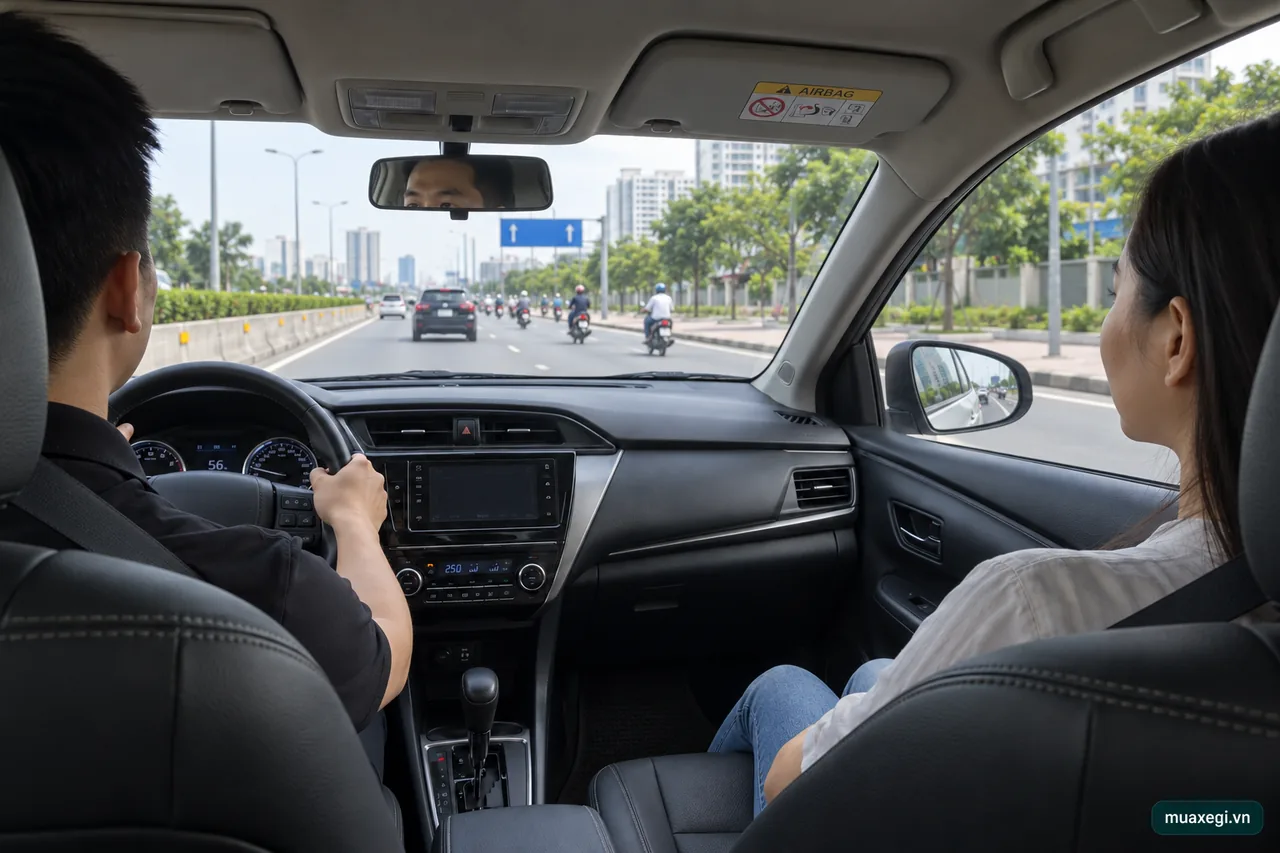
I find the most useful approach is to learn one idea and then recognise it on a real road. Divide the 600 questions into smaller groups and start early so you have time to connect the wording with situations. As a passenger, choose one theme per journey: dividers today, built-up-area signs tomorrow, yielding at a T-junction next time. Study a little regularly, then review the corresponding questions at home.
- Notice one vehicle, sign or situation while you are a passenger, without distracting the driver.
- Name it in familiar words, then use the test term. “Xe ni từ đường mô ra?” becomes “Is this vehicle entering from a branch or the main road?”.
- Explain why yielding, slowing or waiting to change lanes is necessary. Compare the situation with the rule you have learned to see whether the behaviour you observe is correct.
- Change one detail: remove the median, add a priority sign, or replace a 110 cc motorcycle with a legally defined moped. Does the answer change?
- Recall it the next day before reopening the picture. If you cannot explain it, return to the official material or ask an instructor. When driving, concentrate on driving; save lessons, notes, photos and test questions for when you are not driving.
8.10. A manageable study routine you can adapt
You can spread the 600 questions across several study sessions. I suggest starting with about 30–40 minutes a day for two weeks, then adjusting around the areas you still find difficult. This is a routine you can adapt; completing the suggested number of days does not guarantee a pass.
- Days 1–3: road names, road types and vehicle groups. Use the pictures, then redraw them from memory.
- Days 4–6: signs, markings and traffic rules. Find an everyday situation for each group; read the conditions and exceptions carefully.
- Days 7–9: junction diagrams, driving technique, vehicle basics, considerate driving, fire safety and rescue. If you do not understand a practical manoeuvre, ask your instructor; you should not experiment on public roads.
- Days 10–14: mix questions using official material or an app checked against it, record mistakes and revisit them the next day and a few days later. Return to serious-risk questions every day.
A home session might be five minutes recalling what you observed, 15 minutes on one small topic, ten minutes answering without looking and five minutes reviewing errors. A mistake notebook needs three columns: “What did I mix up — what is correct — what picture helps me remember?”. Explain it aloud in your own words, then check that you retained every condition in the original question.
8.11. Old B2, category B and the question bank: what to check for each
If you return to studying after years of driving, both licence names and wording may look different. The category’s new name does not invalidate an old B2 licence: licences issued before the new law took effect remain usable for the period shown on them. When exchanged or reissued, old B1/B2 licences have conversion routes to B or C1 under the rules. Whether you need to retake the test depends on the application and the licence’s validity.
For an app labelled “2026”, check the content itself to see how current it is. The question bank, test format and licence-exchange procedure are separate topics. Circular 108/2026 has provisions taking effect at different points in 2026 and 2027; compare your test notice with Traffic Police guidance. This article helps you understand and study the rules; question counts, timing and scoring must follow the provisions applicable to your test.
Sources: [4] Government Portal — Changes and implementation dates under Circular 108/2026/TT-BCA

8.12. Check your understanding: apply the rules when the situation changes
- Remove the median and leave only paint: is it still a divided road? No. Both directions can still use an undivided two-way road.
- Your indicator is on but another car is close alongside: are the lane-change conditions met? No; observation and safe spacing are still required.
- At the pictured junction, B is on A’s right: who yields? A yields to B under the stated assumptions. Change the instructions and you must reassess.
- Does parking for three minutes to go shopping automatically count as stopping? You cannot classify it by three minutes alone; consider its purpose and the stopping or parking conditions.
- Is a 110 cc bike a motorcycle? Yes; 125 cc separates new A1/A two-wheel licence scopes, not the start of the motorcycle category.
- A minimum-60 sign with a queue ahead: must you keep doing 60? No; favourable, safe conditions no longer exist and you must respond safely.
Sources: [1] Road Traffic Order and Safety Law — consolidated 55/VBHN-VPQH; Articles 2, 11, 13–18, 22, 24–27, 34, 57 and 89 · [2] QCVN 41:2024/BGTVT — Road signs and signals; terms, signs and markings · [5] Consolidated 74/2026/VBHN-TT-BXD — speeds and safe following distances; Articles 3–11
Sources: [1] Road Traffic Order and Safety Law — consolidated 55/VBHN-VPQH; Articles 2, 11, 13–18, 22, 24–27, 34, 57 and 89 · [2] QCVN 41:2024/BGTVT — Road signs and signals; terms, signs and markings
8.13. FAQ: do I need to memorise the definitions?
You need to recognise the official term and understand its full meaning, but you do not have to begin by reciting a long paragraph. Explain it in your own words first, then compare it with the definition to find any missing condition. “Con lươn” helps picture the divider; “a median between opposing traffic” keeps the meaning precise.
Sources: [2] QCVN 41:2024/BGTVT — Road signs and signals; terms, signs and markings
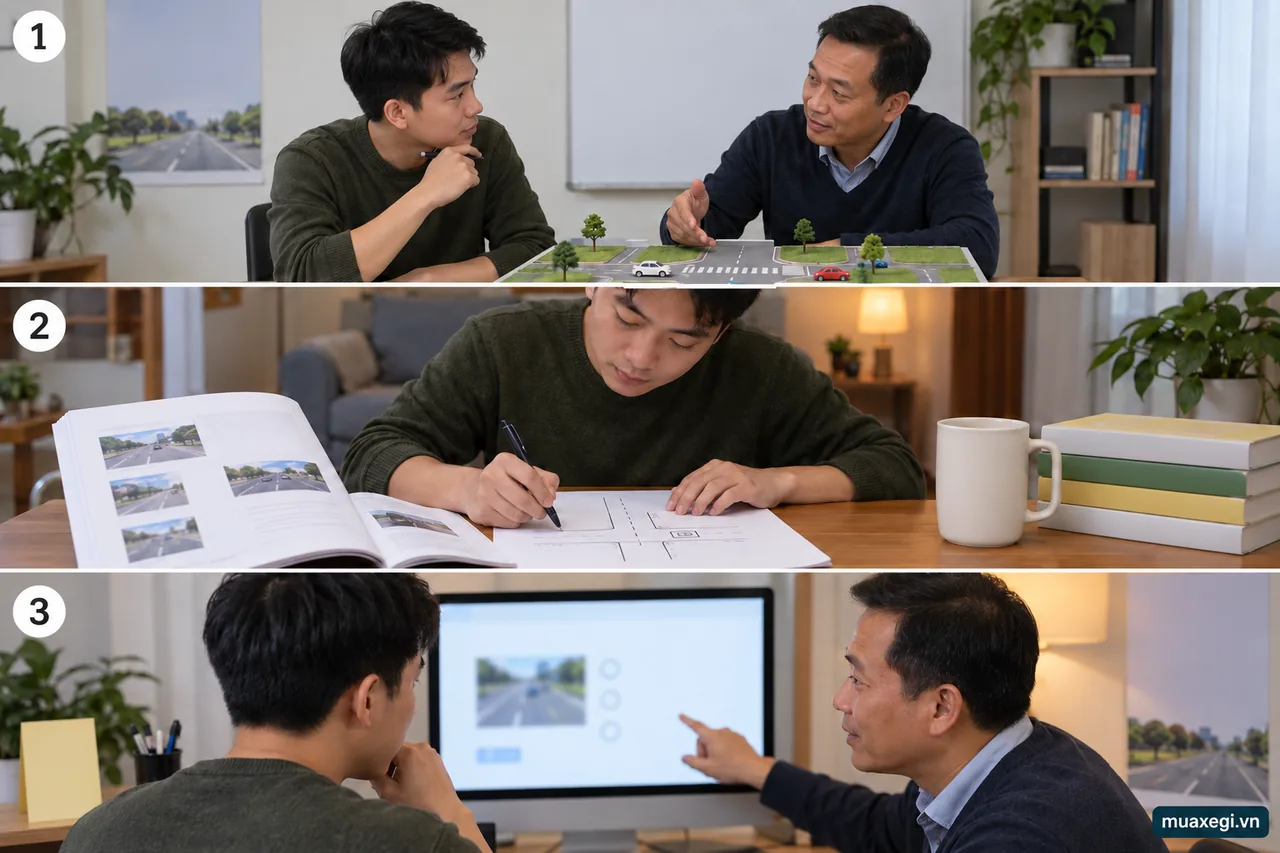
8.14. Are any memory aids worth using?
Yes: group questions by rule, compare pictures that differ in one detail, redraw diagrams and return to mistakes a few days later. These methods help organise your study. To apply what you learn in a new situation, you need to understand the rule and its conditions; an answer’s length, position or an isolated keyword does not capture them fully.
8.15. Is reading this article enough to take the test?
Not yet. This is a bridge to understanding the question bank. You still need to study all the relevant topics, practise with official answers and learn practical driving with an instructor. I would like every answer to end with a short explanation: “I would do that because…” That is when knowledge starts becoming your own decision.
8.16. Good luck with your test—your first car can come next
First, I wish you steady progress with your studies, confidence on test day and success in earning your driving licence. Take one section at a time, understand another situation each day and work through anything unclear with your instructor. Once you have your licence and feel ready to buy a car, you can choose one that suits your needs and budget. At that stage, Your garage and the guides to registration, costs and insurance below can help you prepare.

- Your garage: compare the cars you are considering
- Car registration and fees in Vietnam
- Car insurance in Vietnam: things to know
This article helps you picture some question topics through everyday traffic situations; it is not a complete guide to all 600 questions. You need to study the full question bank that applies to your test, practise and understand why each answer is correct to prepare well and drive more safely. Wishing you success!
References
- Road Traffic Order and Safety Law — consolidated 55/VBHN-VPQH; Articles 2, 11, 13–18, 22, 24–27, 34, 57 and 89
- QCVN 41:2024/BGTVT — Road signs and signals; terms, signs and markings
- Government Portal — Traffic Police guidance on the 600-question bank
- Government Portal — Changes and implementation dates under Circular 108/2026/TT-BCA
- Consolidated 74/2026/VBHN-TT-BXD — speeds and safe following distances; Articles 3–11
- Consolidated Circular 75/2026/VBHN-TT-BXD — vehicle classification; Articles 3–4 and Annexes V, VI, IX, X
- Ural with sidecar photograph — Malber, Wikimedia Commons
- Photograph licence: Creative Commons Attribution–ShareAlike 3.0
- Consolidated 72/2026/VBHN-TT-BXD — railway level crossings, stop lines and traffic operation
- CSGT — 2025 official 600-question driving-test booklet (PDF copy hosted by Báo Văn Hóa)