

CAR OWNERSHIP GUIDES
An EV without home charging in Vietnam: does apartment life fit?
Can an electric car fit apartment life without a private charger? Plan charging visits, costs and backup stations before paying a deposit.
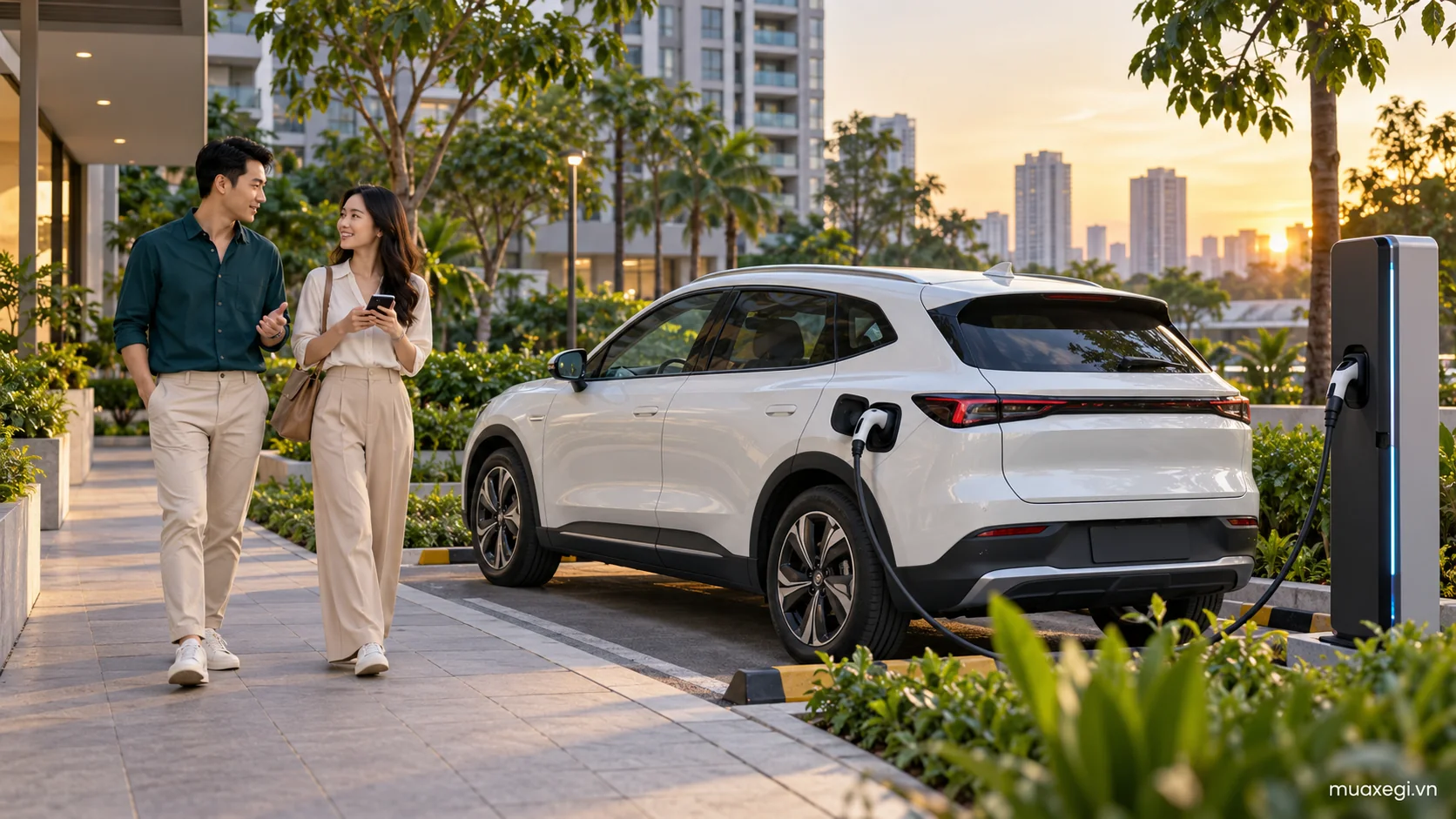
You can own an electric car without private apartment charging if a suitable charger fits your routine and you have a backup. If every charge means a long detour, a queue or rearranging school pickup, that inconvenience deserves more attention than an attractive specification sheet.
I would start with one question: “Where would I charge in an ordinary week?” Answer it with actual places, times and costs before choosing the car, and the decision becomes much easier.
1. A nearby charger is only useful if you can use it
Choose chargers for the model you intend to buy. V-Green’s FAQ states that its charging service is for VinFast EVs. For another make, find a network that accepts your car rather than counting every map marker as an option.
Sources: [1] V-Green — charging eligibility and station search
EverCharge describes an app for finding stations, viewing available connectors and paying. Confirm the connector, supported car and session-start procedure with the operator for the specific location.
Sources: [2] EverCharge — app and station search
- Does the connector match, and does this trim support the station’s AC or DC charging?
- Can you enter when needed, or is access limited to residents, staff or customers of the venue?
- Beyond electricity, are there entry, parking, service or post-charge occupancy fees?
- If the main location is full or unavailable, which backup can you actually use?
2. Try the charging routine before paying a deposit
During an ordinary working week, visit at the time you would charge: after work, at lunch or over the weekend. Note the detour, parking access and how busy it is. If the dealer can arrange a demonstration car, ask for a charging demonstration at your intended location under the dealer’s and operator’s conditions.
A slightly more distant charger beside your usual shopping stop may work better than a closer one requiring a separate wait. For workplace charging, ask about ongoing access: which days, time limits and what happens if you change jobs. This is a test of fit with your life, not a brand ranking.
3. Work out energy needs before counting charging visits
Take a hypothetical week: 40 km a day for five working days, plus 100 km at the weekend, for 300 km total. If the car uses 16 kWh/100 km in your conditions, that driving requires 48 kWh. These are practice numbers, not a consumption promise for a particular model.
Suppose the station bills 54 kWh for that need, including an assumed difference between purchased energy and energy used for driving. At a hypothetical 4,000 VND/kWh, electricity costs 216,000 VND a week. Two visits with an additional 20,000 VND parking fee each bring it to 256,000 VND. The 54 kWh, tariff and parking fees are all assumptions; replace them with actual vehicle, station and bill data.
Two visits are simply the assumption used in the cost example. Your actual visit count depends on the starting charge, your reserve and how much you add each time. Leave a reserve appropriate to unexpected trips and the car’s guidance rather than planning to find a charger only when the battery is exhausted.
If a charging promotion applies, calculate two scenarios: while you qualify and after it ends. Include parking and the attached conditions. A workable long-term budget should make sense in both scenarios.
4. The charger’s rating is not a constant charging speed
kWh measures energy; kW measures power. A simple illustration: adding 30 kWh at an assumed average 30 kW takes about one hour of charging. At an average 15 kW, it takes two hours. These calculations use hypothetical average power and exclude travel, queuing and setup.
The Mustang Mach-E manual explains that the car may reduce DC charging speed to protect the battery and that displayed completion times are estimates. Ask the dealer about your exact trim’s charging curve and AC/DC limits. Use a session matching your needs to judge the time, rather than only the largest kW number on the pedestal.
Sources: [4] Ford — Mustang Mach-E manual, DC charging and estimated times
5. Parking access and charger installation are separate questions
If you hope to charge in the building later, ask management or the parking operator in writing about the location, approval process, survey team and operator. Having a parking space does not establish permission to draw electricity there. A promise of a future station should have a clear location, timetable and responsible contact before it becomes your main reason to buy.
- Who assesses the electrical supply, protection and safety conditions at the installation site?
- Who pays for installation, maintenance and electricity, and how is usage metered and billed?
- Is the bay private or shared, and how are overstays and faults handled?
- If you move, change bays or end the lease, what happens to the equipment and costs?
A portable charger does not make every socket suitable. BYD’s 2.2 kW charger instructions require earthing and appropriate electrical protection and prohibit extension sockets or adapters. Have a qualified provider assess the supply for the equipment; do not run a makeshift lead from an apartment to the parking area.
Sources: [3] BYD Vietnam — 2.2 kW portable charger safety instructions
6. When would I choose an EV, and when would I wait?
- Potentially suitable: you have tried a charger, access hours work, there is a backup, and time and cost are acceptable.
- Resolve first: you know only one map marker and have not checked entry or whether the car can charge there.
- Consider another option: your schedule changes frequently, there is no backup and charging repeatedly disrupts important commitments.
This is my decision framework, not a rule that every apartment resident must choose the same powertrain. Compare petrol cars or non-plug-in hybrids too. If considering a plug-in hybrid, ask how it operates without regular charging and what that use costs, rather than assuming a petrol engine resolves every trade-off.
Frequently asked questions
Can I rely entirely on public charging?
It can work if a network accepting your car fits your travel schedule. Try weekdays and busy periods, keep a backup, and count electricity, parking and time. The locations you can actually use matter more than an advertised network total.
Can workplace charging replace home charging?
It can be the main option if you have permission, enough time and a plan for days off or a job change. Clarify access and charges before treating it as a permanent part of the budget.
Do I need to charge to 100% every time?
Follow the guidance for the particular car, battery and journey. Ask the dealer how to set its charging limit; one percentage does not suit every vehicle. Plan enough energy plus a reserve and release the bay according to the station’s rules.
Before deciding, save three things: your main charger, a backup and a week’s estimated costs. If that plan still leaves your daily life comfortable, an EV deserves a place on the shortlist.